 Back
BackProjectile Motion: Motion in a Plane
Study Guide - Smart Notes
 Tailored notes based on your materials, expanded with key definitions, examples, and context.
Projectile Motion in a Plane
Introduction to Projectile Motion
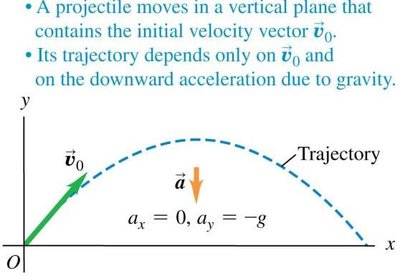
Projectile motion describes the movement of an object that is launched into the air and follows a curved trajectory under the influence of gravity. The motion occurs in a vertical plane and is determined by the initial velocity vector and the constant downward acceleration due to gravity.
Projectile: Any object given an initial velocity and then allowed to move under the influence of gravity alone.
Trajectory: The path followed by a projectile, typically a parabola when air resistance is negligible.
Key Principle: The motion can be separated into horizontal and vertical components.
Separation of Motion: Horizontal and Vertical Components
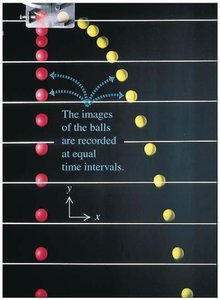
The analysis of projectile motion relies on separating the movement into two independent directions: horizontal (x) and vertical (y). Each direction follows its own set of equations.
Horizontal Motion: Constant velocity, no acceleration (if air resistance is neglected).
Vertical Motion: Constant acceleration due to gravity, .
Equations of Motion
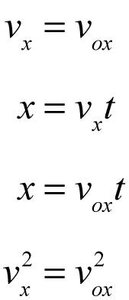
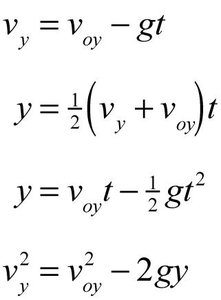
The following equations govern the horizontal and vertical components of projectile motion:
Horizontal (x-direction):
Vertical (y-direction):
Vector Components and Initial Conditions
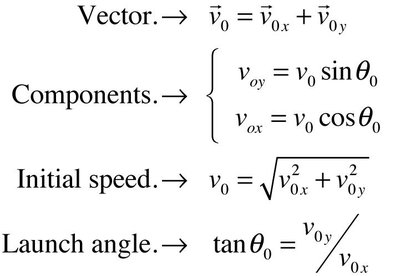
The initial velocity vector can be decomposed into horizontal and vertical components using trigonometric relationships. The launch angle determines the direction of the initial velocity.
Vector Addition:
Components:
Initial Speed:
Launch Angle:
Key Equations Table
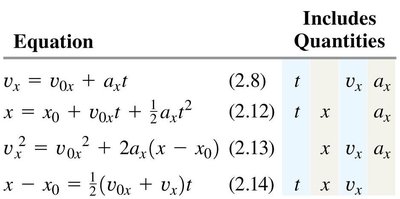
The following table summarizes the main equations used in projectile motion, along with the quantities they include:
Equation | Includes Quantities |
|---|---|
t, , | |
t, x, | |
x, , | |
t, |
Projectile Motion Example: Paintball Problem
Consider a paintball fired horizontally from a height. The horizontal and vertical motions are analyzed separately to determine the time in the air and the range.
Given: m, m/s,
Time in Air:
Use
Solving for t: s
Horizontal Range:
m/s 0.553 s = 41.5 m

Projectile Motion Example: Baseball Home Run
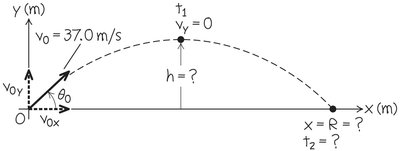
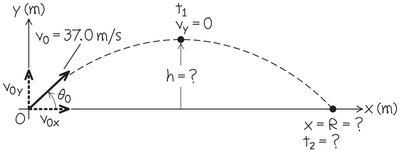
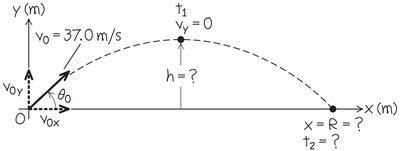
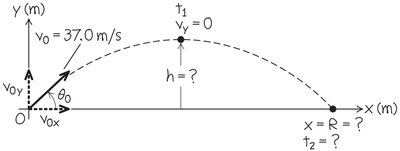
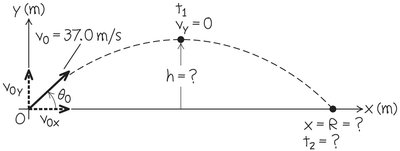
A baseball is hit at an angle, and its position, velocity, maximum height, and range are calculated using the equations of projectile motion.
Given: m/s,
Components:
m/s
m/s
Position at s:
m/s s m/s s m
m/s s m
Velocity at s:
m/s
m/s m/s s m/s
Magnitude: m/s
Direction:
Maximum Height:
At highest point,
Time to top: s
Height: m/s s m/s s m
Range:
Find time when again: s
Range: m/s 6.04 s = 134.1 m
Applications and Examples
Projectile motion is fundamental in physics: It applies to sports, engineering, and natural phenomena.
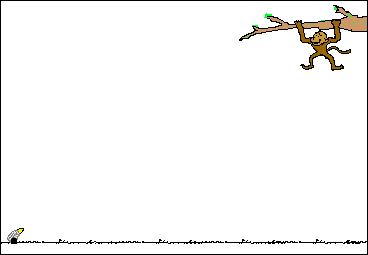
Examples: Paintball trajectory, baseball home run, "shoot the monkey" demonstration.
Summary Table: The equations and principles above allow for the calculation of time of flight, maximum height, range, and velocity at any point in the trajectory of a projectile.
Additional info:
Projectile motion assumes negligible air resistance and a flat Earth for introductory calculations.
For more advanced analysis, air resistance and Earth's curvature may be considered.
