 Back
BackProjectile Motion: Velocity After a Given Time
Study Guide - Smart Notes
 Tailored notes based on your materials, expanded with key definitions, examples, and context.
Chapter 3. First class. Motion on two dimensions.
1. The horizontal coordinates of a in a strong wind are given by
where x and y are in meters, and t is in seconds.
(a) What is the acceleration of the Frisbee? Give a magnitude and a direction, measuring angles
from the positive x direction.
(b) What is the magnitude of the velocity at accurate to the nearest
Answer:
(a) 10 m/ , 323°
(b) 4 m/s
2. An airplane is flying at a speed of in level flight at an altitude of
. A package is to be dropped from the airplane to land on a target on the
ground. Ignore air resistance.
(a) At what horizontal distance away from the target should the package be released
so that it lands on the target?
(b)In what direction relative to the horizontal will the package be traveling when it
hits the ground?
Answer: (a) 2.56 km
(b) 32.1° below the horizontal
3. A child throws a ball with an initial speed of at an angle of 40.0° above the
horizontal. The ball leaves her hand above the ground and experience negligible air
resistance.
(a) How far from where the child is standing does the ball hit the ground?
(b) How long is the ball in flight before it hits the ground?
Answer: (a) 7.46 m
(b) 1.22 s
Q4. A projectile is fired from point O at the edge of a cliff, with initial velocity components and , as shown in the figure. The projectile rises and then falls into the sea at point P. The time of flight of the projectile is 40.0 s, and it experiences no appreciable air resistance in flight. What is the magnitude of the velocity of the projectile 21.0 s after it is fired?
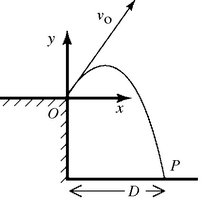
Background
Topic: Two-Dimensional Kinematics (Projectile Motion)
This question tests your understanding of projectile motion, specifically how to determine the velocity of a projectile at a given time after launch, using its initial velocity components and the effects of gravity.
Key Terms and Formulas
Projectile motion: The motion of an object thrown or projected into the air, subject only to gravity.
Velocity components: (horizontal), (vertical)
Gravity: (downward)
Key formulas:
Horizontal velocity: (remains constant)
Vertical velocity:
Magnitude of velocity:
Step-by-Step Guidance
Identify the initial velocity components: and (these are usually given or can be found from the diagram or problem statement).
Recall that the horizontal velocity does not change during flight (no air resistance): .
Calculate the vertical velocity at using .
Set up the formula for the magnitude of the velocity at : .
Try solving on your own before revealing the answer!
Final Answer: 67.4 m/s
.
The calculated magnitude of the velocity at 21.0 s is 67.4 m/s.
