 Back
BackEXAM #3 DAY 15: Pulling at Angles and Forces on Ramps: Newton’s Laws in 2D
Study Guide - Smart Notes
 Tailored notes based on your materials, expanded with key definitions, examples, and context.
Pulling at Angles and Along Ramps
Introduction to Forces in Two Dimensions
Understanding how forces act at angles and along ramps is essential for solving real-world physics problems. These scenarios require breaking forces into components and applying Newton’s laws in two dimensions.
Free Body Diagrams (FBDs): Visual representations of all forces acting on an object.
Vector Components: Forces are resolved into perpendicular axes, typically x (horizontal) and y (vertical).
Static Equilibrium: Occurs when the net force on an object is zero.
Dynamics in 2D: Involves objects accelerating due to net forces not aligned with axes.
Vector Components and Triangle Geometry
Resolving Forces into Components
When a force acts at an angle, it can be split into x and y components using trigonometric functions. This is crucial for analyzing motion and equilibrium.
Component Formulas:
For a force F at angle \theta to the horizontal:
Triangle Geometry: Used to visualize and calculate force components.
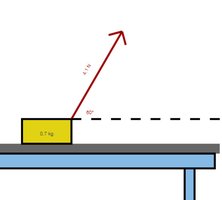
Example: A block is pulled with a force of 42 N at 30° to the horizontal. The x and y components are:
N
N
Applying Newton’s Second Law in Component Form
Newton’s Second Law in 2D
Newton’s Second Law states that the net force on an object equals its mass times its acceleration. In two dimensions, this law is applied separately to each axis.
Choose axes so that one aligns with the direction of acceleration for easier calculations.
Example: Dragging a block at an angle without friction:
Mass: 10 kg
Tension: 42 N at 30°
Calculate acceleration using component forces.
Forces on Ramps
Visualizing and Solving Ramp Problems
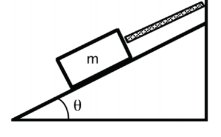
Objects on ramps experience forces that must be resolved along and perpendicular to the ramp. The weight of the object is split into two components: one parallel and one perpendicular to the ramp surface.
Weight Components:
Parallel to ramp:
Perpendicular to ramp:
Normal Force: Acts perpendicular to the ramp surface.
Friction: Opposes motion along the ramp, calculated using coefficients of static or kinetic friction.
Friction on Ramps
Static and Kinetic Friction
Frictional forces depend on the nature of the surfaces and whether the object is moving. The maximum static friction must be overcome for motion to start; kinetic friction acts once the object is moving.
Static Friction:
Kinetic Friction:
Normal Force:
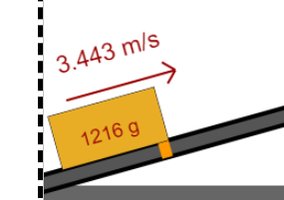
Example: A block on a ramp with , , mass 5.0 kg, angle 37°, initial velocity 3.0 m/s.
Calculate forces, net force, acceleration, and distance traveled before stopping.
Solving Ramp Problems: Step-by-Step
Procedure for Analyzing Forces and Motion
To solve problems involving ramps, follow these steps:
Draw the Free Body Diagram (FBD).
Resolve weight into components along and perpendicular to the ramp.
Calculate normal force and friction.
Apply Newton’s Second Law along the ramp:
Use kinematic equations to find distance traveled:
Sample Problems and Applications
Example: Cart on Ramp Without Friction
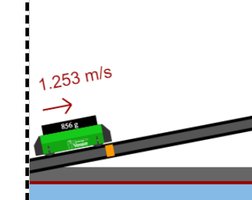
A cart with mass 2.0 kg is pushed up a ramp at 30° with initial speed 3.0 m/s. Friction is ignored.
Forces: Weight, normal force.
Net force along ramp:
Acceleration:
Distance before stopping: Use kinematic equations.
Example: Cart on Ramp With Friction
Ramp angle is 37°, mass is 5.0 kg, initial velocity is 3.0 m/s, , .
Calculate normal force:
Calculate friction:
Net force:
Acceleration:
Distance before stopping: Use
Summary Table: Forces on Ramps
Force | Direction | Formula |
|---|---|---|
Weight (w) | Downward | |
Weight along ramp | Parallel to ramp | |
Weight into ramp | Perpendicular to ramp | |
Normal force (n) | Perpendicular to ramp | |
Friction (f) | Opposes motion |
Key Concepts and Takeaways
Always resolve forces into components for angled and ramp problems.
Use Free Body Diagrams to identify all forces.
Apply Newton’s Second Law separately to each axis.
Friction must be considered for realistic ramp problems.
Choose axes strategically to simplify calculations.
