 Back
BackQuantum Harmonic Oscillator: Energy Levels, Wavefunctions, and Quantum Intuition
Study Guide - Smart Notes
 Tailored notes based on your materials, expanded with key definitions, examples, and context.
Q1a.i. Why do all bound particles in quantum mechanics have only a discrete set of allowed energies?
Background
Topic: Quantization of Energy in Quantum Mechanics
This question explores the fundamental reason for energy quantization in quantum systems, focusing on the mathematical and physical principles that restrict bound particles to discrete energy levels.
Key Terms and Concepts:
Bound particle: A particle confined to a finite region by a potential.
Quantization: The restriction of physical quantities to discrete values.
Schrödinger Equation: The central equation of quantum mechanics.
Step-by-Step Guidance
Recall that the Schrödinger equation for a bound system (like a particle in a box or a harmonic oscillator) leads to solutions (wavefunctions) that must satisfy boundary conditions.
These boundary conditions restrict the possible wavefunctions to only certain forms, which correspond to discrete energy eigenvalues.
Think about how, for a bound particle, the wavefunction must be normalizable (finite probability), which is only possible for specific energy values.
Consider the analogy with standing waves on a string: only certain wavelengths fit, leading to discrete frequencies (energies).
Try solving on your own before revealing the answer!
Final Answer:
Bound particles have discrete energies because only certain wavefunctions satisfy the boundary conditions and normalization requirements of the Schrödinger equation. This is analogous to standing waves, where only specific wavelengths are allowed.
Q1a.ii.I. Why is the natural frequency of a mass-spring system given by ? What happens to if or increases?
Background
Topic: Classical Harmonic Oscillator Frequency
This question tests your understanding of the physical and mathematical reasoning behind the formula for the natural frequency of a mass-spring system.
Key formula:
= spring constant (stiffness)
= mass
= angular frequency
Step-by-Step Guidance
Use dimensional analysis: has units of N/m, has units of kg. should have units of .
Check how increasing (stiffer spring) or (heavier mass) affects .
Reason physically: A stiffer spring (larger ) means faster oscillations; a heavier mass (larger ) means slower oscillations.
Try solving on your own before revealing the answer!
Final Answer:
increases with and decreases with . This makes sense: a stiffer spring oscillates faster, a heavier mass oscillates slower.
Q1a.ii.II. In what sense is the mass a bound particle? What is its amplitude in terms of energy ?
Background
Topic: Bound States and Oscillation Amplitude
This question asks you to relate the energy of a classical oscillator to its amplitude, and to understand what it means for the mass to be "bound" in the context of oscillation.
Key formula:
= total energy
= amplitude
= spring constant
Step-by-Step Guidance
Recall that the mass oscillates between and , so it is "bound" to this region.
Use the energy formula to relate to and .
Rearrange the formula to solve for in terms of and .
Try solving on your own before revealing the answer!
Final Answer:
The amplitude is given by . The mass is bound to the region .
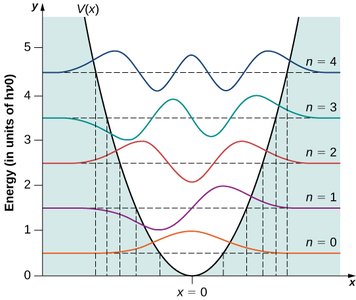
Q1a.iii. Why are the energy levels of the quantum harmonic oscillator evenly spaced with spacing ?
Background
Topic: Quantum Harmonic Oscillator Energy Levels
This question asks you to explain why the energy levels of the quantum harmonic oscillator are evenly spaced, unlike other systems such as the particle in a box.
Key formula:
= quantum number (integer)
= reduced Planck constant
= angular frequency
Step-by-Step Guidance
Recall that the harmonic oscillator potential is quadratic: .
Solving the Schrödinger equation for this potential yields energy levels that are evenly spaced.
Compare to the particle in a box, where the energy levels are not evenly spaced due to the different potential shape.
Think about the mathematical property of the harmonic oscillator: its solutions involve Hermite polynomials and a Gaussian envelope, leading to equal spacing.
Try solving on your own before revealing the answer!
Final Answer:
The energy levels are evenly spaced because the harmonic oscillator potential is quadratic, leading to solutions with equal energy spacing . This is a unique property of the harmonic oscillator.
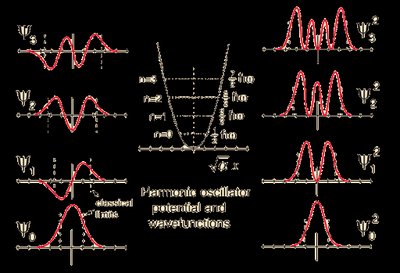
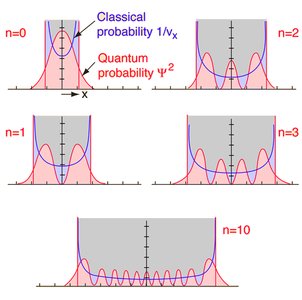
Q1b. Sketch and discuss the spatial dependence of the first four harmonic oscillator wavefunctions , comparing to the particle-in-a-box.
Background
Topic: Quantum Harmonic Oscillator Wavefunctions
This question asks you to analyze and sketch the wavefunctions for the first four energy states of the quantum harmonic oscillator, and compare them to the particle-in-a-box wavefunctions.
Key Terms:
Wavefunction : Describes the probability amplitude for finding the particle at position .
Classical turning points: Points where the classical energy equals the potential energy.
Classically forbidden region: Where the particle's energy is less than the potential energy.
Step-by-Step Guidance
Sketch the wavefunctions for ; note the number of nodes increases with .
Compare to particle-in-a-box: Both have nodes, but harmonic oscillator wavefunctions are not zero at the classical turning points.
Discuss why wavefunctions extend into classically forbidden regions (tunneling effect).
Explain why higher energy states have wavefunctions that spread out more and have shorter wavelength near .
Discuss the classical probability function and how it relates to the quantum probability distribution.
Try solving on your own before revealing the answer!
Final Answer:
The harmonic oscillator wavefunctions have increasing nodes with , are not zero at classical turning points, and extend into forbidden regions. The classical probability is highest near turning points, while quantum probability spreads out as $n$ increases.
