 Back
BackQuantum Mechanics: Foundations, Free Particle, and Potential Wells
Study Guide - Smart Notes
 Tailored notes based on your materials, expanded with key definitions, examples, and context.
Quantum Mechanics: Introduction and Wave Description
Wave-Particle Duality and the Need for Quantum Mechanics
Quantum mechanics arose from the need to describe the state of a particle using the language of waves, replacing the classical scheme based on coordinates and velocities. The wave function is central to this new description, encapsulating all information about a quantum system.
Wave Function (Ψ): In quantum mechanics, the wave function Ψ(x, y, z, t) describes the probability amplitude for a particle's position and time.
Classical Wave Equation: The classical wave equation for a string is , with solutions in the form of sinusoidal waves.
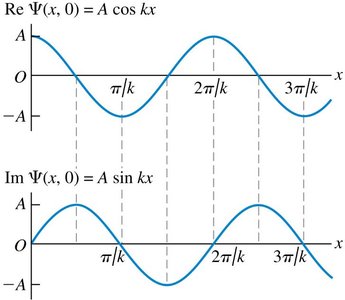
Quantum Wave Function: The quantum wave function can be written as Ψ(x, t), with its real and imaginary parts often represented as cosine and sine functions, respectively.
Schrödinger Equation and Free Particle Solutions
Time-Dependent Schrödinger Equation (TDSE)
The fundamental equation of quantum mechanics for a free particle is the time-dependent Schrödinger equation:
Its general solution for a free particle is a complex exponential:
The wave number k relates to momentum:
The energy is
Interpretation of the Wave Function
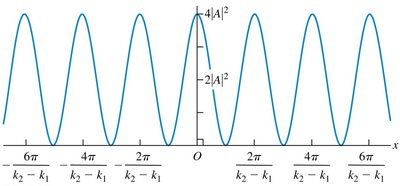
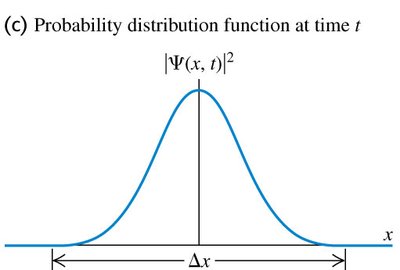
The Born interpretation states that gives the probability density for finding a particle at position x and time t. The wave function must be normalized so that the total probability is 1:
Heisenberg Uncertainty Principle
The uncertainty principle relates the uncertainties in position and momentum:
A wave function with definite momentum (plane wave) is completely delocalized in position.
Wave Packets and Localization
Superposition and Wave Packets
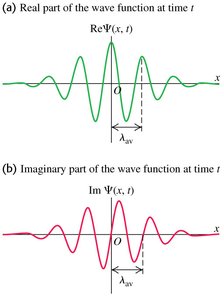
A localized particle is described by a wave packet, which is a superposition of many plane waves with different k values:
The width of the packet in position space is inversely related to the spread in k (momentum) space.
Schrödinger Equation with Potential: Bound States
Time-Independent Schrödinger Equation (TISE)
For a particle in a potential U(x), the time-independent Schrödinger equation is:
Stationary states have definite energy and their probability densities do not depend on time.
Particle in a Box (Infinite Square Well)
Model and Boundary Conditions
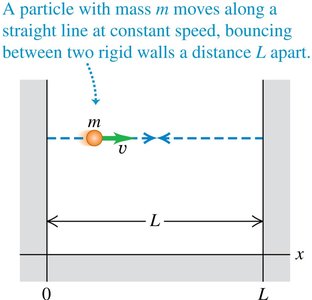
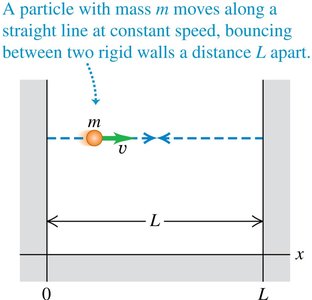
A particle confined between two infinitely high potential walls (at x = 0 and x = L) is a classic quantum system. The potential is zero inside the box and infinite outside:
for ; elsewhere
Boundary conditions:
Allowed Wave Functions and Energies
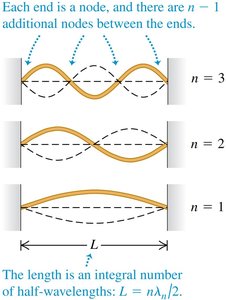
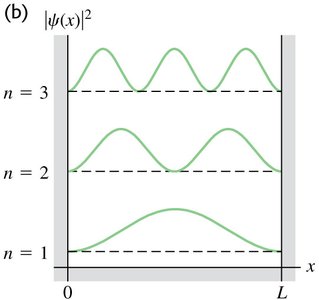
The solutions are standing waves:
,
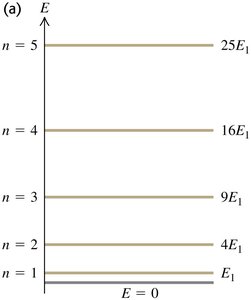
Energy levels:
Only discrete (quantized) energy values are allowed.
Probability Densities
The probability density shows where the particle is most likely to be found for each quantum state.
Finite Potential Wells
Finite Square Well
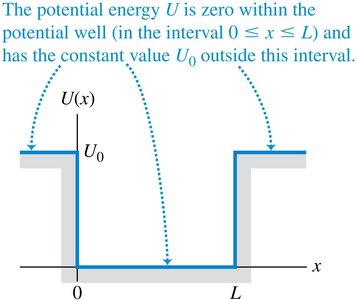
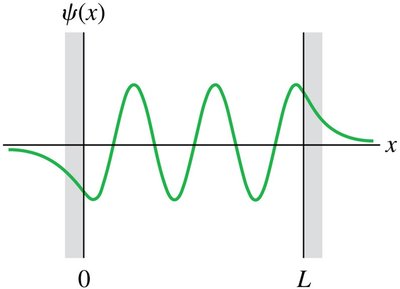
A more realistic model is the finite square well, where the potential outside the well is finite (U0) rather than infinite. Bound states exist for energies less than U0, and the wave function decays exponentially outside the well.
Inside the well:
Outside the well:
Quantization conditions arise from matching boundary conditions at the edges.
Potential Barriers and Quantum Tunneling
Quantum Tunneling
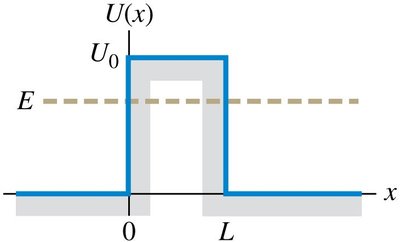
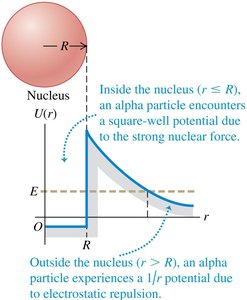
Quantum mechanics allows particles to penetrate and cross potential barriers even if their energy is less than the barrier height—a phenomenon called tunneling.
The tunneling probability (T) for a barrier of width L and height U0 is approximately:
, where
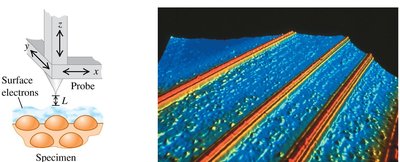
Tunneling is fundamental to phenomena such as alpha decay and scanning tunneling microscopy.
The Quantum Harmonic Oscillator
Schrödinger Equation for the Harmonic Oscillator
The quantum harmonic oscillator models systems with a restoring force proportional to displacement, such as atoms in a molecule or lattice vibrations in solids.
Potential:
Schrödinger equation:
Energy levels: ,
Physical Applications
Molecular vibrations and phonons in solids are accurately described by the quantum harmonic oscillator model.
Summary Table: Key Equations and Concepts
Concept | Equation | Description |
|---|---|---|
Time-Dependent Schrödinger Equation | Describes quantum evolution in time | |
Time-Independent Schrödinger Equation | Stationary states and energy quantization | |
Particle in a Box Energy | Quantized energy levels | |
Harmonic Oscillator Energy | Equally spaced energy levels | |
Heisenberg Uncertainty | Limits simultaneous knowledge of position and momentum | |
Tunneling Probability | Probability of quantum tunneling through a barrier |
