Back
BackQuantum Mechanics II: The Hydrogen Atom and Many-Electron Atoms
Study Guide - Smart Notes
 Tailored notes based on your materials, expanded with key definitions, examples, and context.
Quantum Mechanics: The Hydrogen Atom
Basic Structure and Coulomb Potential
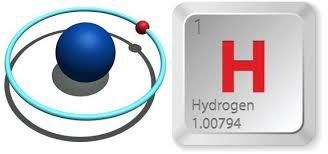
The hydrogen atom is the simplest atomic system, consisting of one electron (mass me, charge -e) and one proton (mass mp, charge +e). The force between them is governed by Coulomb's law, which describes the electric potential energy for two point charges separated by a distance r:
Electric Potential Energy:
Reduced Mass: The motion is analyzed using the reduced mass , which accounts for both electron and proton masses.
Schrödinger Equation and Separation of Variables
The hydrogen atom's potential forms a spherically symmetric well, allowing the use of separation of variables in the Schrödinger equation. The wavefunction is written as:
The general 3D Schrödinger equation:
Solving these equations yields quantized energy levels:
, where n is the principal quantum number.
Quantum Numbers and Atomic Orbitals
The solutions to the Schrödinger equation introduce three quantum numbers:
n: Principal quantum number (energy level)
l: Orbital angular momentum quantum number
ml: Magnetic quantum number (component of angular momentum)
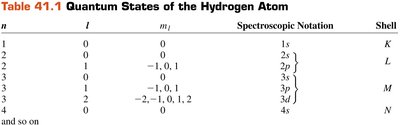
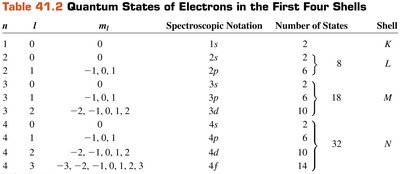
Each quantum state is described by these numbers, and the spectroscopic notation (e.g., 1s, 2p) is used to label them.
n | l | ml | Spectroscopic Notation | Shell |
|---|---|---|---|---|
1 | 0 | 0 | 1s | K |
2 | 0 | 0 | 2s | L |
2 | 1 | -1, 0, 1 | 2p | L |
3 | 0 | 0 | 3s | M |
3 | 1 | -1, 0, 1 | 3p | M |
3 | 2 | -2, -1, 0, 1, 2 | 3d | M |
4 | 0 | 0 | 4s | N |
Radial Probability Distribution and Bohr Radius
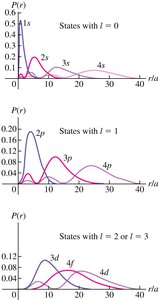
The probability of finding the electron at a distance r from the nucleus is given by the radial probability distribution function:
The Bohr radius m is the most probable distance for the ground state electron.
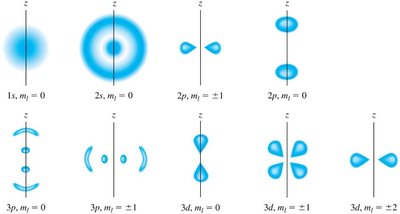
Atomic Orbitals and Probability Densities
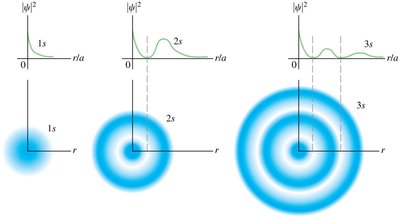
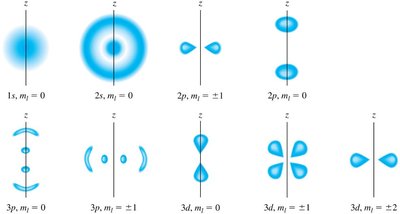
The spatial distribution of electron probability densities for different quantum states (orbitals) is visualized as follows:
s orbitals (l = 0): Spherically symmetric
p orbitals (l = 1): Dumbbell-shaped, oriented along axes
d orbitals (l = 2): More complex shapes
Quantization of Angular Momentum
Orbital Angular Momentum
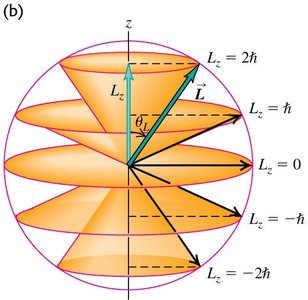
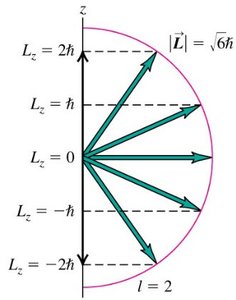
Quantum mechanics predicts that orbital angular momentum is quantized:
Magnitude:
Component along z-axis: , where
The Zeeman Effect
Energy Level Splitting in Magnetic Fields
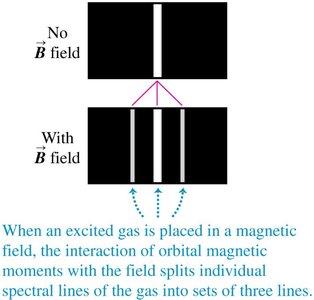
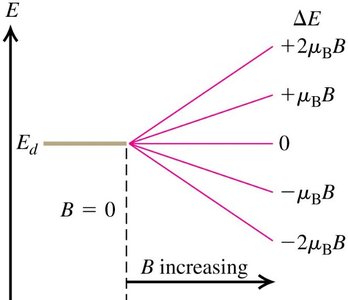
The Zeeman effect describes the splitting of atomic energy levels and spectral lines when an atom is placed in a magnetic field. The interaction energy is:
For orbital angular momentum: , where is the Bohr magneton.
Selection Rules for Transitions
Not all transitions between energy levels are allowed. The selection rules are:
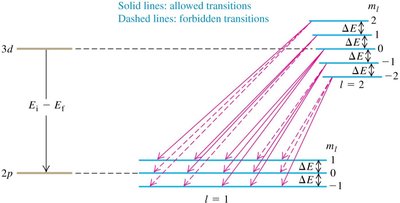
Electron Spin and Stern-Gerlach Experiment
Spin Quantum Numbers
Electron spin is an intrinsic form of angular momentum, with quantum numbers:
Spin quantum number:
Spin magnetic quantum number:
Magnitude:
Component:
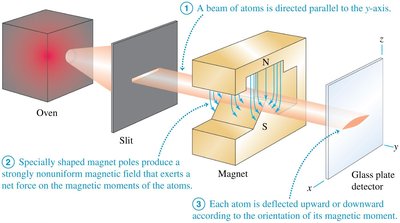
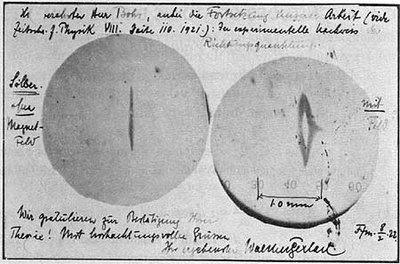
Spin-Orbit Coupling and Fine Structure
Spin-orbit coupling is the interaction between the electron's spin and its orbital angular momentum, leading to further splitting of energy levels (fine structure):
Total angular momentum:
Possible values:
Many-Electron Atoms and the Exclusion Principle
Central-Field Approximation and Quantum Numbers
For atoms with more than one electron, the Schrödinger equation cannot be solved exactly. The central-field approximation allows the use of atomic orbitals and quantum numbers (n, l, ml, ms).
Each electron state is labeled by four quantum numbers.
The exclusion principle (Pauli principle): No two electrons in an atom can have the same set of quantum numbers.
Screening and Effective Nuclear Charge
Electrons in inner shells screen the nuclear charge for outer electrons, so each electron experiences an effective charge Zeff:
Energy levels:
Screening depends on both n and l.
Electron Configurations and the Periodic Table
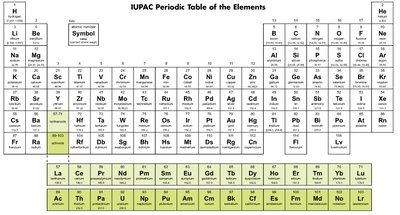
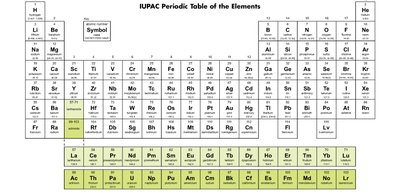
The arrangement of electrons in shells and subshells determines the chemical properties of elements. The periodic table is organized by electron configurations:
s subshell: max 2 electrons
p subshell: max 6 electrons
d subshell: max 10 electrons
f subshell: max 14 electrons
X-ray Spectra and Moseley's Law
K-shell and L-shell Transitions
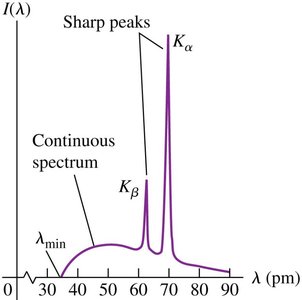
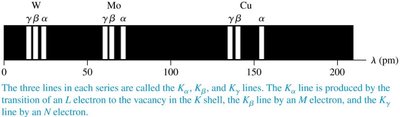
X-ray spectra arise from electron transitions between inner shells. The Kα line is produced when an electron drops from the L-shell to a vacancy in the K-shell.
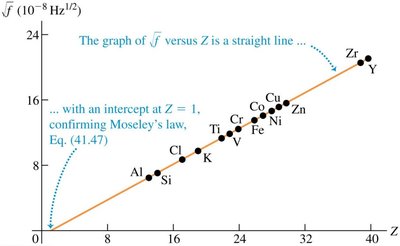
Moseley's Law: Hz
Measurement of Kα line frequency allows determination of atomic number Z.