 Back
BackQuantum Mechanics in Three Dimensions: Particle in a Box
Study Guide - Smart Notes
 Tailored notes based on your materials, expanded with key definitions, examples, and context.
Quantum Mechanics in Three Dimensions
Kinetic Energy and the Schrödinger Equation
In quantum mechanics, the behavior of a particle in three dimensions is governed by the three-dimensional Schrödinger equation. The kinetic energy operator in three dimensions is expressed as the sum of the kinetic energies in each spatial direction.
Kinetic Energy Operator: The kinetic energy for a particle of mass m is given by:
Time-Dependent Schrödinger Equation:
Normalization Condition: The wave function must satisfy:
Stationary States: For a state of definite energy, the wave function can be separated as:
Time-Independent Schrödinger Equation:
Particle in a Three-Dimensional Box
Potential and Boundary Conditions
The three-dimensional box (also called an infinite potential well) is a fundamental quantum system where a particle is confined within a cubical region of side L with infinitely high potential walls.
Potential Energy Function:
for , otherwise
for , otherwise
for , otherwise
Boundary Conditions: The wave function must vanish at the walls: at .
Separation of Variables and Solution
The time-independent Schrödinger equation inside the box can be solved using separation of variables, assuming a solution of the form .
Separation of Variables: Leads to three independent equations for , , and , each resembling the one-dimensional particle in a box problem.
Allowed Solutions:
,
,
,
General Solution:
Normalization: The constant is determined by the normalization condition.
Energy Levels and Quantum Numbers
The energy levels of a particle in a three-dimensional box depend on three quantum numbers: , , and .
Energy Eigenvalues:
Quantum Numbers:
Degeneracy: Different combinations of quantum numbers can yield the same energy (degenerate states).
Probability Distributions and Nodal Planes
The probability density describes the likelihood of finding the particle at a given location. Nodal planes are regions where the probability density is zero.
Nodal Planes: For each quantum number greater than one, there is a nodal plane perpendicular to the corresponding axis.
Examples:
For , there is a nodal plane at where the probability density is zero.
For , the nodal plane is at .
For , the nodal plane is at .
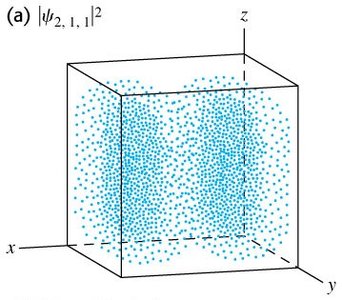
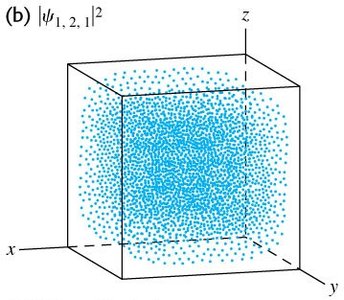
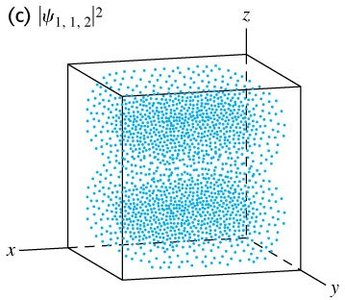
Energy Level Diagram and Degeneracy
The energy levels for a particle in a cubical box can be represented graphically, showing the degeneracy (number of states with the same energy) for each level. Degeneracy arises from the symmetry of the box; if the box is not symmetric (i.e., ), degeneracy is lifted.
Energy Level Structure: The lowest energy state is . Higher energy levels correspond to higher quantum numbers and may be degenerate.
Degeneracy Table: The number of distinct quantum states for each energy level is shown in the diagram below.
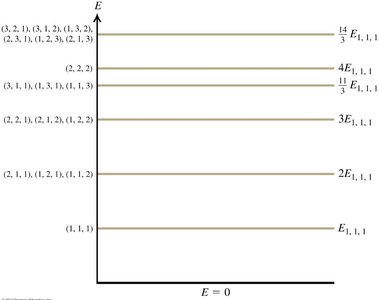
Summary Table: Energy Levels and Degeneracy
Quantum Numbers (n_X, n_Y, n_Z) | Energy (in units of ) | Degeneracy |
|---|---|---|
(1,1,1) | 1 | |
(2,1,1), (1,2,1), (1,1,2) | 2 | 3 |
(2,2,1), (2,1,2), (1,2,2) | 3 | 3 |
(2,2,2) | 4 | 1 |
(3,1,1), (1,3,1), (1,1,3) | 3 | |
(3,2,1), (3,1,2), (2,3,1), (2,1,3), (1,3,2), (1,2,3) | 6 |
Additional info: Degeneracy is a direct consequence of the symmetry of the box. If the box dimensions are not equal, the degeneracy is removed, and each energy level becomes unique to its quantum numbers.
