 Back
BackQuantum Mechanics: Wave Functions, Schrödinger Equation, and Quantum Wells
Study Guide - Smart Notes
 Tailored notes based on your materials, expanded with key definitions, examples, and context.
Quantum Mechanics: Foundations and Wave Functions
Introduction to Quantum Mechanics
Quantum mechanics is a fundamental theory in physics that describes the behavior of matter and energy at the smallest scales, such as atoms and subatomic particles. Unlike classical mechanics, quantum mechanics uses the concept of wave functions to describe the state of a particle.
Wave Function (Ψ): The central mathematical object in quantum mechanics, representing the probability amplitude for a particle's position and time.
Classical vs Quantum Description: Classical mechanics uses coordinates and velocities, while quantum mechanics uses wave functions.
Notation: Ψ(x, y, z, t) for space and time dependence; ψ(x, y, z) for spatial dependence only.
The Classical Wave Equation
The classical wave equation describes the motion of waves, such as those on a string. Its solutions are sinusoidal functions representing traveling waves.
General Solution:
Wave Parameters: (wave number), (angular frequency)
Phase Velocity:
Quantum Mechanical Wave Functions
Schrödinger Equation for a Free Particle
The Schrödinger equation is the fundamental equation of quantum mechanics, governing the evolution of the wave function.
Time-dependent Schrödinger Equation (1D, free particle):
Sinusoidal Solution:
Momentum and Energy: ,
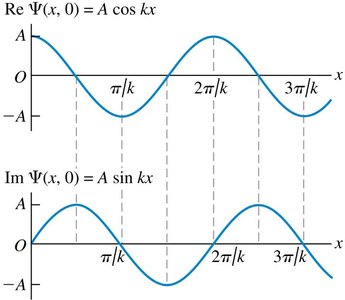
Interpretation of the Wave Function
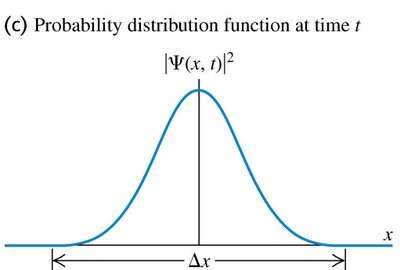
The physical meaning of the wave function is given by the Born interpretation: the probability density of finding a particle at position x and time t is .
Probability Density:
Normalization Condition:

Heisenberg Uncertainty Principle
The uncertainty principle states that the product of the uncertainties in position and momentum cannot be smaller than a fundamental constant:
Uncertainty Principle:
If a particle has a definite momentum (plane wave), its position is completely uncertain.
Wave Packets and Superposition
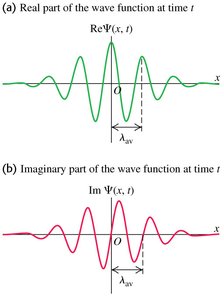
To localize a particle, a superposition of waves with different momenta (wave numbers) is used, forming a wave packet.
Wave Packet:
Dispersion: For matter waves, different components travel at different speeds, causing the packet to spread.
Quantum Wells: Particle in a Box
Infinite Square Well (Particle in a Box)
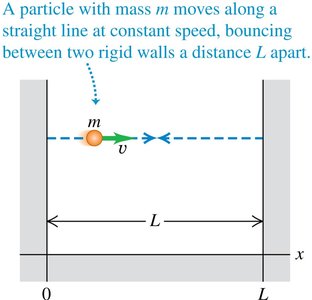
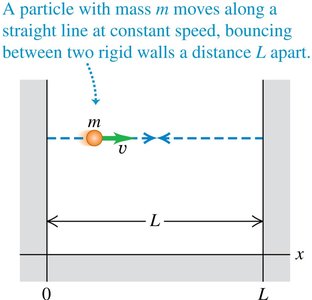
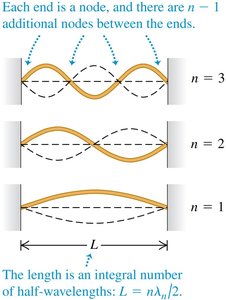
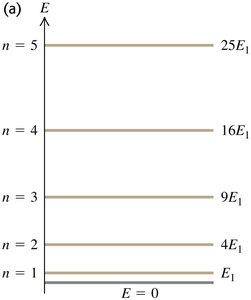
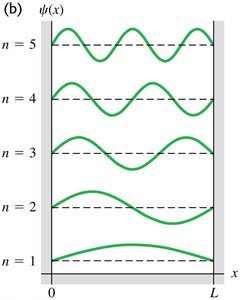
A particle confined between two infinitely high potential walls (0 < x < L) can only occupy certain energy levels. The wave function must be zero at the walls.
Potential: for , elsewhere
Allowed Wave Functions: ,
Energy Levels:
Normalization and Probability Density
The wave functions must be normalized so that the total probability of finding the particle in the box is 1. The probability density is .
Normalization:
Probability Density: Peaks and nodes correspond to regions of high and zero probability, respectively.
Finite Square Well
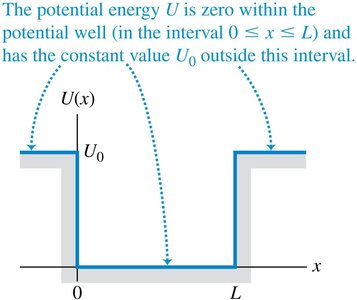
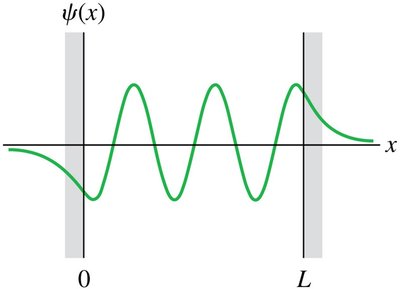
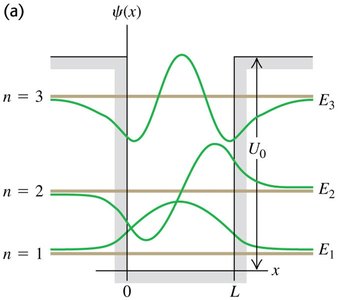
A more realistic model is the finite potential well, where the potential outside the well is finite (U0), not infinite. This allows for quantum tunneling.
Potential: for , elsewhere
Wave Function: Sinusoidal inside the well, exponential decay outside.
Energy Quantization: Only certain energies are allowed, but fewer than in the infinite well.
Quantum Tunneling and Potential Barriers
Potential Barriers and Tunneling
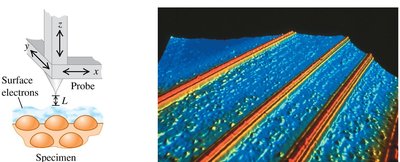
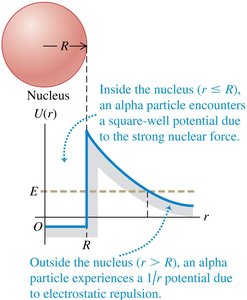
Quantum mechanics allows particles to penetrate and cross potential barriers even if their energy is less than the barrier height, a phenomenon known as tunneling.
Tunneling Probability (approximate): , where
Applications: Scanning tunneling microscope, alpha decay in nuclei.
The Quantum Harmonic Oscillator
Quantum Harmonic Oscillator
The quantum harmonic oscillator models systems where the force is proportional to displacement, such as atoms in a molecule or lattice vibrations in solids.
Potential:
Schrödinger Equation:
Energy Levels: ,
Physical Applications
Molecular Vibrations: The quantum harmonic oscillator describes vibrational modes of molecules.
Phonons: Collective oscillations of atoms in a solid, quantized as phonons.
Summary Table: Key Equations and Concepts
Concept | Equation | Notes |
|---|---|---|
Time-dependent Schrödinger Equation | General form | |
Probability Density | Born interpretation | |
Infinite Square Well Energies | n = 1, 2, 3, ... | |
Harmonic Oscillator Energies | n = 0, 1, 2, ... | |
Tunneling Probability | For |
Additional info: The notes above expand on the original content by providing definitions, equations, and context for each quantum mechanical concept, ensuring a self-contained and comprehensive study guide for college-level physics students.
