 Back
BackQuantum Physics and the Photoelectric Effect: Study Guide
Study Guide - Smart Notes
 Tailored notes based on your materials, expanded with key definitions, examples, and context.
Quantum Physics Overview
Introduction to Quantum Physics
Quantum physics explores the behavior of matter and energy at the smallest scales, where classical physics fails to explain certain phenomena. Key topics include the quantization of light, the photoelectric effect, wave-particle duality, and the Heisenberg uncertainty principle.
Quantization of Light: Light exhibits both wave-like and particle-like properties, leading to the concept of photons.
Photoelectric Effect: Demonstrates the particle nature of light and provides evidence for quantization.
Wave-Particle Duality: Both light and matter can behave as waves and particles.
Heisenberg Uncertainty Principle: Fundamental limit to the precision with which certain pairs of physical properties can be known.
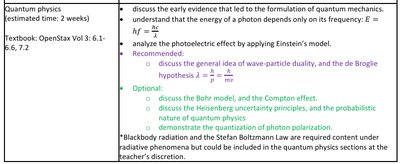
Blackbody Radiation
Learning Objectives
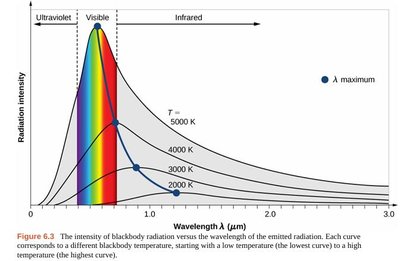
Blackbody radiation refers to the emission of electromagnetic radiation by an idealized object that absorbs all incident radiation. This topic introduces Planck's hypothesis and laws governing blackbody emission.
Apply Wien's and Stefan's laws to analyze radiation emitted by a blackbody.
Explain Planck's hypothesis of energy quanta.

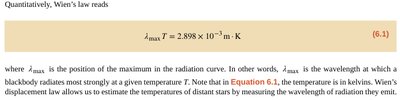
Wien's Law
Wien's law relates the temperature of a blackbody to the wavelength at which it emits radiation most strongly.
Formula:
Application: Used to estimate the temperature of stars by measuring their emitted wavelength.
Planck's Quantum Hypothesis
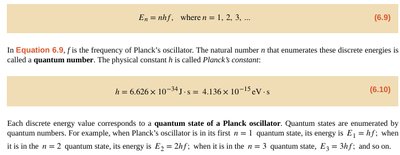
Planck proposed that energy is emitted in discrete packets called quanta, leading to the formula:
Energy of a quantum:
Planck's constant:

The Photoelectric Effect
Learning Objectives
The photoelectric effect occurs when light of sufficient frequency strikes a metal surface, causing the emission of electrons. This effect cannot be explained by classical physics and supports the quantum model of light.
Describe physical characteristics of the photoelectric effect.
Explain why classical physics fails to account for the effect.
Describe Einstein's model for the photoelectric effect.

Key Equations and Concepts
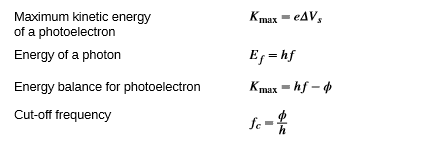
Maximum kinetic energy of a photoelectron:
Energy of a photon:
Energy balance for photoelectron: (where is the work function of the metal)
Cut-off frequency:
Experimental Setup
The photoelectric effect is studied using a circuit with a metal surface, voltmeter, and ammeter. The incident light causes electrons to be emitted and measured as current.
Intensity and Stopping Potential
The stopping potential is the voltage required to stop the most energetic photoelectrons. The intensity of light affects the number of emitted electrons but not their maximum kinetic energy.
Frequency Dependence
The kinetic energy of photoelectrons depends linearly on the frequency of incident light, with each metal having its own cut-off frequency.
Compton Effect
Learning Objectives
The Compton effect demonstrates the particle nature of light through the scattering of X-rays by electrons, resulting in a wavelength shift.
Describe Compton's experiment and its significance.
Explain the Compton wavelength shift and its confirmation of photon behavior.
Momentum of a Photon
Photon Properties
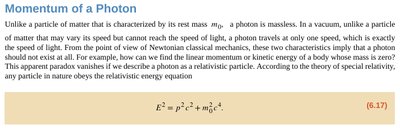
Photons are massless particles that travel at the speed of light and possess momentum and energy.
Relativistic energy equation:
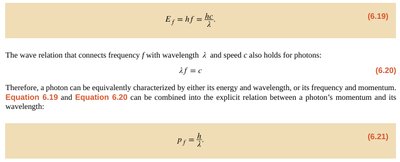
Photon energy:
Photon momentum:
Bohr's Model of the Hydrogen Atom
Learning Objectives
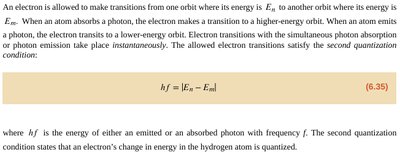
Bohr's model explains the quantized energy levels of electrons in hydrogen and the emission/absorption spectra.
Energy transitions:
Absorption and emission: Electrons absorb photons to move to higher energy levels and emit photons when transitioning to lower levels.
De Broglie's Matter Waves
Learning Objectives
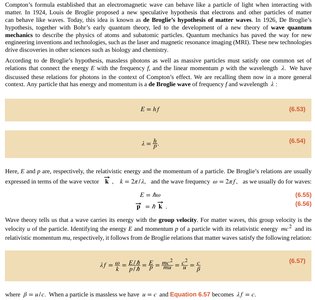
De Broglie hypothesized that particles of matter, such as electrons, exhibit wave-like properties characterized by wavelength and frequency.
De Broglie wavelength:
Energy of a particle:
Group velocity:

Wave-Particle Duality
Learning Objectives
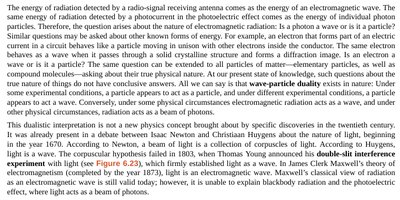
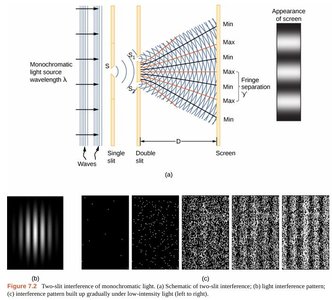
Wave-particle duality describes the phenomenon where electromagnetic waves and particles exhibit both wave-like and particle-like behavior under different conditions.
Examples: Double-slit experiment, photoelectric effect, and Compton scattering.
Statistical interpretation: Quantum mechanics provides a probabilistic description of physical reality.


Heisenberg Uncertainty Principle
Learning Objectives
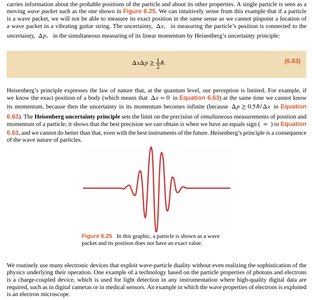
The Heisenberg uncertainty principle states that it is impossible to simultaneously know the exact position and momentum of a particle. This principle is fundamental to quantum mechanics.
Uncertainty relation:
Physical meaning: Measurement of one property increases the uncertainty in the other.

Lasers
Learning Objectives
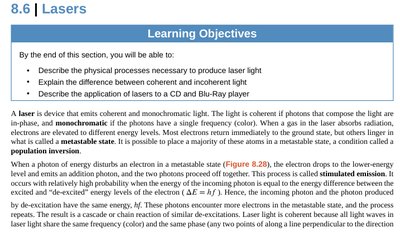
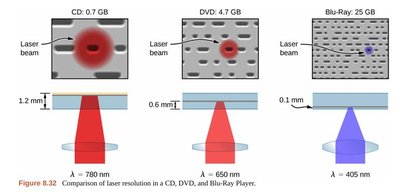
Lasers produce coherent and monochromatic light through stimulated emission and population inversion. Applications include CD, DVD, and Blu-Ray technology.
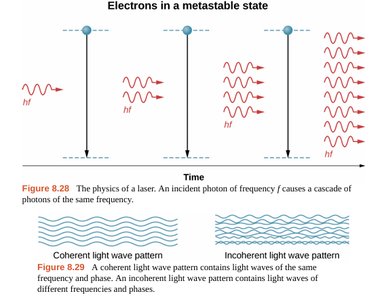
Coherent light: Photons have the same frequency and phase.
Stimulated emission: Incident photons cause a cascade of photons of the same frequency.
Population inversion: More electrons in excited states than ground states.

Electric Current and Potential Difference
Defining Current and the Ampere
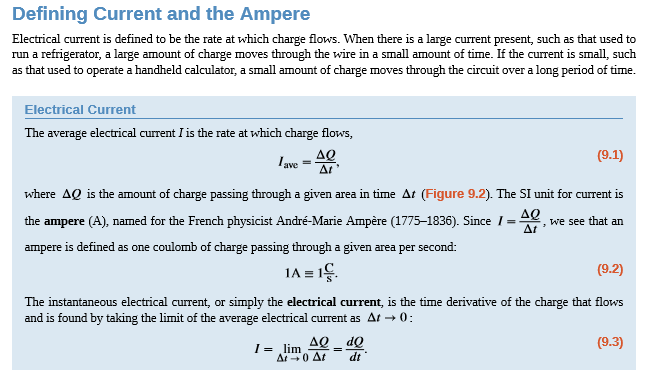
Electric current is the rate at which charge flows through a conductor. The SI unit is the ampere (A), defined as one coulomb per second.
Average current:
Instantaneous current:
Electric Potential Difference
The electric potential difference (voltage) is the change in potential energy per unit charge between two points. The SI unit is the volt (V).
Formula:

Summary Table: Key Quantum Physics Equations
Concept | Equation | Description |
|---|---|---|
Photon Energy | Energy of a photon | |
Photoelectron Kinetic Energy | Energy balance for photoelectron | |
Cut-off Frequency | Minimum frequency to emit electrons | |
De Broglie Wavelength | Wavelength of a particle | |
Heisenberg Uncertainty | Position-momentum uncertainty | |
Wien's Law | Peak wavelength of blackbody |
