 Back
BackQuantum Physics: Blackbody Radiation, Photoelectric Effect, and Wave-Particle Duality
Study Guide - Smart Notes
 Tailored notes based on your materials, expanded with key definitions, examples, and context.
Quantum Physics
Blackbody Radiation
Blackbody radiation refers to the electromagnetic radiation emitted by an idealized object that absorbs all incident radiation, regardless of frequency or angle. Such an object is called a blackbody. Real-world examples include heated objects like tungsten filaments and charcoal briquettes, which emit visible light and heat as their temperature increases.
Definition: A blackbody is an idealized physical body that absorbs all incident electromagnetic radiation and re-emits energy characteristic of its temperature.
Stefan-Boltzmann Law: The total power radiated per unit area of a blackbody is proportional to the fourth power of its absolute temperature.
The Stefan-Boltzmann Law is given by:
$P = \sigma A T^4$
where $P$ is the power radiated, $A$ is the surface area, $T$ is the temperature in Kelvin, and $\sigma = 5.67 \times 10^{-8} \ \mathrm{W/(m^2 K^4)}$ is the Stefan-Boltzmann constant.
Wien's Law: The wavelength $\lambda_p$ at which the emission of a blackbody spectrum is maximum is inversely proportional to its temperature:
$\lambda_p T = 2.90 \times 10^{-3} \ \mathrm{m \cdot K}$
This law allows us to estimate the temperature of stars and other objects from their peak emission wavelength.
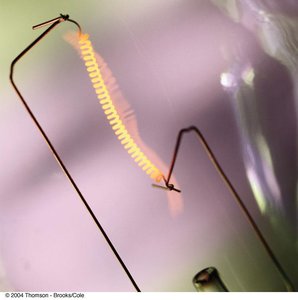

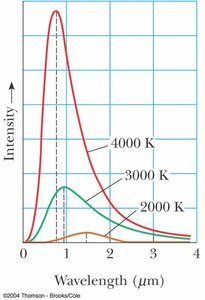
Key Properties of Blackbody Radiation:
All blackbodies at the same temperature emit the same spectrum.
Increasing temperature increases intensity at all wavelengths and shifts the peak to shorter wavelengths.
The visible spectrum is only a small part of the total emission.
Planck's Solution to Blackbody Radiation
Classical physics could not explain the observed blackbody spectrum, leading to the so-called "ultraviolet catastrophe." In 1900, Max Planck proposed that energy is quantized and can only be emitted or absorbed in discrete amounts called quanta.
Planck's Law for the spectral radiance $R(\lambda, T)$ is:
$R(\lambda, T) = \frac{2\pi h c^2}{\lambda^5} \frac{1}{e^{hc/(\lambda kT)} - 1}$
where $h$ is Planck's constant ($6.63 \times 10^{-34} \ \mathrm{J \cdot s}$), $c$ is the speed of light ($3.0 \times 10^8 \ \mathrm{m/s}$), $k$ is Boltzmann's constant ($1.38 \times 10^{-23} \ \mathrm{J/K}$), $\lambda$ is wavelength, and $T$ is temperature in Kelvin.
Photons and the Photoelectric Effect
Einstein extended Planck's quantization idea to light itself, proposing that light consists of discrete packets called photons. Each photon has energy:
$E = h f$
where $f$ is the frequency of the light.
1 electron volt (eV) = $1.60 \times 10^{-19}$ J
The Photoelectric Effect
The photoelectric effect is the emission of electrons from a metal surface when light of sufficient frequency shines on it. Key experimental observations include:
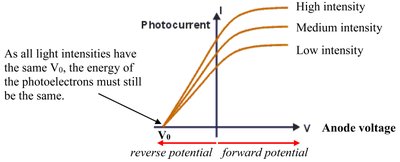
The maximum kinetic energy of ejected electrons is independent of light intensity.
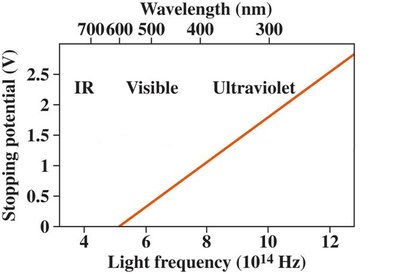
There is a threshold frequency $f_c$ below which no electrons are emitted, regardless of intensity.
The maximum kinetic energy increases with light frequency above $f_c$.
Electrons are emitted immediately when light is incident.
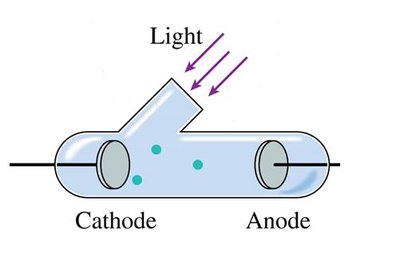
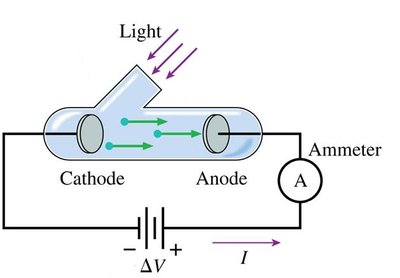
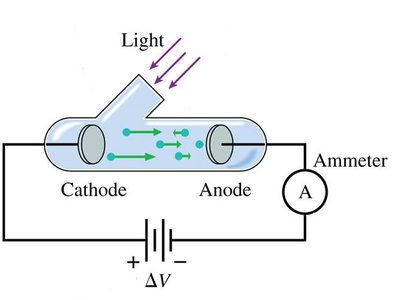
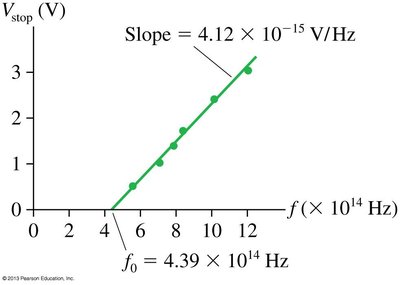
Einstein explained these results by proposing that each photon delivers its energy to a single electron. The minimum energy required to eject an electron is called the work function ($\phi$) of the metal. If $hf < \phi$, no electrons are emitted. If $hf > \phi$, the maximum kinetic energy of the ejected electron is:
$K_{\text{max}} = hf - \phi$
The stopping potential $\Delta V_{\text{stop}}$ is the voltage needed to stop the most energetic electrons:
$K_{\text{max}} = e \Delta V_{\text{stop}}$
where $e$ is the elementary charge.
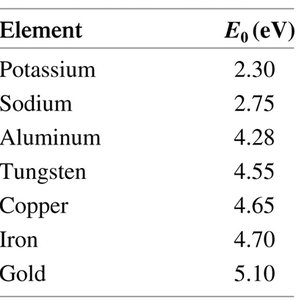
Element | Work Function $\phi$ (eV) |
|---|---|
Potassium | 2.30 |
Sodium | 2.75 |
Aluminum | 4.28 |
Tungsten | 4.55 |
Copper | 4.65 |
Iron | 4.70 |
Gold | 5.10 |
Wave-Particle Duality
Light exhibits both wave-like and particle-like properties. In phenomena such as interference and diffraction, light behaves as a wave. In the photoelectric effect and Compton scattering, it behaves as a particle.
Wave Model: Explains interference, diffraction, and polarization.
Particle Model: Explains photoelectric effect, Compton effect, and blackbody radiation.
de Broglie Hypothesis and Matter Waves
In 1923, Louis de Broglie proposed that particles such as electrons also have wave-like properties. The wavelength associated with a particle is called the de Broglie wavelength:
$\lambda = \frac{h}{p} = \frac{h}{mv}$
where $p$ is the momentum, $m$ is mass, and $v$ is velocity.
The frequency of the matter wave is:
$f = \frac{E}{h}$
where $E$ is the total energy of the particle.
Experimental Evidence for Matter Waves
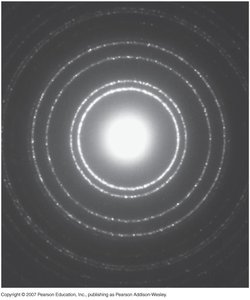
The wave nature of electrons is demonstrated by diffraction and interference experiments, such as passing electrons through a thin crystal or a double slit. The resulting patterns match those predicted for waves of wavelength given by de Broglie's formula.

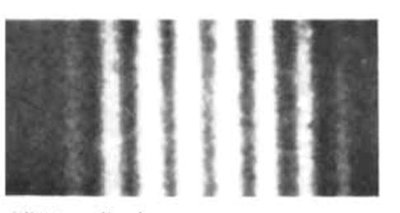
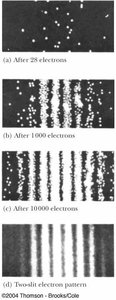
At high intensities, a clear interference pattern is observed, confirming the wave nature of electrons.
At low intensities, electrons arrive one at a time, but the overall pattern still builds up as an interference pattern, showing the probabilistic nature of quantum mechanics.
Summary Table: Key Equations
Concept | Equation | Description |
|---|---|---|
Stefan-Boltzmann Law | $P = \sigma A T^4$ | Total power radiated by a blackbody |
Wien's Law | $\lambda_p T = 2.90 \times 10^{-3} \ \mathrm{m \cdot K}$ | Peak wavelength of blackbody spectrum |
Photon Energy | $E = h f$ | Energy of a photon |
Photoelectric Effect | $K_{\text{max}} = h f - \phi$ | Maximum kinetic energy of ejected electron |
de Broglie Wavelength | $\lambda = \frac{h}{p}$ | Wavelength of a particle |
Example Applications:
Estimating the temperature of the Sun using Wien's Law.
Calculating the energy of photons in a microwave oven.
Determining the stopping potential in a photoelectric effect experiment.
Calculating the de Broglie wavelength of a moving electron or macroscopic object.
Additional info: The notes above expand on the original content by providing full definitions, equations, and context for each concept, ensuring the material is self-contained and suitable for college-level physics study.
