 Back
BackQuantum Physics: Foundations and Key Concepts
Study Guide - Smart Notes
 Tailored notes based on your materials, expanded with key definitions, examples, and context.
Quantum Physics
Introduction to Quantum Physics
Quantum physics is the branch of physics that deals with phenomena at atomic and subatomic scales, where the classical laws of physics no longer apply. It emerged in the early 20th century to explain observations that could not be accounted for by classical theories of light and matter.
Key Figures: Max Planck, Albert Einstein, Niels Bohr, Louis de Broglie, Werner Heisenberg, Erwin Schrödinger.
Key Concepts: Quantization, wave-particle duality, uncertainty principle, quantum atomic theory.
Birth of Quantum Theory
Historical Background
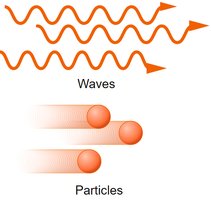
By 1900, the debate over whether light was a wave or a particle seemed resolved in favor of the wave theory, supported by experiments such as Young's double-slit experiment and Maxwell's electromagnetic theory. However, new experimental results challenged this view.
1801: Young's double-slit experiment demonstrated the wave nature of light.
1862: Maxwell's equations predicted electromagnetic waves.
1887: Hertz confirmed the existence of electromagnetic waves experimentally.
The Ultraviolet Catastrophe
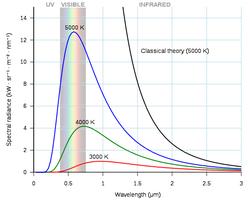
The ultraviolet catastrophe referred to the failure of classical physics to predict the observed spectrum of blackbody radiation. Classical theory predicted infinite energy emission at short wavelengths, which was not observed experimentally.
Planck's Quantum Hypothesis
In 1900, Max Planck proposed that energy is emitted or absorbed in discrete packets called quanta, proportional to the frequency of radiation. This assumption resolved the ultraviolet catastrophe and accurately described blackbody spectra.
Planck's Equation: where is energy, is Planck's constant, and is frequency.
Einstein and the Photoelectric Effect
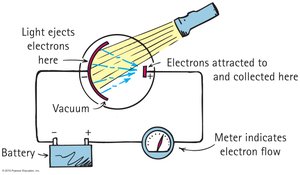
In 1905, Albert Einstein extended Planck's idea to light itself, proposing that light consists of discrete packets called photons. This explained the photoelectric effect, where light ejects electrons from metal surfaces in a way that classical physics could not account for.
Quantization
Definition and Examples
Quantization is the concept that certain physical properties, such as energy or electric charge, can only exist in discrete values rather than any arbitrary value.
Quantum: The smallest discrete unit of a physical quantity.
Examples: Energy levels in atoms, photons, electric charge, angular momentum of electrons.

Planck-Einstein Relation
The energy of a photon is directly proportional to its frequency:
This explains why ultraviolet and X-rays can damage living cells (high energy per photon), while microwaves cannot (low energy per photon).
The Photoelectric Effect
Experimental Observations
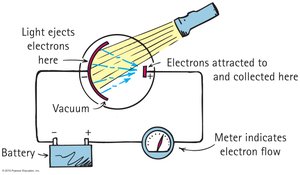
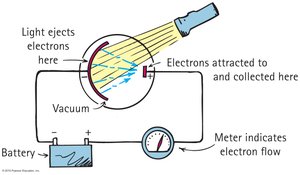
The photoelectric effect is the emission of electrons from a metal surface when illuminated by light. Classical physics could not explain several key observations:
Immediate Emission: Electrons are emitted instantly, even at low light intensity.
Intensity Effect: Increasing light intensity increases the number of electrons emitted, but not their energy.
Frequency Effect: Only light above a certain frequency (threshold) can eject electrons, regardless of intensity.
Energy of Electrons: The maximum kinetic energy of ejected electrons depends on the light's frequency, not its intensity.
Einstein's Photon Model
Einstein proposed that light consists of photons, each with energy . Photons interact with electrons one at a time, transferring their energy. The intensity of light corresponds to the number of photons, not the energy per photon.
Wave–Particle Duality
Light as Both Wave and Particle
Experiments such as the double-slit experiment show that light exhibits both wave-like and particle-like properties. This duality is a central concept in quantum physics.
Wave Behavior: Interference and diffraction patterns.
Particle Behavior: Photoelectric effect, photon detection.
Double-Slit Experiment
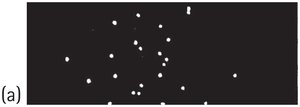
When light passes through two slits, it creates an interference pattern characteristic of waves. However, when detected, light arrives as individual photons, like particles.
Even when photons are sent one at a time, the interference pattern emerges over time, indicating wave-like behavior.
Matter Waves
de Broglie Hypothesis
Louis de Broglie proposed that all matter exhibits wave-like properties. The wavelength associated with a particle is given by:
Where is the wavelength, is Planck's constant, and is the momentum of the particle.
Experimental Confirmation
Electron diffraction experiments confirmed that electrons (and other particles) exhibit wave-like interference patterns, validating de Broglie's hypothesis.
Heisenberg's Uncertainty Principle
Statement of the Principle
The uncertainty principle states that it is impossible to simultaneously know both the exact position and exact momentum of a quantum particle. The more precisely one is known, the less precisely the other can be known.
= uncertainty in position
= uncertainty in momentum
Wave-Particle Duality and Uncertainty
To localize a particle (know its position), many wavelengths must be superposed, increasing momentum uncertainty. A single wavelength (well-defined momentum) is spread out in space (uncertain position).
Quantum Atomic Theory
Bohr Model and Quantized Orbits
Niels Bohr proposed that electrons orbit the nucleus only at specific, quantized distances. These orbits correspond to discrete energy levels.
Electrons can jump between orbits by absorbing or emitting photons of specific energies.
de Broglie and Standing Waves
de Broglie showed that allowed electron orbits correspond to standing waves around the nucleus, with the circumference of the orbit being an integer multiple of the electron's wavelength.
Schrödinger Equation
The fundamental equation of quantum mechanics is the Schrödinger equation, which describes how the quantum state (wave function) of a system evolves over time.
is the wave function, is the Hamiltonian operator, is the reduced Planck constant.
The wave function gives the probability amplitude for finding a particle at a given location.
Interpretations of Quantum Mechanics
Major Interpretations
Copenhagen Interpretation: Physical systems do not have definite properties until measured. The wave function collapses upon observation.
Many-Worlds Interpretation: All possible outcomes of quantum measurements are realized in separate, branching universes.
Pilot Wave Theory (de Broglie-Bohm): Particles have definite trajectories guided by a wave.
Other Interpretations: Consistent histories, objective collapse, ensemble interpretation, QBism.
Complementarity
Complementarity is the principle that objects can display particle-like or wave-like behavior depending on the experimental setup, but never both simultaneously.
Summary Table: Key Quantum Concepts
Concept | Description | Key Equation |
|---|---|---|
Quantization | Physical quantities exist in discrete units | |
Photoelectric Effect | Light ejects electrons from metals | |
Wave-Particle Duality | Light and matter exhibit both wave and particle properties | |
Uncertainty Principle | Limits on simultaneous knowledge of position and momentum | |
Schrödinger Equation | Describes quantum state evolution |
Additional info: This guide expands on the original lecture outline with academic context, definitions, and equations to provide a self-contained summary suitable for college-level physics students.
