 Back
BackQuantum Physics: Single & Double Slit Experiments and Particle-in-a-Box
Study Guide - Smart Notes
 Tailored notes based on your materials, expanded with key definitions, examples, and context.
Q1. Single & Double Slit Experiments with Tiny Baseballs
Background
Topic: Quantum Mechanics – Wave-Particle Duality and Interference
This question explores the behavior of nano-scale particles ("tiny baseballs") in single and double slit experiments, drawing parallels to quantum phenomena such as diffraction and interference. It also asks you to consider classical mechanics (Newton's laws) and quantum concepts (wavefunction, probability).
Key Terms and Formulas:
Momentum (): The product of mass and velocity, .
Force (): Newton's second law, or .
De Broglie Wavelength: , where is Planck's constant.
Probability Pattern (): The likelihood of a particle hitting a certain position on the detector screen.
Wave Amplitude (): In quantum mechanics, the square of the amplitude gives the probability density.
Step-by-Step Guidance
For the single slit experiment, imagine a setup where tiny baseballs are fired at a slit and detected on a screen. Consider how the momentum affects the spread of hits: large (high speed) leads to a narrow pattern, small $p$ (low speed) leads to a wider pattern due to increased diffraction.
Draw a diagram showing the slit, the source of baseballs, and the detector screen. Indicate the probability distribution for different values of (large, medium, small).
Apply Newton's second law: If a baseball lands in the "shadow" region (where classical trajectories would not reach), ask whether it must have experienced a force (acceleration) along its path. Consider possible sources of force, such as interactions with the slit edges or external fields.
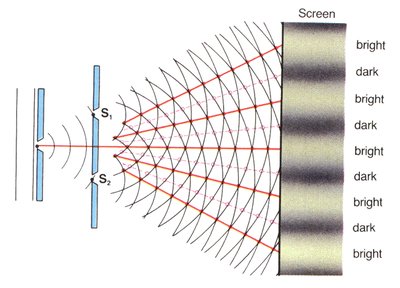
For the double slit experiment, sketch the setup with two slits and the screen. Show the interference pattern (alternating bright and dark regions) and discuss how the probability of hitting certain points changes when one or both slits are open.
Discuss whether a baseball passing through one slit can "know" if the other slit is open, and whether it can be in a state of indefinite position (passing through both slits simultaneously). Relate this to quantum superposition and wave behavior.
Try solving on your own before revealing the answer!
Final Answer:
The sketches should show that for large , the probability pattern is narrow; for small , it is wide due to diffraction. In the double slit experiment, the interference pattern appears only when both slits are open, with zero probability at certain points due to destructive interference. A quantum particle can be in a superposition, allowing it to "pass through both slits" simultaneously, unlike a classical particle.
For the force discussion, a baseball in the shadow region must have experienced a force or acceleration, possibly from interactions at the slit. In quantum mechanics, the wavefunction describes the probability, and the square gives the probability density, not energy.
