Back
BackQuantum Theory: The Photoelectric Effect
Study Guide - Smart Notes
 Tailored notes based on your materials, expanded with key definitions, examples, and context.
Quantum Theory
The Photoelectric Effect
The photoelectric effect is a foundational experiment in quantum physics that demonstrates the particle-like properties of light. It provides evidence for the quantization of electromagnetic radiation and the existence of photons.
Explanation of the Photoelectric Effect
Einstein's Hypothesis: Einstein explained the photoelectric effect by postulating that light consists of discrete packets of energy called photons.
Definition: The photoelectric effect is the emission of electrons (photoelectrons) from a material, typically a metal, when it is exposed to electromagnetic radiation.
Features Unexplained by Classical Physics
The photoelectric effect cannot be explained using classical wave theory of light, which predicts that energy should accumulate gradually and eventually release electrons regardless of light frequency.
Instead, the effect shows that electrons are only emitted if the light frequency exceeds a certain threshold, regardless of intensity.
Photoelectric-Effect Experiment
A typical experiment involves shining light of varying frequency onto a metal surface and measuring the emitted electrons' energy and number.
Key observations include the existence of a threshold frequency and the direct proportionality between photon energy and frequency.
Photon Energy Calculation
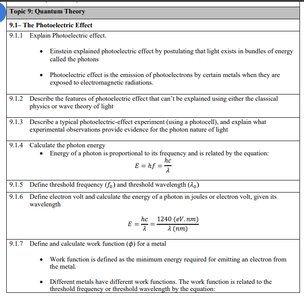
The energy of a photon is proportional to its frequency and is given by:
Where h is Planck's constant and f is the frequency of the light.
Threshold Frequency and Threshold Wavelength
Threshold frequency (f0): The minimum frequency required to emit electrons from a material.
Threshold wavelength (\lambda_0): The maximum wavelength that can cause electron emission.
Photon Energy and Electron Volt Calculation
The energy of a photon in terms of its wavelength is:
Where h is Planck's constant, c is the speed of light, and \lambda is the wavelength.
For practical calculations, the energy in electron volts (eV) can be found using:
(where \lambda is in nm)
Work Function (\phi)
The work function is the minimum energy required to remove an electron from the surface of a material.
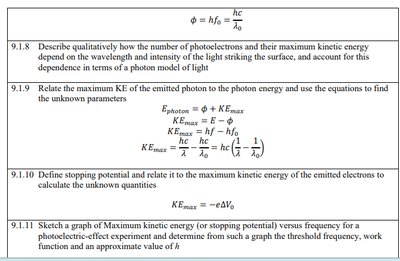
Different materials have different work functions, which are related to the threshold frequency or wavelength by:
Number of Photoelectrons and Maximum Kinetic Energy
The number of photoelectrons emitted and their maximum kinetic energy depend on the wavelength and intensity of the incident light.
Increasing intensity increases the number of emitted electrons, but not their maximum kinetic energy.
Shorter wavelengths (higher frequencies) increase the maximum kinetic energy of the emitted electrons.
Maximum Kinetic Energy of Emitted Electrons
The maximum kinetic energy (KEmax) of photoelectrons is given by:
Stopping Potential
The stopping potential is the voltage required to stop the most energetic photoelectrons from reaching the detector.
It is related to the maximum kinetic energy by:
Where e is the elementary charge and V0 is the stopping potential.
Graphical Analysis
A graph of maximum kinetic energy (or stopping potential) versus frequency for a photoelectric-effect experiment can be used to determine the threshold frequency, work function, and an approximate value of Planck's constant h.