 Back
BackRadioactivity: Activity, Decay, Uses, and Safety
Study Guide - Smart Notes
 Tailored notes based on your materials, expanded with key definitions, examples, and context.
Activity & Decay
Radioactive Sources and Activity
Radioactive materials contain unstable nuclei that spontaneously decay, emitting radiation. The activity of a radioactive source is defined as the rate at which these unstable nuclei decay, measured in becquerels (Bq), where 1 Bq equals one decay per second.
Activity decreases over time as the number of unstable nuclei diminishes.
Radioactive decay is a random process, evidenced by fluctuations in the count rate measured by a Geiger-Muller (GM) tube.
Count rate refers to the number of radioactive emissions detected per unit time, which is not always identical to the activity due to detection efficiency and geometry.

Worked Example: Calculating Decays
Given: Activity = 2000 Bq, Time = 2 minutes (120 seconds)
Number of decays = Activity × Time = 2000 × 120 = 240,000 decays
Examiner Tip: Do not confuse activity (rate of decay) with count rate (rate of detection).
Half-Life
Definition and Measurement
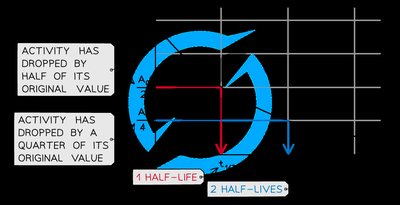
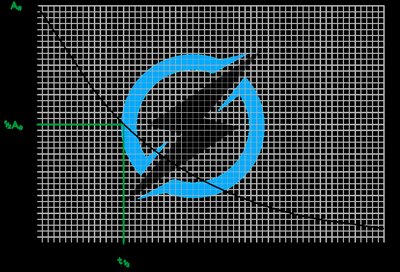
The half-life of a radioactive isotope is the time required for half the nuclei in a sample to decay, or equivalently, for the activity to fall to half its original value. Each isotope has a characteristic half-life, ranging from fractions of a second to billions of years.
Half-life is constant for a given isotope.
After each half-life, the remaining radioactive material is halved.
Graphical Representation and Calculations
Graphs of activity versus time show exponential decay. The time interval for the activity to decrease from 100% to 50% is the half-life, and the same interval applies for subsequent halvings (e.g., 50% to 25%).
After n half-lives, the fraction remaining is .
Number of Half-Lives | Proportion Remaining |
|---|---|
0 | 1 (100%) |
1 | 1/2 (50%) |
2 | 1/4 (25%) |
3 | 1/8 (12.5%) |
4 | 1/16 (6.25%) |

Worked Example: Determining Half-Life from Data
Initial activity: 880 Bq; after 1 year: 220 Bq
880 → 440 (1 half-life), 440 → 220 (2 half-lives)
2 half-lives = 1 year, so 1 half-life = 6 months
Uses of Radioactivity
Applications of Radioactive Isotopes
Radioactivity is used in various fields, with the choice of isotope depending on the type and properties of the radiation emitted.
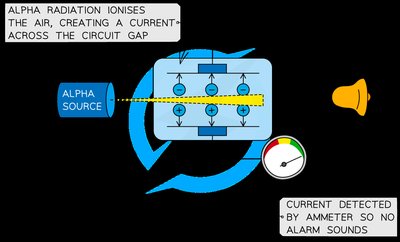
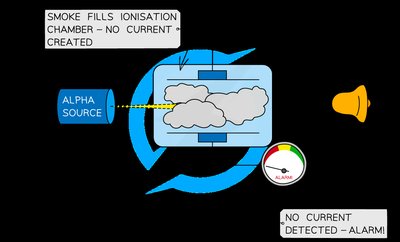
Smoke detectors: Use alpha emitters to ionise air; smoke blocks the alpha particles, triggering the alarm.
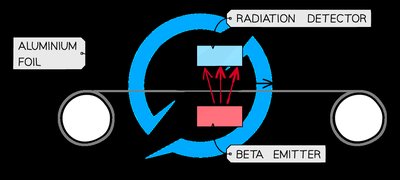
Thickness monitoring: Beta emitters measure the thickness of materials like aluminium foil by detecting how much radiation passes through.
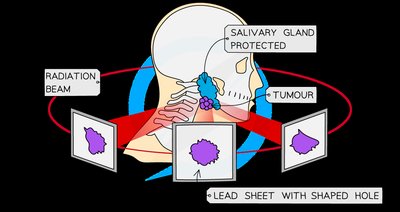
Medical uses: Gamma rays are used for cancer treatment (radiotherapy) and as tracers in diagnostic imaging.
Sterilisation: Gamma rays sterilise medical equipment and food by killing microorganisms.
Archaeology: Radioactive dating (e.g., carbon-14) determines the age of ancient artefacts.

Contamination & Irradiation
Definitions and Differences
Contamination: Accidental transfer of radioactive material onto or into an object, making it a source of radiation.
Irradiation: Exposure of an object to radiation without making it radioactive.
Contamination is dangerous if radioactive material enters the body, while irradiation can be controlled with shielding.
Protection Methods
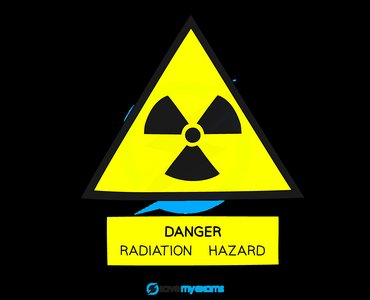
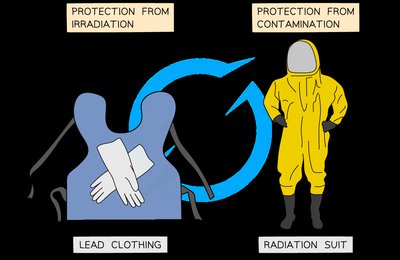
To prevent irradiation: Use lead shielding, keep sources at a distance, and minimise exposure time.
To prevent contamination: Use airtight suits and handle sources safely to avoid direct contact.
Comparison Table: Irradiation vs. Contamination
Irradiation | Contamination | |
|---|---|---|
Description | Exposure to radiation source outside the object | Radioactive material present on or in the object |
Prevention | Shielding (e.g., lead) | Safe handling, airtight suits |
Causes | Deliberate exposure | Accidental transfer |
Risks Based on Half-Life
Irradiation risk: Greater for sources with short half-lives (high activity).
Contamination risk: Greater for sources with long half-lives (remain radioactive longer).
Dangers of Radiation
Biological Effects
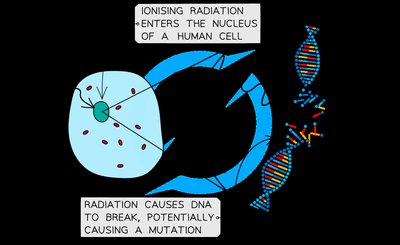
Ionising radiation can damage living cells and DNA, potentially causing mutations and cancer. The risk depends on the type and energy of the radiation, as well as whether the source is inside or outside the body.
Alpha particles: Highly ionising, most dangerous if ingested or inhaled.
Gamma rays: Highly penetrating, most dangerous from external sources.
Safe Handling and Monitoring
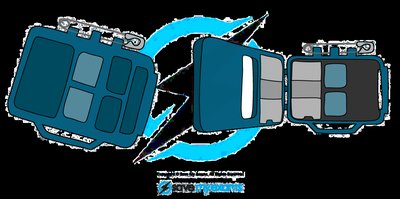
Store sources in lead-lined containers.
Use tongs and wear gloves when handling radioactive materials.
Wear protective clothing and limit exposure time.
Monitor exposure with a dosemeter (radiation badge).
Disposal of Nuclear Waste
Nuclear waste is categorised by the type of radiation emitted and must be stored securely to prevent environmental contamination.
Alpha waste: Stored in plastic or metal canisters.
Beta waste: Stored in metal canisters and concrete silos.
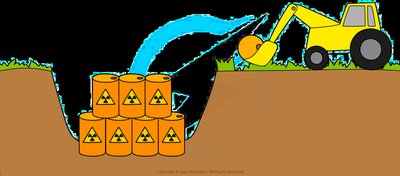
Gamma waste: Requires lead-lined, thick concrete silos and often burial underground in stable locations.
Containers must resist rust and corrosion, and sites must be secure and geologically stable.
Additional info: Radioactive waste can also be diluted in seawater to reduce concentration, but this is subject to strict regulation due to environmental concerns.
