Back
Random Walk Model for Diffusing Molecules
Study Guide - Smart Notes
 Tailored notes based on your materials, expanded with key definitions, examples, and context.
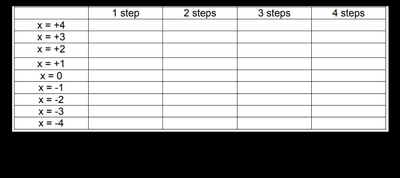
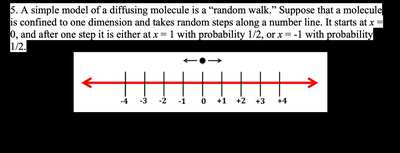
Q5. A simple model of a diffusing molecule is a “random walk.” Suppose that a molecule is confined to one dimension and takes random steps along a number line. It starts at x = 0, and after one step it is either at x = +1 with probability 1/2, or x = -1 with probability 1/2. Complete the table to show the probability of finding the molecule at each position (x = -4 to x = +4) after 1, 2, 3, and 4 steps.
Background
Topic: Statistical Physics / Random Walks
This question explores the concept of a random walk, which is a fundamental model for diffusion and Brownian motion in physics. The random walk describes how a particle moves step by step, with each step being independent and equally likely to go in either direction. This is a key idea in understanding how molecules spread out over time due to random motion.
Key Terms and Formulas
Random Walk: A process where an object moves in steps, each of which is determined randomly.
Probability: The likelihood of the molecule being at a certain position after a given number of steps.
Binomial Distribution: The probability of being at position after steps is given by: where (number of steps to the right), and is the number of steps to the left. This formula is valid only if is even and .
Step-by-Step Guidance
Start by considering the possible positions after each step. After 1 step, the molecule can only be at or .
For each subsequent step, the molecule can move one unit to the left or right from its current position. For example, after 2 steps, possible positions are .
Use the binomial distribution formula to calculate the probability of being at each position after steps. Remember, must be an integer between 0 and .
Fill in the table for each value of and (steps), using the formula above. For positions where is odd or , the probability is zero.
Continue this process for 1, 2, 3, and 4 steps, but stop before calculating the final probabilities for each position. Set up the expressions you would use for each cell in the table.
Try solving on your own before revealing the answer!
Final Answer: Probabilities for Each Position After 1–4 Steps
Here is the completed table with the probabilities for each position after 1, 2, 3, and 4 steps:
Position | 1 step | 2 steps | 3 steps | 4 steps |
|---|---|---|---|---|
x = +4 | 0 | 0 | 0 | 1/16 |
x = +3 | 0 | 0 | 1/8 | 0 |
x = +2 | 0 | 1/4 | 0 | 1/4 |
x = +1 | 1/2 | 0 | 3/8 | 0 |
x = 0 | 0 | 1/2 | 0 | 3/8 |
x = -1 | 1/2 | 0 | 3/8 | 0 |
x = -2 | 0 | 1/4 | 0 | 1/4 |
x = -3 | 0 | 0 | 1/8 | 0 |
x = -4 | 0 | 0 | 0 | 1/16 |
These probabilities are calculated using the binomial distribution formula for a symmetric random walk. For example, after 4 steps, the probability of being at is .