 Back
BackRay Optics and Image Formation: Study Notes
Study Guide - Smart Notes
 Tailored notes based on your materials, expanded with key definitions, examples, and context.
Ray Optics and Image Formation
The Ray Model of Light
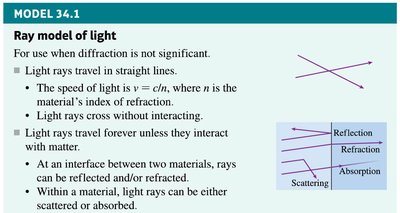
The ray model of light is a foundational concept in geometric optics, describing light as traveling in straight lines called rays. This model is valid when diffraction effects are negligible, typically when apertures and obstacles are much larger than the wavelength of light.
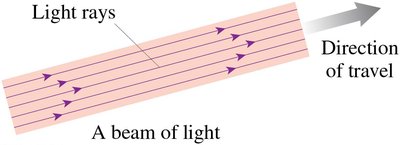
Light Ray: A line indicating the direction along which light energy propagates. A narrow beam, such as a laser, consists of many parallel light rays. A single light ray is the limiting case as the beam diameter approaches zero.
Speed of Light: In a medium with index of refraction n, the speed of light is given by , where c is the speed of light in vacuum.
Light Ray Behavior: Light rays travel in straight lines and cross without interacting unless they encounter matter, where they may be reflected, refracted, scattered, or absorbed.
Objects as Sources of Light Rays
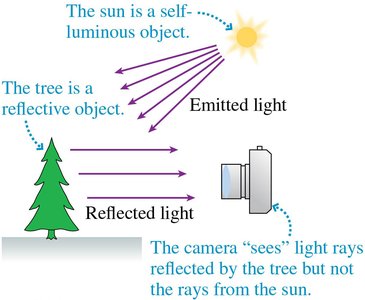
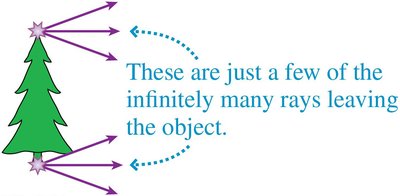
Every object is a source of light rays, either by emitting its own light (self-luminous) or by reflecting light from other sources. Rays originate from every point on an object and travel in all directions.
Self-Luminous Objects: Emit their own light (e.g., the sun, flames, lightbulbs).
Reflective Objects: Most objects reflect light from other sources.
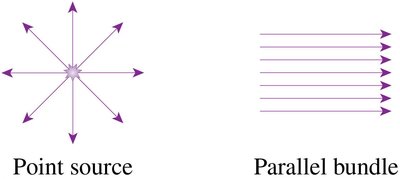
Point Source vs. Parallel Bundle: A point source emits rays in all directions, while a parallel bundle (e.g., a distant laser) consists of rays traveling parallel to each other.
Ray Diagrams and Image Formation
Ray diagrams are simplified representations showing only a few rays to illustrate how images are formed by optical systems. Each point on an object emits rays in all directions, but only a subset is typically drawn for clarity.
Apertures and the Camera Obscura
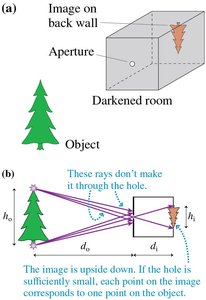
An aperture is a small opening through which light passes. The camera obscura is a darkened room with a small hole (aperture) that projects an inverted image of an object onto the opposite wall. The relationship between object and image heights and distances is:
Reflection of Light
Reflection occurs when light bounces off a surface. There are two main types:
Specular Reflection: Occurs on smooth, flat surfaces (e.g., mirrors), where reflected rays remain orderly.
Diffuse Reflection: Occurs on rough surfaces, scattering light in many directions.

Law of Reflection
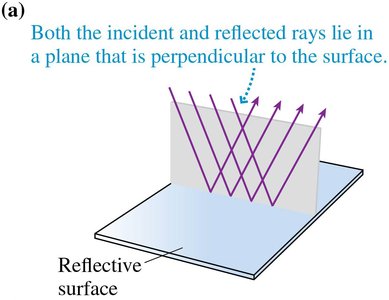
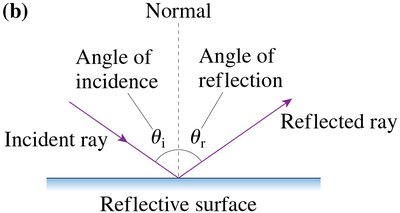
The incident ray, reflected ray, and the normal to the surface all lie in the same plane.
The angle of incidence equals the angle of reflection:
Plane Mirrors and Image Formation
Plane mirrors create virtual images that appear to be the same distance behind the mirror as the object is in front. The image is upright and laterally inverted.
Object distance and image distance are related by .


Minimum Mirror Height for Full Image
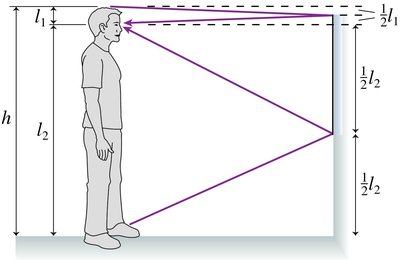
To see your full image in a plane mirror, the minimum mirror height required is half your height, and the top of the mirror should be positioned midway between your eyes and the top of your head.
Summary Table: Types of Reflection
Type | Surface | Ray Behavior |
|---|---|---|
Specular | Smooth, flat | Rays reflect in one direction |
Diffuse | Rough, irregular | Rays scatter in many directions |
Key Equations
Law of Reflection:
Speed of Light in Medium:
Camera Obscura (Aperture) Relation:
Additional info: The ray model is valid when apertures and obstacles are much larger than the wavelength of light (typically >1 mm). For smaller apertures, wave optics and diffraction become significant.
