 Back
BackRay Optics and Refraction: Step-by-Step Physics Guidance
Study Guide - Smart Notes
 Tailored notes based on your materials, expanded with key definitions, examples, and context.
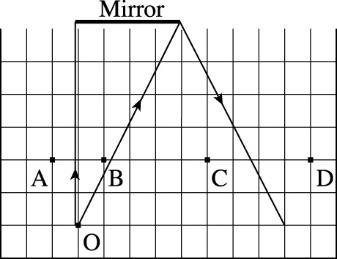
Q1. From which locations (A–D) is the image of object O visible in the plane mirror?
Background
Topic: Reflection and Ray Optics
This question tests your understanding of how light rays reflect from a plane mirror and how the law of reflection determines visibility of an object's image from different positions.
Key Terms and Formulas:
Law of Reflection: The angle of incidence equals the angle of reflection ().
Ray Diagram: Used to trace the path of light from the object to the observer via the mirror.
Step-by-Step Guidance
Draw rays from object O to the ends of the mirror. These rays represent the extreme paths that light can take to reach the mirror and then reflect toward possible observer locations.
Apply the law of reflection at the mirror: For each ray, ensure the angle of incidence equals the angle of reflection.
Identify the region between the two reflected rays. Only observers located within this region (between the rays) will be able to see the image of O in the mirror.
Check which labeled locations (A, B, C, D) fall within this region. Consider whether the mirror is long enough for rays to reach all points.
Try solving on your own before revealing the answer!
Final Answer: The image of object O is visible from locations B and C.
Locations A and D are outside the region defined by the reflected rays, so the image cannot be seen from those points.
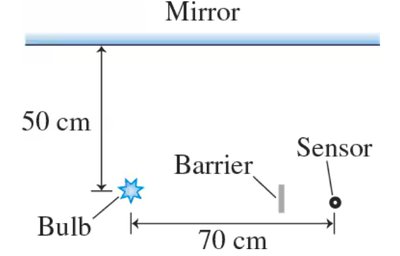
Q2. What is the light intensity at the sensor, given a 1.5 W bulb 50 cm from a mirror and a sensor 70 cm to the right, with a barrier blocking direct rays?
Background
Topic: Reflection and Light Intensity
This question tests your ability to calculate the intensity of light at a point after it reflects from a mirror, considering the geometry and the spreading of light.
Key Terms and Formulas:
Intensity (): Power per unit area,
Power (): The energy per second emitted by the bulb (in watts).
Distance (): The total path length from the bulb to the sensor via the mirror.
Step-by-Step Guidance
Determine the path the light takes: From the bulb to the mirror, then from the mirror to the sensor. Add these distances to find the total path length ().
Calculate the total distance: meters, or use the geometry provided to find the exact value.
Use the formula for intensity: , where W and is the total path length.
Plug in the values for and (in meters) to set up the calculation for intensity at the sensor.
Try solving on your own before revealing the answer!
Final Answer: W/m2
Using , the intensity at the sensor is approximately W/m2.
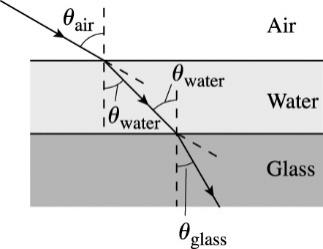
Q3. A light ray in air is incident on water at 60° from the normal, then passes through a 1.0-cm-thick layer of water and enters glass. What is the ray’s angle from the normal in the glass?
Background
Topic: Refraction and Snell’s Law
This question tests your ability to apply Snell’s law at multiple interfaces to determine how a light ray bends as it passes through different media.
Key Terms and Formulas:
Snell’s Law:
Index of Refraction (): A measure of how much light slows down in a medium.
Angle from Normal (): The angle between the light ray and the perpendicular to the surface.
Step-by-Step Guidance
Apply Snell’s law at the air–water interface: .
Solve for using the known values for , , and .
Apply Snell’s law again at the water–glass interface: .
Solve for using the value of found in the previous step.
Try solving on your own before revealing the answer!
Final Answer: The ray’s angle from the normal in glass is approximately 35°.
After applying Snell’s law at both interfaces, the angle in glass is smaller than in air, as expected due to the higher index of refraction.
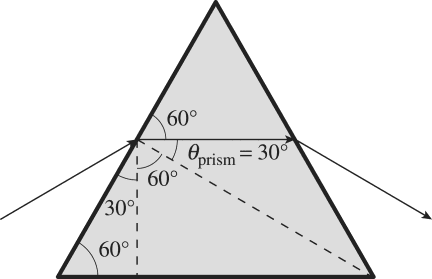
Q4. A ray of light enters an equilateral prism at 40° from the normal and emerges at the same angle. What is the index of refraction of the prism?
Background
Topic: Refraction and Prism Geometry
This question tests your ability to use Snell’s law and geometric reasoning to find the index of refraction for a prism.
Key Terms and Formulas:
Snell’s Law:
Prism Geometry: For an equilateral prism, the internal angles are 60°, and the ray inside is parallel to the base.
Step-by-Step Guidance
Identify the angle of incidence in air () and the angle inside the prism () using the geometry of the prism.
Apply Snell’s law at the air–prism interface: .
Plug in the values for , , and (from the diagram).
Rearrange the equation to solve for .
Try solving on your own before revealing the answer!
Final Answer: The index of refraction of the prism is approximately 1.5.
This value is typical for glass and matches the geometric setup of the prism.
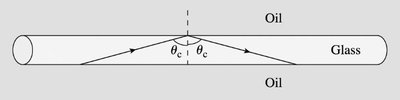
Q5. What is the critical angle for light traveling inside a thin glass rod submerged in oil?
Background
Topic: Total Internal Reflection and Critical Angle
This question tests your understanding of the conditions for total internal reflection and how to calculate the critical angle using indices of refraction.
Key Terms and Formulas:
Critical Angle (): The minimum angle of incidence for total internal reflection.
Formula: , where is the index of the glass and is the index of oil.
Step-by-Step Guidance
Identify the indices of refraction: , (from the table or problem statement).
Set up the formula for the critical angle: .
Plug in the values for and .
Calculate by taking the inverse sine of the result.
Try solving on your own before revealing the answer!
Final Answer: The critical angle is approximately 76.7°.
This is the angle above which total internal reflection occurs for light inside the glass rod.
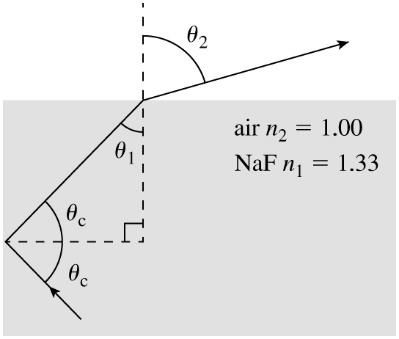
Q6. A light ray travels inside a block of sodium fluoride (n=1.33), strikes the vertical wall at the critical angle, totally reflects, and then emerges into air. What is the angle θ2 at which the ray emerges?
Background
Topic: Total Internal Reflection and Refraction
This question tests your ability to use geometry and Snell’s law to find the exit angle of a ray after total internal reflection and refraction.
Key Terms and Formulas:
Critical Angle ():
Snell’s Law:
Step-by-Step Guidance
Calculate the critical angle for NaF to air: .
Use geometry to find the angle for the ray inside the block after reflection: .
Apply Snell’s law at the NaF–air interface: .
Solve for using the value of found in the previous step.
Try solving on your own before revealing the answer!
Final Answer: The ray emerges at an angle of approximately 61.3°.
This is the angle from the normal at which the ray exits into air after total internal reflection and refraction.
