 Back
BackRay Optics: Reflection, Refraction, and Image Formation
Study Guide - Smart Notes
 Tailored notes based on your materials, expanded with key definitions, examples, and context.
Ray Optics
Introduction to Ray Optics
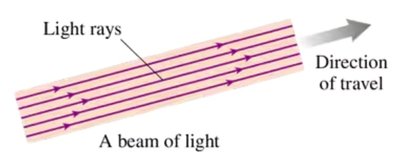
Ray optics, also known as geometric optics, is a model of light that describes the propagation of light as straight lines called rays. This model is particularly useful for understanding the behavior of light in mirrors, lenses, and optical instruments, especially when the dimensions of obstacles and apertures are much larger than the wavelength of light.
Ray Model of Light: Light travels in straight lines and can be represented by rays indicating the direction of energy flow.
Wave Model of Light: Light exhibits wave-like properties such as interference and diffraction, but these are negligible in the ray model for large-scale objects.
Particle/Photon Model: Light can also be described as particles (photons), important for quantum phenomena but not the focus here.
Light Rays and Objects
Nature of Light Rays
Light rays are conceptual lines that indicate the direction in which light energy is propagating. They are not physical entities but are useful for analyzing optical systems.
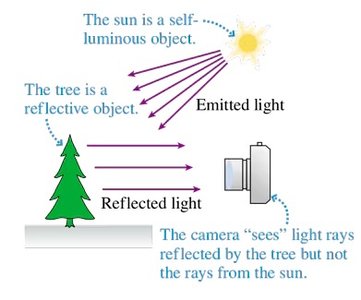
Self-luminous objects: Emit their own light (e.g., the sun).
Reflective objects: Reflect light from other sources (e.g., a tree).
Light rays travel in straight lines until they interact with matter.
Only rays entering the eye or a camera are seen or recorded, but many more rays exist.
Ray Diagrams and Image Formation
Drawing Ray Diagrams
Ray diagrams are graphical tools used to analyze the paths of light rays as they interact with optical elements such as mirrors and apertures. They help in understanding image formation and the behavior of light in optical systems.
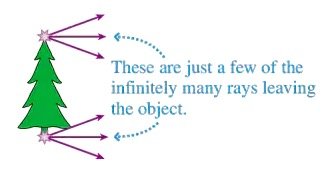
Rays are typically drawn from the top and bottom of objects to analyze image formation.
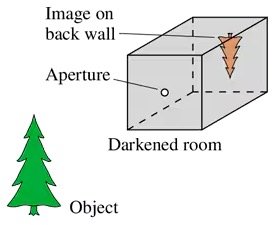
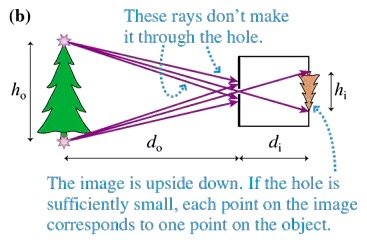
Ray diagrams are especially useful for devices like the camera obscura, which forms inverted images through a small aperture.
Magnification in Ray Diagrams
The size of the image formed by an aperture can be related to the object size and distances using the magnification formula:
Let be the distance from the object to the aperture, the distance from the image to the aperture, the object height, and the image height.
Reflection of Light
Specular and Diffuse Reflection
Reflection occurs when light bounces off a surface. There are two main types:
Specular reflection: Occurs on smooth surfaces like mirrors, producing clear images.
Diffuse reflection: Occurs on rough surfaces, scattering light in many directions.
Law of Reflection
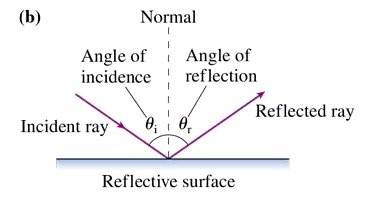
The law of reflection governs how light reflects from a surface:
The incident ray, reflected ray, and the normal (perpendicular to the surface) all lie in the same plane.
The angle of incidence () equals the angle of reflection ():
Plane Mirrors and Virtual Images
Image Formation by Plane Mirrors
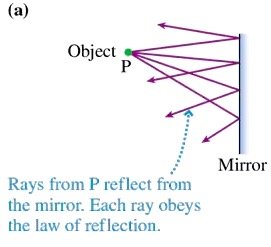
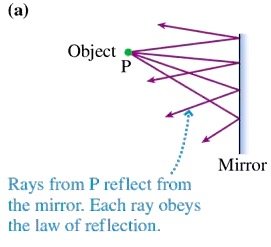
When an object is placed in front of a plane mirror, the reflected rays appear to originate from a point behind the mirror, forming a virtual image.
Each point on the object reflects off a different point on the mirror.
The virtual image appears as far behind the mirror as the object is in front.
Refraction of Light
Refraction at Media Boundaries
Refraction is the bending of light as it passes from one medium to another with a different refractive index. This occurs because the speed of light changes in different media.
The incident ray is the ray before it hits the boundary; the refracted ray is after transmission.
Angles are measured relative to the normal to the surface.
Snell's Law
Snell's Law quantitatively describes refraction:
, are the indices of refraction of the two media.
, are the angles of incidence and refraction, respectively.
Index of Refraction and Speed of Light
The index of refraction is defined as:
is the speed of light in vacuum, is the speed of light in the medium.
For all media other than vacuum, .
Wavelength and Frequency in Refraction
When light enters a new medium, its speed and wavelength change, but its frequency remains constant:
(speed = wavelength × frequency)
Since is constant, changes as changes.
Total Internal Reflection (TIR)
Conditions for TIR
Total internal reflection occurs when light attempts to move from a medium with higher refractive index to one with lower refractive index at an angle greater than the critical angle. No refraction occurs; all light is reflected back into the original medium.
TIR only occurs for .
The critical angle is given by:
If , TIR occurs.
Applications of TIR
Fibre Optics: Light is guided through optical fibers by repeated total internal reflection, allowing efficient transmission of signals over long distances.
Summary Table: Key Laws and Equations
Phenomenon | Key Law/Equation | Description |
|---|---|---|
Reflection | Angle of incidence equals angle of reflection | |
Refraction (Snell's Law) | Describes bending of light at a boundary | |
Index of Refraction | Ratio of speed of light in vacuum to that in medium | |
Critical Angle for TIR | Minimum angle for total internal reflection | |
Magnification (Aperture) | Relates image and object sizes and distances |
Conclusion
Ray optics provides a powerful framework for understanding the behavior of light in everyday optical systems, including mirrors, lenses, and fiber optics. Mastery of the laws of reflection, refraction, and total internal reflection is essential for analyzing and designing optical devices.
