 Back
BackRay Optics: Reflection, Refraction, Mirrors, and Lenses
Study Guide - Smart Notes
 Tailored notes based on your materials, expanded with key definitions, examples, and context.
Introduction to Light and Optics
Nature of Light
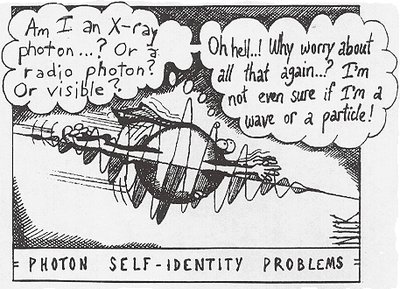
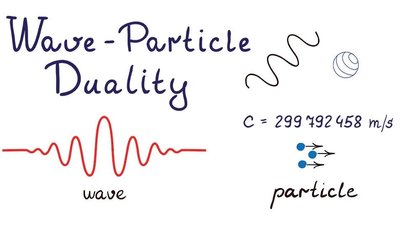
Light is a fundamental phenomenon in physics, exhibiting both wave-like and particle-like properties. The study of light and its interactions with matter is known as optics. There are several models to describe light:
Geometric Optics: Treats light as rays that travel in straight lines and bend at interfaces between different media.
Wave Optics: Describes light as an electromagnetic wave, explaining phenomena such as interference and diffraction.
Modern (Quantum) Optics: Recognizes light as consisting of particles called photons, incorporating both wave and particle aspects.
Visible light is a small part of the electromagnetic spectrum, with wavelengths from 400 nm (violet) to 700 nm (red).
Reflection and Refraction
Reflection
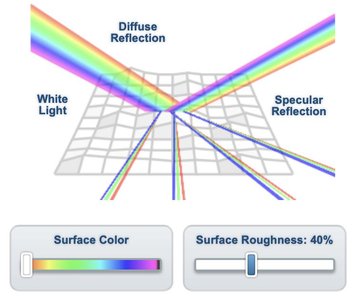
When light strikes a surface, it may be reflected, transmitted, or absorbed. Reflection can be:
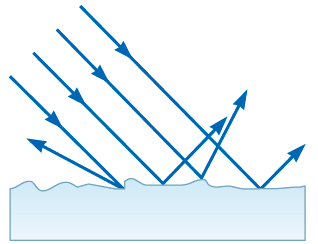
Specular Reflection: Occurs on smooth surfaces, where reflected rays remain parallel, like a mirror.
Diffuse Reflection: Occurs on rough surfaces, scattering light in many directions.
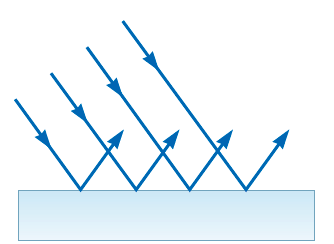
The law of reflection states that the angle of incidence equals the angle of reflection, both measured from the normal to the surface:
Refraction
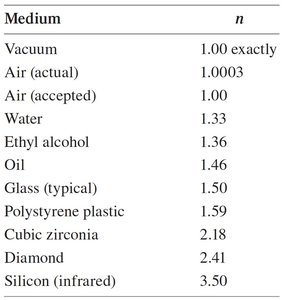
Refraction is the bending of light as it passes from one medium to another due to a change in speed. The index of refraction of a material is defined as:
where is the speed of light in vacuum and is the speed of light in the medium. The index of refraction is always .
The relationship between the angles and indices of refraction is given by Snell's Law:
where is the angle of incidence and is the angle of refraction.
Total Internal Reflection and Fiber Optics
Total Internal Reflection
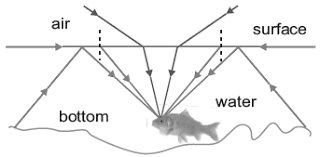
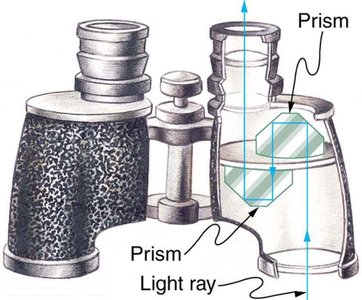
Total internal reflection occurs when light attempts to move from a medium with higher refractive index to one with lower refractive index at an angle greater than the critical angle :
where . For , all light is reflected back into the denser medium.
Condition 1: Light must travel from a denser to a rarer medium ().
Condition 2: Angle of incidence must be greater than the critical angle.
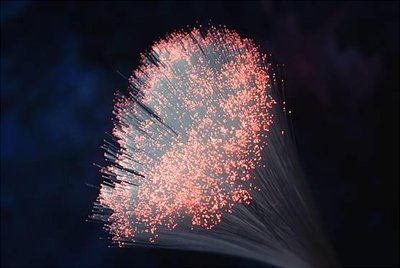
This principle is used in fiber optics to transmit light over long distances with minimal loss.
Dispersion
Wavelength Dependence of Refraction
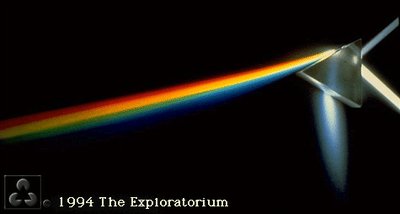
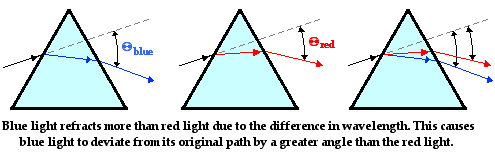
The index of refraction of a material depends on the wavelength (color) of light. This phenomenon is called dispersion. Shorter wavelengths (blue light) are refracted more than longer wavelengths (red light), leading to the separation of white light into its constituent colors when passing through a prism.
Plane Mirrors
Image Formation by Plane Mirrors
A plane mirror forms an image that is:
Upright
Virtual (cannot be projected onto a screen)
Same size as the object
Reversed front-to-back
The object distance and image distance are related by:
The magnification is:
where and are the object and image heights, respectively.
Spherical Mirrors
Concave and Convex Mirrors
Spherical mirrors are sections of a sphere and can be either concave (converging) or convex (diverging). Important terms:
Center of Curvature (C): Center of the sphere from which the mirror is cut.
Radius of Curvature (R): Distance from the vertex to the center of curvature.
Focal Point (F): Point where parallel rays converge (concave) or appear to diverge from (convex).
Focal Length (f):

Mirror Equations and Ray Diagrams
The mirror equation relates object distance , image distance , and focal length :
The magnification is:
Sign conventions are crucial for solving mirror problems:
Positive for concave, negative for convex mirrors.
Positive for real images, negative for virtual images.
Refraction at Spherical Surfaces
Image Formation by Refraction
When light passes through a spherical surface separating two media, the image and object positions are related by:
where and are the indices of refraction, and are the object and image distances, and is the radius of curvature.
The magnification is:
Thin Lenses
Types of Lenses
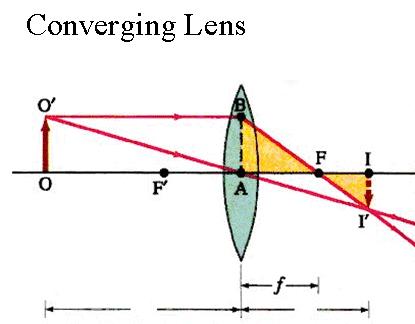
Converging (Convex) Lenses: Thicker at the center, focus parallel rays to a point.
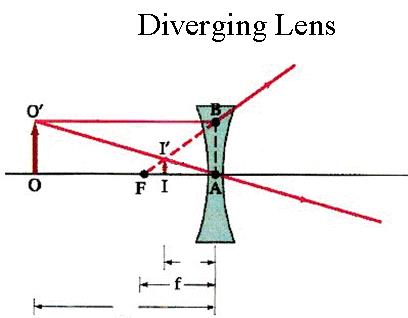
Diverging (Concave) Lenses: Thicker at the edges, cause parallel rays to diverge as if from a point.
The lensmaker's equation for a thin lens in air is:
where and are the radii of curvature of the two surfaces, and is the refractive index of the lens material.
Lens Equation and Magnification
The lens equation is:
The magnification is:
Sign conventions are similar to those for mirrors.
Summary Tables
Image Formation for Mirrors
Type | Focal length | Object distance | Image distance | Character | Orientation | Size |
|---|---|---|---|---|---|---|
Plane | Virtual | Upright | Same | |||
Concave | Real | Inverted | Reduced | |||
Concave | Real | Inverted | Enlarged | |||
Concave | Virtual | Upright | Enlarged | |||
Convex | Virtual | Upright | Reduced |
Image Formation for Lenses
Type | Focal length | Object distance | Image distance | Character | Orientation | Size |
|---|---|---|---|---|---|---|
Converging | Real | Inverted | Reduced | |||
Converging | Real | Inverted | Enlarged | |||
Converging | Virtual | Upright | Enlarged | |||
Diverging | Virtual | Upright | Reduced |
Applications
Fiber optics: Use total internal reflection for communication.
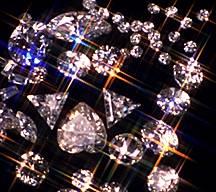
Diamonds: High refractive index leads to brilliance due to multiple internal reflections.
Mirrors and lenses: Used in telescopes, microscopes, cameras, and corrective optics.
