 Back
BackRay Tracing and Thin Lens/Mirror Equations – Guided Study Notes
Study Guide - Smart Notes
 Tailored notes based on your materials, expanded with key definitions, examples, and context.
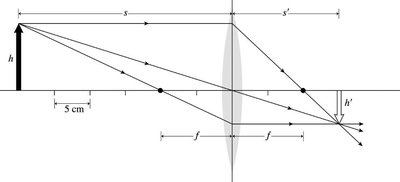
Q1. An object is 30 cm in front of a converging lens with a focal length of 10 cm. Use ray tracing to determine the location of the image. Is the image upright or inverted? Is it real or virtual?
Background
Topic: Geometric Optics – Ray Tracing with Thin Lenses
This question tests your understanding of how to use ray tracing to locate the image formed by a converging (convex) lens, and how to determine the nature (real/virtual, upright/inverted) of the image.
Key Terms and Formulas:
Converging lens: A lens that brings parallel rays of light to a focus.
Focal length (f): The distance from the lens to the focal point.
Object distance (s): The distance from the object to the lens.
Image distance (s'): The distance from the image to the lens.
Ray tracing: Drawing principal rays to locate the image.
Step-by-Step Guidance
Draw the principal axis, the lens, and mark the focal points (f) on both sides of the lens. Place the object 30 cm from the lens.
Draw the three principal rays from the top of the object: 1. A ray parallel to the axis, refracted through the far focal point. 2. A ray through the center of the lens (continues straight). 3. A ray through the near focal point, refracted parallel to the axis.
Identify where the refracted rays converge on the other side of the lens. This is the image location.
Determine the orientation (upright/inverted) and type (real/virtual) of the image based on the ray diagram.
Try solving on your own before revealing the answer!
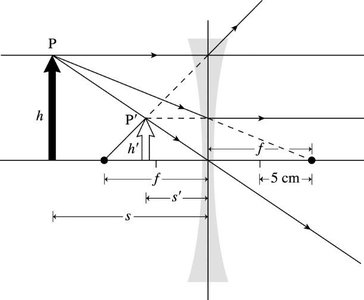
Q2. An object is 15 cm in front of a diverging lens with a focal length of −10 cm. Use ray tracing to determine the location of the image. Is the image upright or inverted? Is it real or virtual?
Background
Topic: Geometric Optics – Ray Tracing with Diverging Lenses
This question tests your ability to use ray tracing to find the image formed by a diverging (concave) lens and to classify the image.
Key Terms and Formulas:
Diverging lens: A lens that spreads parallel rays apart.
Focal length (f): Negative for diverging lenses.
Ray tracing: Drawing principal rays to locate the image.
Step-by-Step Guidance
Draw the principal axis, the lens, and mark the focal points (f) on both sides. Place the object 15 cm from the lens.
Draw the three principal rays from the top of the object: 1. A ray parallel to the axis, refracted as if it came from the near focal point. 2. A ray heading toward the far focal point, refracted parallel to the axis. 3. A ray through the center of the lens (continues straight).
Extend the refracted rays backward to find where they appear to originate. This is the image location.
Determine the orientation and type of the image based on the ray diagram.
Try solving on your own before revealing the answer!
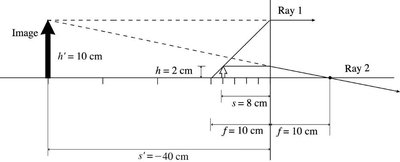
Q3. A 2.0-cm-tall object is located 8.0 cm in front of a converging lens with a focal length of 10 cm. Use ray tracing to determine the location and height of the image. Is the image upright or inverted? Is it real or virtual?
Background
Topic: Geometric Optics – Ray Tracing and Image Properties
This question asks you to use ray tracing to find both the position and size of the image formed by a converging lens, and to determine its orientation and type.
Key Terms and Formulas:
Ray tracing: Drawing at least two principal rays to locate the image.
Magnification (m):
Step-by-Step Guidance
Draw the lens, principal axis, and mark the focal points (10 cm from the lens on both sides). Place the object 8.0 cm from the lens.
Draw two principal rays from the top of the object: 1. Parallel to the axis, refracted through the far focal point. 2. Through the center of the lens (straight line).
Extend the refracted rays to see where they appear to converge (or diverge from). This is the image location.
Measure the image height from the diagram and compare it to the object height to determine magnification and orientation.
Try solving on your own before revealing the answer!
