 Back
BackRC Circuits and Introduction to Magnetism
Study Guide - Smart Notes
 Tailored notes based on your materials, expanded with key definitions, examples, and context.
RC Circuits
Introduction to RC Circuits
An RC circuit consists of a resistor (R) and a capacitor (C) connected in series with a source of electromotive force (emf). These circuits are fundamental in understanding how capacitors charge and discharge over time, and are widely used in timing and filtering applications.
Resistor (R): Limits the current in the circuit.
Capacitor (C): Stores electrical energy in the form of an electric field.
emf (Electromotive Force): Provides the voltage that drives current through the circuit.
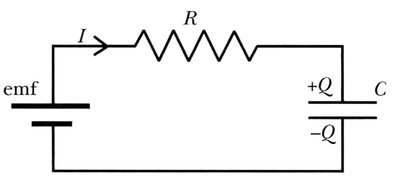
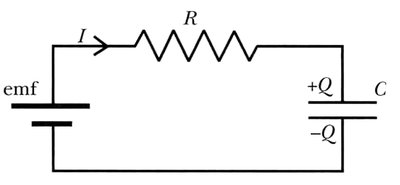
Charging a Capacitor in an RC Circuit
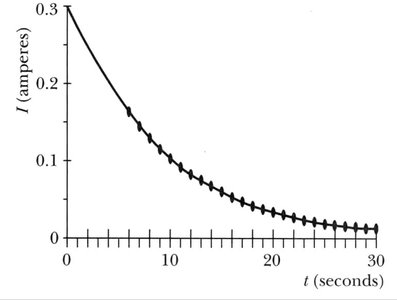
When the circuit is first closed, the capacitor begins to charge. The current and charge on the capacitor change with time according to exponential laws.
Current as a function of time:
Charge on the capacitor as a function of time:
Voltage across the capacitor:
Time constant (\( \tau = RC \)): The time required for the charge (or current) to change significantly (about 63% of the way to its final value).
Key Properties and Behavior
At t = 0: The current is maximum, and the charge on the capacitor is zero.
As t → ∞: The current approaches zero, and the charge on the capacitor approaches its maximum value, \( Q = C \cdot \text{emf} \).
The current and voltage change exponentially, not linearly.
Introduction to Magnetism
Historical Background
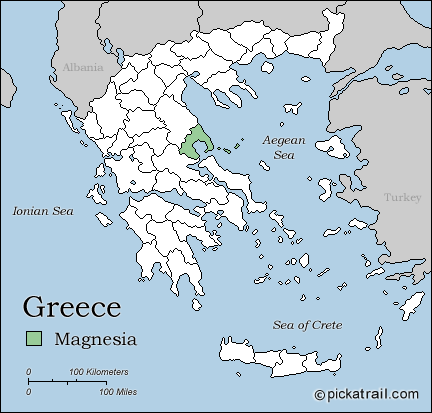
The study of magnetism dates back to ancient times, with the discovery of naturally magnetized rocks called lodestones in the region of Magnesia, Greece. Magnetism was initially considered separate from electricity, but is now unified under the theory of electromagnetism.

Magnetic Poles and Dipoles
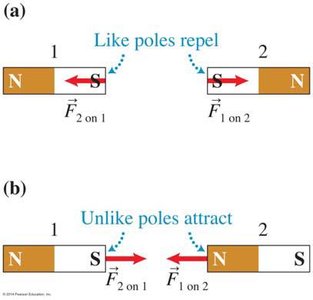
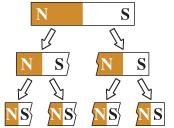
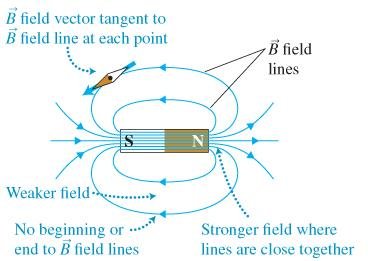
Magnets always have two poles: a north and a south pole. Like poles repel, and unlike poles attract. If a magnet is broken, each piece forms a new dipole with both a north and south pole.
Magnetic monopoles have not been observed in nature.
Magnetic Fields
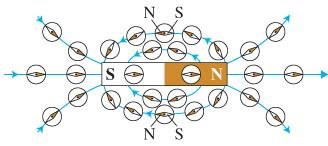
A magnetic field (denoted \( \vec{B} \)) is a region where a magnetic force can be detected. The SI unit for magnetic field strength is the Tesla (T).
Magnetic field lines emerge from the north pole and enter the south pole of a magnet.
Field lines are continuous and never cross.

Magnetic Field Strength: Typical Values
Magnetic field strengths vary widely in nature and technology.
Source | Typical B field (Tesla) |
|---|---|
Interstellar magnetic field | |
Earth's magnetic field | |
Fridge magnet | |
Electromagnet | |
Rare earth magnet | 1 |
Magnetic Resonance Imaging (MRI) machine | 2 |
Superconducting magnets | 10 |
Neutron star |
Earth as a Magnet
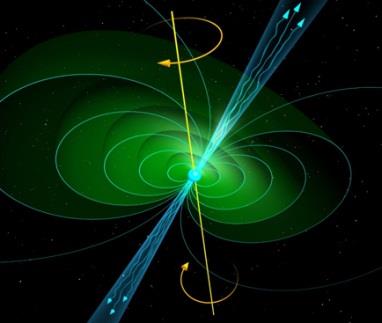
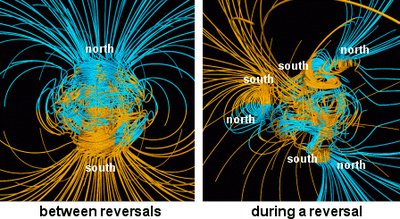
The Earth acts as a giant magnet, with its magnetic south pole near the geographic north pole. The Earth's magnetic field is generated by electric currents in its liquid iron core.
The geomagnetic poles wander over time and can even reverse, causing significant environmental changes.
Connection Between Electricity and Magnetism
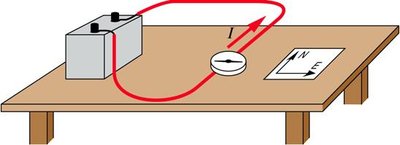
Electric currents produce magnetic fields. This was first observed by Hans Christian Ørsted in 1820, who noticed that a compass needle was deflected by a nearby electric current.
Magnetic Field Produced by a Current
The magnetic field around a straight current-carrying wire is given by:
\( \mu_0 \) is the permeability of free space:
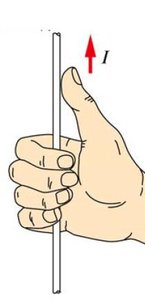
The direction of the field is given by the right-hand rule.
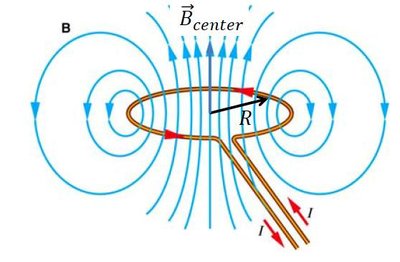
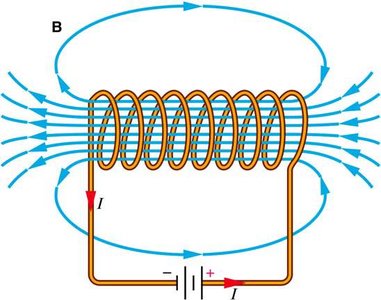
Magnetic Field of a Current Loop and Solenoid
At the center of a circular loop of radius R:
For N loops:
Inside a long solenoid (length L, N turns):
Magnetic Force on a Moving Charge
A charge q moving with velocity \( \vec{v} \) in a magnetic field \( \vec{B} \) experiences a force:
The direction of the force is perpendicular to both \( \vec{v} \) and \( \vec{B} \), determined by the right-hand rule.
The magnitude is where \( \theta \) is the angle between \( \vec{v} \) and \( \vec{B} \).
Comparison: Electric vs. Magnetic Forces
Electric force: (acts in the direction of the electric field)
Magnetic force: (acts perpendicular to both velocity and field)
Lorentz force: (total force in presence of both fields)
Example: A proton moving through a magnetic field will experience a force perpendicular to both its velocity and the field direction, causing it to move in a circular or helical path.
Additional info: The study of RC circuits and magnetism forms the foundation for understanding more advanced topics in electromagnetism, electronics, and modern physics.
