 Back
BackRC Circuits and Magnetism: Fundamentals and Applications
Study Guide - Smart Notes
 Tailored notes based on your materials, expanded with key definitions, examples, and context.
RC Circuits
Introduction to RC Circuits
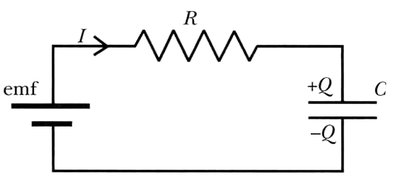
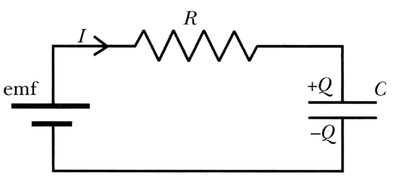
An RC circuit consists of a resistor (R) and a capacitor (C) connected in series with a source of electromotive force (emf). These circuits are fundamental in understanding how capacitors charge and discharge through resistors, which is essential in timing and filtering applications in electronics.
Charging a Capacitor in an RC Circuit
Initial Condition: At time t = 0, the capacitor is uncharged (Q = 0), and the current is at its maximum value.
Kirchhoff's Loop Rule: The sum of the potential differences around the loop is zero:
Differential Equation: The current and charge change with time, leading to the equation:
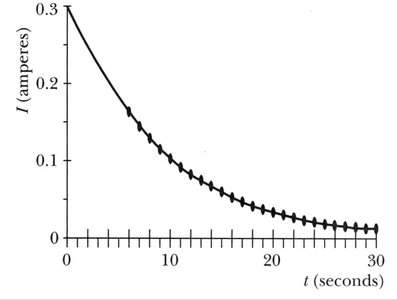
Solution for Current: , where is the initial current.
Solution for Charge:
Solution for Voltage across Capacitor:
Time Constant (\tau): is the time required for the current to decrease to of its initial value or for the charge to reach about 63% of its final value.
Graphical Analysis
Current Decay: The current decreases exponentially as the capacitor charges.
Charge Growth: The charge on the capacitor increases asymptotically toward its maximum value .
Magnetism
Historical Background
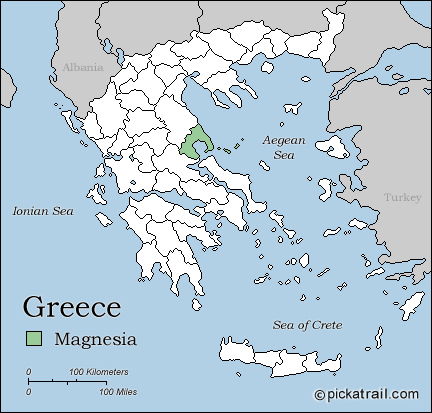
The study of magnetism began with the discovery of naturally magnetized rocks called lodestones in the region of Magnesia, Greece. Magnetism was crucial for early navigation and is now unified with electricity under electromagnetism.

Magnetic Poles and Interactions
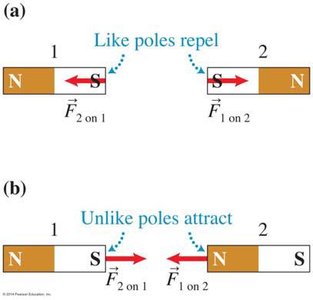
Poles: Every magnet has a north and a south pole (magnetic dipole). Like poles repel; unlike poles attract.
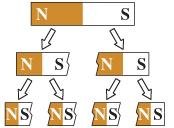
Magnetic Monopoles: No isolated magnetic monopoles have been found in nature; breaking a magnet always results in two dipoles.
Magnetic Fields
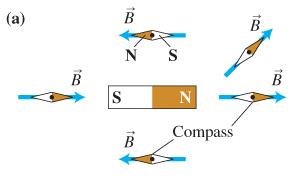
Definition: A magnetic field (\(\vec{B}\)) is a region where a magnetic force can be detected. It is produced by magnets and moving charges.
SI Unit: Tesla (T); 1 T = 10,000 Gauss.

Magnetic Field Strengths
Magnetic field strengths vary widely in nature and technology:
Source | Typical B field (Tesla) |
|---|---|
Interstellar magnetic field | |
Earth's magnetic field | |
Fridge magnet | |
Electromagnet | |
Rare earth magnet | 1 |
Magnetic Resonance Imaging (MRI) machine | 2 |
Superconducting magnets | 10 |
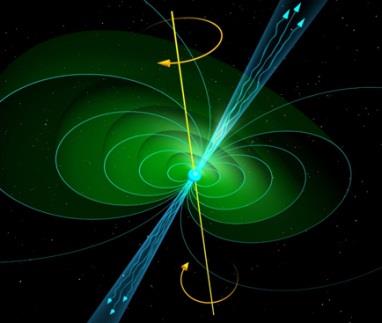
Neutron star |
Magnetic Field Lines
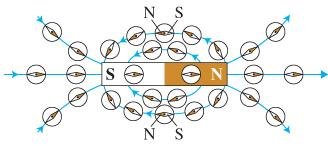
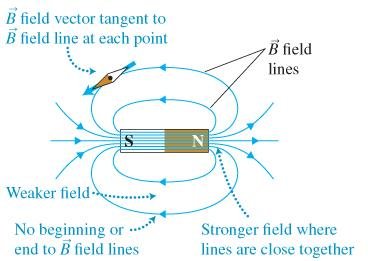
Direction: Field lines exit the north pole and enter the south pole outside the magnet.
Properties: Field lines are continuous loops and never cross.
Strength: The field is stronger where lines are closer together.
Earth as a Magnet
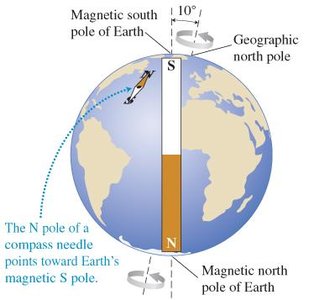
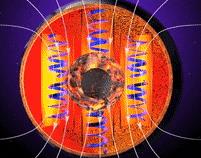
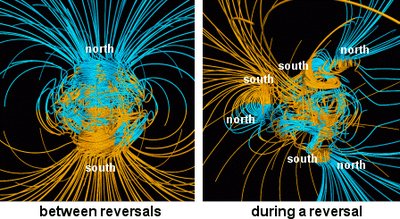
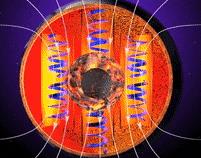
Earth's Magnetic Field: The Earth acts as a giant magnet due to electric currents in its liquid outer core.
Magnetic Poles: The magnetic south pole is near the geographic north pole and vice versa.
Geomagnetic Reversals: Earth's magnetic field reverses polarity over geological timescales, affecting life and navigation.
Magnetism from Electricity
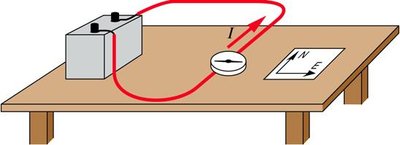
Oersted's Experiment: A current-carrying wire deflects a nearby compass needle, demonstrating that electric currents produce magnetic fields.
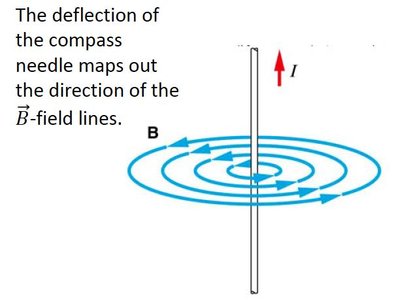
Right-Hand Rule: The direction of the magnetic field around a current-carrying wire can be found using the right-hand rule: thumb in the direction of current, fingers curl in the direction of the field.
Magnetic Field of a Current-Carrying Wire
Formula: The magnetic field at a distance r from a long, straight wire carrying current I is , where is the permeability of free space.
Direction: Determined by the right-hand rule.
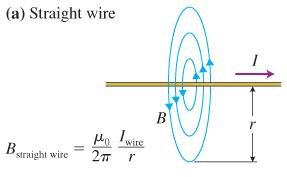
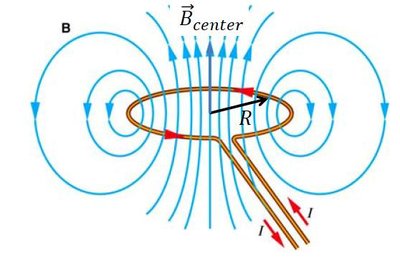
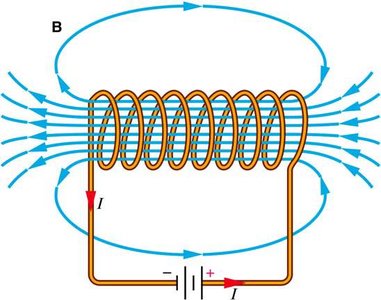
Magnetic Field of a Loop and Solenoid
Current Loop: At the center of a loop of radius R carrying current I, ; for N loops, .
Solenoid: Inside a long solenoid of length L and N turns, ; the field is nearly uniform inside.
Magnetic Force on Moving Charges
Force Law: A charge q moving with velocity \(\vec{v}\) in a magnetic field \(\vec{B}\) experiences a force .
Direction: Given by the right-hand rule for positive charges; opposite for negative charges.
Magnitude: , where \(\theta\) is the angle between \(\vec{v}\) and \(\vec{B}\).
Comparison: Electric vs. Magnetic Forces
Electric Force: ; acts in the direction of the electric field.
Magnetic Force: ; acts perpendicular to both velocity and magnetic field.
Lorentz Force: The total force on a charge in both fields is .
Applications and Importance
Earth's Magnetic Field: Shields the planet from solar wind and cosmic radiation, essential for life.
Technological Uses: MRI machines, particle accelerators, electric motors, and generators all rely on magnetic fields.
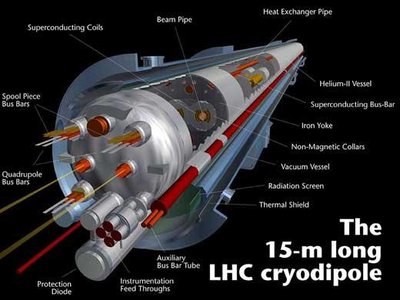
Additional info: The RC circuit and magnetism topics are foundational for understanding more advanced concepts in electromagnetism, electronics, and modern physics.
