 Back
BackRC Circuits: Charging and Discharging Capacitors
Study Guide - Smart Notes
 Tailored notes based on your materials, expanded with key definitions, examples, and context.
RC Circuits: Charging and Discharging Capacitors
Introduction to RC Circuits
RC circuits are fundamental electrical circuits consisting of resistors (R) and capacitors (C) connected in series or parallel. They are essential for understanding transient responses in circuits, such as how capacitors charge and discharge over time. The time-dependent behavior of voltage and current in these circuits is governed by first-order differential equations.
Discharging a Capacitor in an RC Circuit
Physical Setup and Initial Conditions
When a charged capacitor is connected in series with a resistor and the circuit is closed, the capacitor begins to discharge through the resistor. Initially, the current is zero when the switch is open, and the capacitor holds a charge .
Capacitor charge: on one plate, on the other
Current: (switch open)
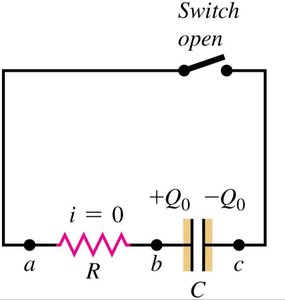
Discharge Process
When the switch is closed, the capacitor discharges through the resistor. The charge on the capacitor and the current in the circuit both decrease over time.
Current direction: From positive to negative plate through the resistor
Both charge and current decrease exponentially
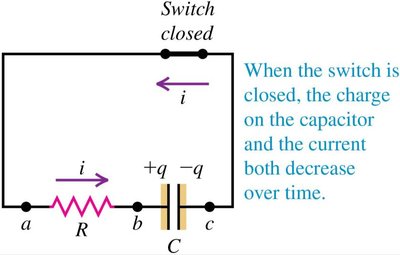
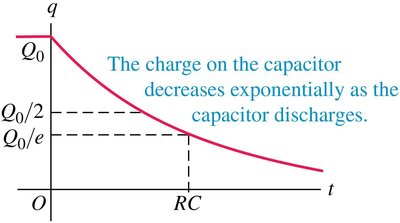
Exponential Decay of Charge
The charge on the capacitor as a function of time is given by:
Time constant: (determines the rate of decay)
After one time constant (),

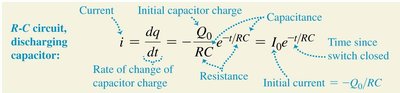
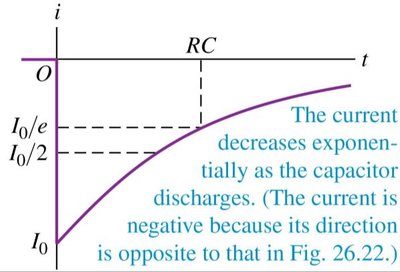
Exponential Decay of Current
The current in the circuit as the capacitor discharges is:
, where
Current is negative: Indicates direction is opposite to charging
Current decreases exponentially with the same time constant
Charging a Capacitor in an RC Circuit
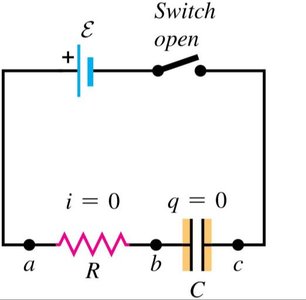
Physical Setup and Initial Conditions
When a capacitor is initially uncharged and connected in series with a resistor and a battery (emf ), closing the switch allows the capacitor to charge.
Initial charge:
Initial current: (switch open)
Charging Process
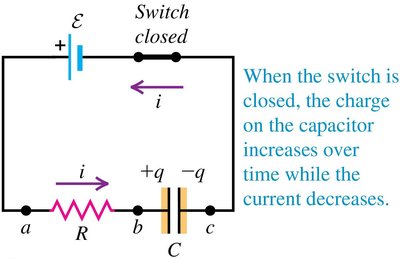
When the switch is closed, current flows and the capacitor begins to accumulate charge. Over time, the charge on the capacitor increases while the current decreases.
Current direction: From battery through resistor to capacitor
Charge increases, current decreases
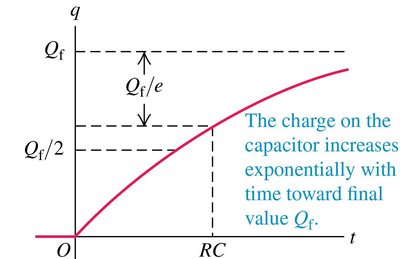
Exponential Growth of Charge
The charge on the capacitor as a function of time is:
Final charge:
After one time constant (),

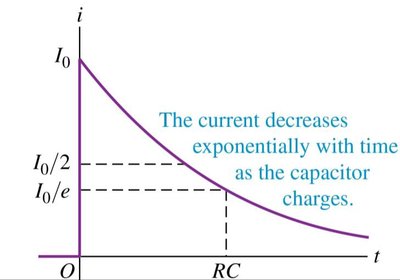
Exponential Decay of Current
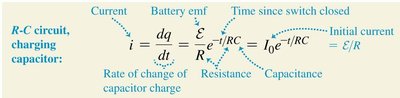
The current in the circuit as the capacitor charges is:
, where
Current is maximum at and decreases to zero as the capacitor becomes fully charged
Key Concepts and Formulas
Time Constant (): (seconds)
Discharging capacitor:
Charge:
Current:
Charging capacitor:
Charge:
Current:
Example Application: RC circuits are widely used in timing circuits, filters, and analog signal processing due to their predictable exponential response.
