 Back
BackReactions in Aqueous Solutions: Dissociation, Solvation, Precipitation, and Net Ionic Equations
Study Guide - Smart Notes
 Tailored notes based on your materials, expanded with key definitions, examples, and context.
Reactions in Aqueous Solutions
Dissociation of Ionic Compounds in Water
When ionic compounds dissolve in water, they dissociate into their constituent ions. This process is fundamental to understanding chemical reactions in aqueous solutions.
Dissociation: The separation of an ionic solid into its positive and negative ions when dissolved in water.
Example Equations:
Application: Dissociation allows ions to move freely and participate in chemical reactions.
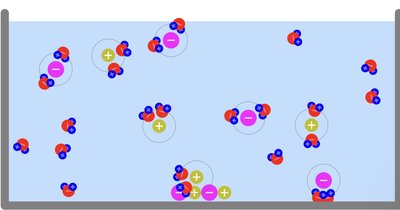
The Process of Solvation
Solvation is the process by which solvent molecules surround and interact with solute ions or molecules. In aqueous solutions, water's polarity plays a crucial role in this process.
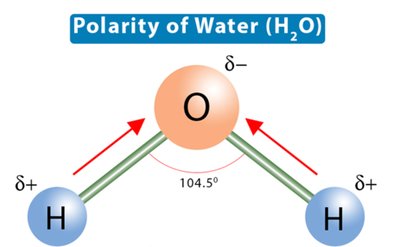
Polarity of Water: Water is a polar molecule due to the difference in electronegativity between oxygen and hydrogen, resulting in a partial negative charge (δ−) on oxygen and partial positive charges (δ+) on hydrogens.
Ion-Dipole Attraction: The negative end of water molecules is attracted to cations, while the positive end is attracted to anions.
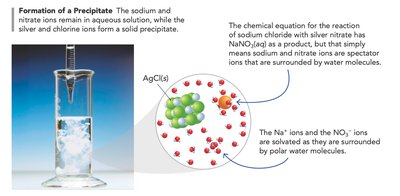
Hydration Shells: Water molecules form a hydration shell around each ion, stabilizing them and preventing recombination.
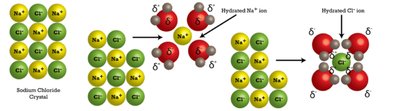
How Solvation Enables Chemical Reactions
Once ions are solvated and free-moving in solution, they can collide and react with other ions. This mobility is essential for the occurrence of double-replacement and precipitation reactions in aqueous solutions.
Key Point: Solvation allows ions to separate and move freely, making them available for new interactions and chemical reactions.
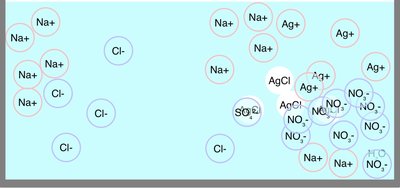
Example: The reaction between sodium chloride and silver nitrate in water forms a precipitate of silver chloride.
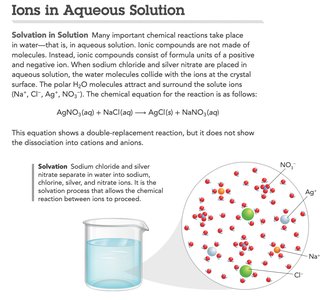
Double-Replacement and Precipitation Reactions
Double-Replacement Reaction: NaCl and AgNO3
Double-replacement reactions involve the exchange of ions between two compounds in solution, often resulting in the formation of a precipitate.
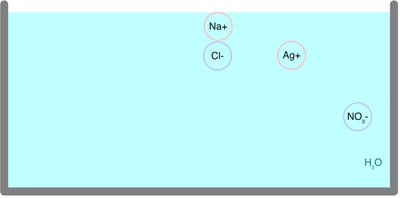
Step 1: Dissociation
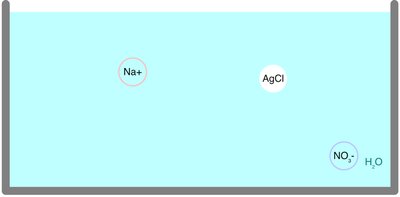
Step 2: Ion Exchange and Precipitation
Na+ pairs with NO3− (remains soluble)
Ag+ pairs with Cl− (forms insoluble AgCl, a precipitate)
Observation: The formation of AgCl is visible as a white cloudy substance in the solution.
Complete and Net Ionic Equations
Writing Chemical, Complete Ionic, and Net Ionic Equations
Understanding the different ways to represent reactions in aqueous solutions is essential for analyzing chemical changes and identifying the ions involved.
Chemical Equation: Shows the overall reaction using chemical formulas.
Complete Ionic Equation: Shows all soluble ionic compounds as dissociated ions.
Net Ionic Equation: Shows only the ions and molecules directly involved in the reaction.
Spectator Ions: Ions that do not participate in the actual chemical change and remain unchanged on both sides of the equation (e.g., Na+ and NO3− in the above reaction).
Examples of Net Ionic Equations and Spectator Ions
Example 1:
Net Ionic:
Spectator Ions: Na+, NO3−
Example 2:
Net Ionic:
Spectator Ions: K+, NO3−
Predicting Precipitate Formation: Solubility Rules
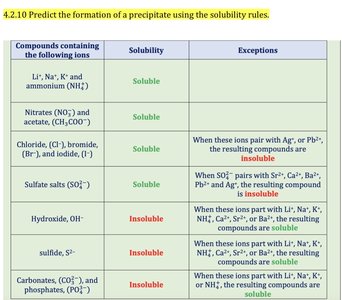
Solubility Rules Table
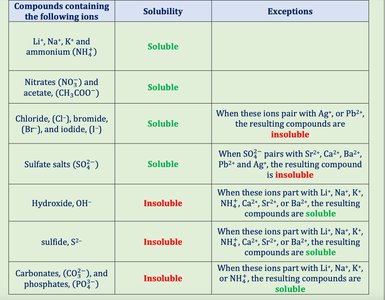
Solubility rules help predict whether a precipitate will form when two aqueous solutions are mixed. Compounds that are insoluble or only slightly soluble in water will form precipitates.
Compounds containing the following ions | Solubility | Exceptions |
|---|---|---|
Li+, Na+, K+, NH4+ | Soluble | None |
Nitrates (NO3−), acetates (CH3COO−) | Soluble | None |
Chloride (Cl−), bromide (Br−), iodide (I−) | Soluble | Insoluble with Ag+, Pb2+ |
Sulfate salts (SO42−) | Soluble | Insoluble with Sr2+, Ca2+, Ba2+, Pb2+ |
Hydroxide (OH−) | Insoluble | Soluble with Li+, Na+, K+, NH4+ |
Sulfide (S2−) | Insoluble | Soluble with Li+, Na+, K+, NH4+ |
Carbonates (CO32−), phosphates (PO43−) | Insoluble | Soluble with Li+, Na+, K+, NH4+ |
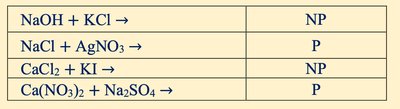
Examples: Predicting Precipitate Formation
Reaction | Precipitate? |
|---|---|
NaOH + KCl | NP (No Precipitate) |
NaCl + AgNO3 | P (Precipitate forms) |
CaCl2 + KI | NP (No Precipitate) |
Ca(NO3)2 + Na2SO4 | P (Precipitate forms) |
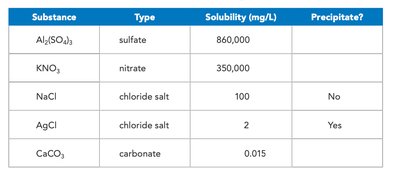
Solubility and Precipitate Formation: Data Table
Substance | Type | Solubility (mg/L) | Precipitate? |
|---|---|---|---|
Al2(SO4)3 | sulfate | 860,000 | No |
KNO3 | nitrate | 350,000 | No |
NaCl | chloride salt | 100 | No |
AgCl | chloride salt | 2 | Yes |
CaCO3 | carbonate | 0.015 | Yes |
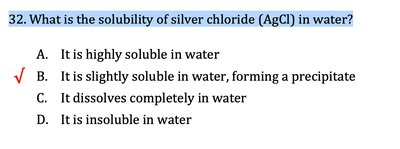
Solubility of Silver Chloride (AgCl)
AgCl is slightly soluble in water, forming a precipitate.
It does not dissolve completely, and its low solubility leads to the visible formation of a solid in solution.
Summary Table: Key Terms and Concepts
Term | Definition |
|---|---|
Dissociation | Process by which an ionic compound separates into ions in solution |
Solvation | Process by which solvent molecules surround and stabilize solute ions |
Precipitate | Insoluble solid formed in a chemical reaction in solution |
Spectator Ion | An ion that does not participate in the actual chemical change |
Net Ionic Equation | Equation showing only the ions and molecules directly involved in the reaction |
Additional info: The above notes integrate chemical principles relevant to introductory college chemistry and physics courses, focusing on the behavior of ions in aqueous solutions, the role of water's polarity, and the prediction of precipitate formation using solubility rules.
