 Back
BackReflection, Refraction, and Wave Properties of Light: Study Notes
Study Guide - Smart Notes
 Tailored notes based on your materials, expanded with key definitions, examples, and context.
Reflection of Light
Definition and Basic Principles
Reflection is the process by which light rays bounce off a surface and return into the medium from which they originated. This phenomenon is fundamental to the formation of images in mirrors and is governed by specific physical laws.
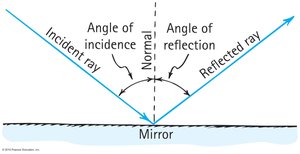
Law of Reflection: The angle of reflection equals the angle of incidence, both measured from the normal (a line perpendicular to the surface at the point of incidence).
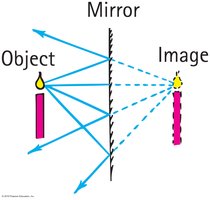
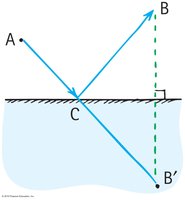
Virtual Image Formation: In a plane mirror, the image appears to be the same size and distance from the mirror as the object, but it is virtual (cannot be projected onto a screen).
Types of Mirrors and Image Properties
Plane Mirrors: Produce images that are the same size as the object and located the same distance behind the mirror as the object is in front.
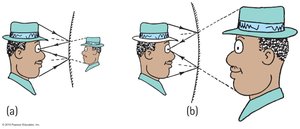
Convex Mirrors: Produce virtual images that are smaller and closer to the mirror than the object.
Concave Mirrors: Produce virtual images that are larger and farther from the mirror than the object.
Specular vs. Diffuse Reflection
The nature of the reflecting surface determines the type of reflection:
Specular Reflection: Occurs on smooth surfaces (like mirrors), where parallel incident rays reflect in a single direction, preserving image clarity.
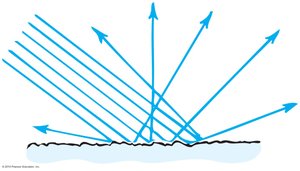
Diffuse Reflection: Occurs on rough or irregular surfaces, causing light to scatter in many directions and preventing the formation of a clear image.
Principle of Least Time (Fermat's Principle)
Statement and Application
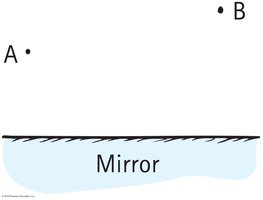
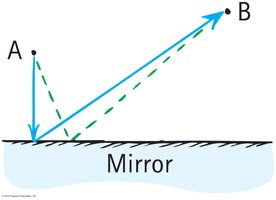
Fermat's Principle states that the path taken by light between two points is the one that requires the least time. This principle underlies both reflection and refraction phenomena.
Reflection: The path of least time corresponds to the law of reflection.
Refraction: The path of least time explains why light bends when passing between different media.
Refraction of Light
Definition and Laws
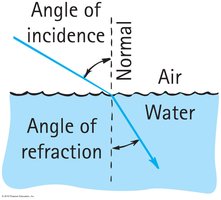
Refraction is the bending of light as it passes from one transparent medium to another with a different optical density. This occurs because light changes speed in different media.
Law of Refraction (Snell's Law): The relationship between the angles and the indices of refraction of the two media is given by:
Index of Refraction (n): Defined as , where is the speed of light in vacuum and is the speed of light in the medium.
When light enters a medium with a higher refractive index, it bends toward the normal; when entering a lower index, it bends away from the normal.
Refractive Illusions and Applications
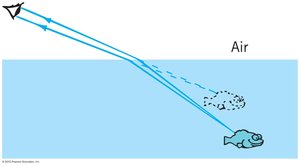
Objects submerged in water appear closer to the surface due to refraction.
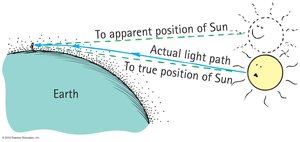
Atmospheric refraction causes the apparent displacement of celestial objects, such as the Sun appearing higher in the sky than its true position.
Dispersion and Rainbows
Dispersion
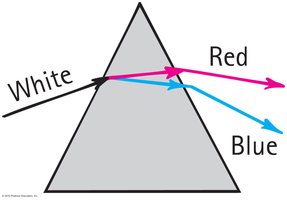
Dispersion is the process by which light separates into its component colors due to different degrees of refraction for different frequencies (wavelengths).
When white light passes through a prism, shorter wavelengths (blue/violet) are bent more than longer wavelengths (red).
Rainbows
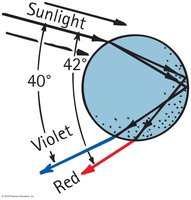
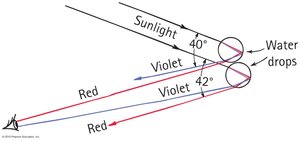
Rainbows are formed by the dispersion of sunlight in water droplets, with each color emerging at a slightly different angle relative to the incoming sunlight.
Red light emerges at a higher angle (about 42°) than violet light (about 40°).
Total Internal Reflection
Definition and Conditions
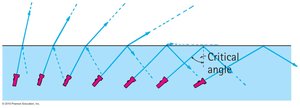
Total internal reflection (TIR) occurs when light attempts to move from a medium with a higher refractive index to one with a lower refractive index at an angle greater than the critical angle, causing all the light to reflect back into the original medium.
Critical Angle: The minimum angle of incidence for which total internal reflection occurs.
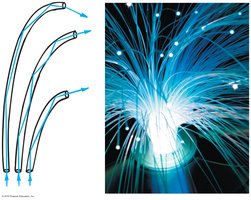
TIR is used in optical fibers and many optical instruments to efficiently guide light.
Diffraction and Huygens' Principle
Diffraction
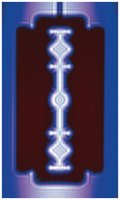
Diffraction is the bending and spreading of waves when they encounter an obstacle or pass through a narrow opening. The amount of diffraction increases as the size of the opening approaches the wavelength of the wave.
Diffraction explains why waves can bend around obstacles and why sharp shadows are not always formed.
Huygens' Principle
Huygens' Principle states that every point on a wavefront acts as a source of secondary spherical wavelets. The new wavefront is the envelope of these wavelets, explaining reflection, refraction, and diffraction phenomena.
Helps visualize how waves propagate, bend, and interfere.
Young’s Double-Slit Experiment and Interference
Superposition and Interference
When two or more waves overlap, their amplitudes add (superposition), resulting in constructive (bright) or destructive (dark) interference patterns. This is direct evidence of the wave nature of light.
Young’s double-slit experiment demonstrated that light produces an interference pattern, confirming its wave-like behavior.
Diffraction Grating
A diffraction grating is an optical device with many parallel slits that separates light into its component wavelengths, producing a spectrum.
Used in spectrometers and for analyzing light sources.
Summary Table: Reflection, Refraction, and Diffraction
Phenomenon | Definition | Key Law/Principle | Example/Application |
|---|---|---|---|
Reflection | Bouncing of light from a surface | Law of Reflection | Plane mirror image |
Refraction | Bending of light at a boundary between media | Snell's Law | Straw in water appears bent |
Dispersion | Separation of light into colors by frequency | Frequency-dependent refraction | Prism, rainbow |
Diffraction | Bending of waves around obstacles/openings | Huygens' Principle | Double-slit experiment |
Total Internal Reflection | Complete reflection at a boundary | Critical Angle | Optical fibers |
Key Equations
Law of Reflection:
Snell's Law (Law of Refraction):
Index of Refraction:
Additional info: These notes integrate and expand upon the provided lecture content, ensuring a comprehensive and academically robust overview of the wave and ray properties of light, suitable for college-level physics students.
