 Back
BackOptics - Refraction and Reflection of Light: Laws, Applications, and Wave-Particle Duality
Study Guide - Smart Notes
 Tailored notes based on your materials, expanded with key definitions, examples, and context.
Refraction and Reflection of Light
Introduction to Light Interaction
Light exhibits both particle and wave properties, a concept unified in the quantum realm. The study of light's interaction with matter includes reflection, refraction, dispersion, polarization, and scattering. The foundational work on refraction was established by Ibn Sahl in the 10th century, laying the groundwork for modern optics.

Nature of Light: Particle and Wave Duality
Light can be described using two complementary models:
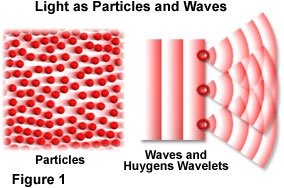
Particle Model: Light consists of photons, which carry energy in discrete packets. This model explains phenomena such as emission and absorption.
Wave Model: Light is an electromagnetic wave, characterized by oscillating electric and magnetic fields perpendicular to each other and to the direction of propagation.
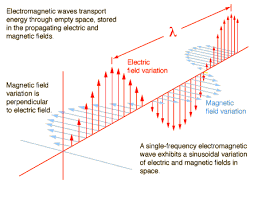
Quantum Mechanics unifies these models, describing light as having both wave-like and particle-like properties depending on the experimental context.
Laws of Reflection
Law of Reflection
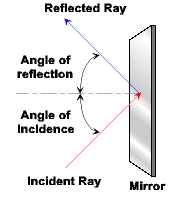
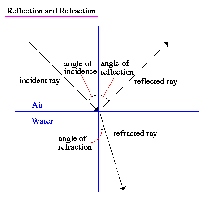
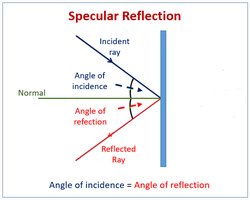
The law of reflection states that when a light ray strikes a smooth surface, the angle of incidence is equal to the angle of reflection:
Angle of Incidence (\(\theta_i\)): The angle between the incident ray and the normal to the surface.
Angle of Reflection (\(\theta_r\)): The angle between the reflected ray and the normal.
\(\theta_i = \theta_r\)
Plane Mirrors and Image Formation
Plane mirrors produce virtual images that are upright, the same size as the object, and located as far behind the mirror as the object is in front.
Virtual Image: Formed by the apparent divergence of rays from a point behind the mirror.
Lateral Inversion: Left and right are reversed in the mirror image.
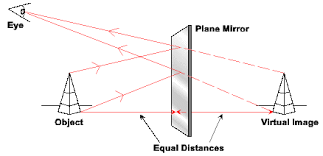
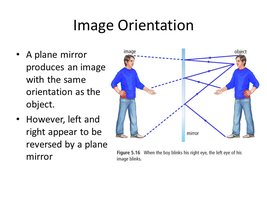
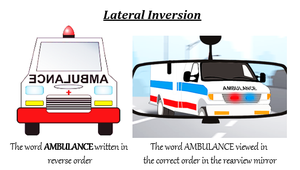
Application: Emergency vehicles display reversed text so it appears correctly in rear-view mirrors.
Types of Reflection
Reflection can be classified based on the surface:
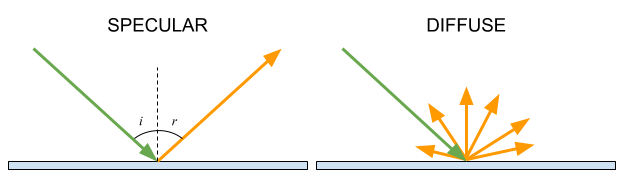
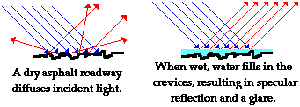
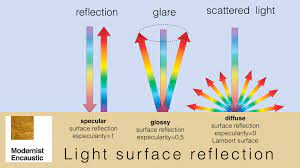
Specular Reflection: Occurs on smooth surfaces (e.g., mirrors), producing clear images.
Diffuse Reflection: Occurs on rough surfaces, scattering light in many directions and allowing us to see non-luminous objects.
Refraction of Light
Definition and Principle
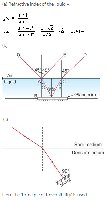
Refraction is the bending of light as it passes from one medium to another with a different refractive index. This occurs due to a change in the speed of light in different materials.
Refractive Index (n): A dimensionless number indicating how much the speed of light is reduced in a medium compared to vacuum.
\(n = \frac{c}{v}\), where \(c\) is the speed of light in vacuum and \(v\) is the speed in the medium.
Snell's Law
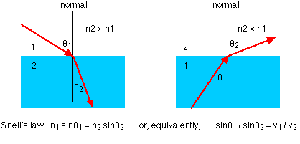
Snell's Law quantitatively describes the relationship between the angles and refractive indices of two media:
\(n_1 \sin \theta_1 = n_2 \sin \theta_2\)
When light enters a medium with higher refractive index, it bends toward the normal; when entering a lower index, it bends away.
Wavefronts and Rays
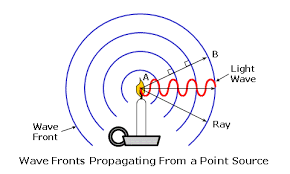
Light can be represented as rays (direction of energy propagation) or wavefronts (surfaces of constant phase). Plane waves have parallel rays and flat wavefronts.
Electromagnetic Nature of Light
Light is an electromagnetic wave, consisting of oscillating electric and magnetic fields perpendicular to each other and to the direction of propagation.
Conservation of Energy in Reflection and Refraction
At a boundary, the sum of the energies in the reflected and refracted rays equals the energy of the incident ray, provided no energy is absorbed by the interface.
Dispersion
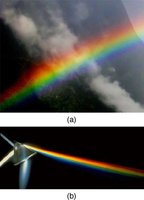
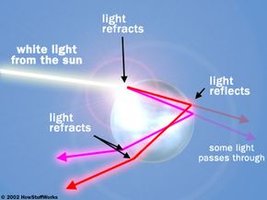
Dispersion is the dependence of the refractive index on wavelength, causing different colors (wavelengths) of light to refract by different amounts. This effect is responsible for the formation of rainbows and the splitting of white light by prisms.
Red light (longer wavelength) bends less than violet light (shorter wavelength).
Rainbows and Total Internal Reflection
Rainbows are formed by the combination of dispersion, refraction, and internal reflection within water droplets. The primary and secondary rainbows are separated by a dark region known as Alexander's band.
Critical Angle: The minimum angle of incidence for which total internal reflection occurs.
Total Internal Reflection: All light is reflected back into the medium when the angle of incidence exceeds the critical angle.
Refractive Index Table
The refractive index varies for different materials, as shown in the table below:
Medium | Refractive Index |
|---|---|
Vacuum | 1.00 |
Air | 1.00 |
Water | 1.33 |
Alcohol | 1.36 |
Sugar solution (80%) | 1.49 |
Perspex | 1.50 |
Glass | 1.50–1.70 |
Diamond | 2.42 |
Polarization of Light
Definition and Mechanism
Polarization refers to the orientation of the oscillations of the electric field in a transverse wave. Unpolarized light consists of waves vibrating in all directions perpendicular to the direction of propagation, while polarized light vibrates in a single plane.
Polarizers: Devices that allow only light oscillating in a specific direction to pass through.
Malus's Law: The intensity of polarized light after passing through a polarizer is given by \(I = I_0 \cos^2 \phi\), where \(\phi\) is the angle between the light's polarization direction and the axis of the polarizer.

Applications and Examples
Fiber Optics
Fiber optic cables use total internal reflection to transmit light signals over long distances with minimal loss. The light remains trapped within the core due to repeated internal reflections at the core-cladding boundary.
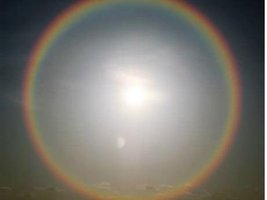
Everyday Applications of Reflection and Refraction
Mirrors in vehicles for safety and navigation
Prisms and lenses in optical instruments
Rainbows as natural demonstrations of dispersion and internal reflection
Summary Table: Key Concepts in Reflection and Refraction
Concept | Description | Key Equation |
|---|---|---|
Law of Reflection | Angle of incidence equals angle of reflection | \(\theta_i = \theta_r\) |
Snell's Law | Relationship between angles and refractive indices | \(n_1 \sin \theta_1 = n_2 \sin \theta_2\) |
Critical Angle | Minimum angle for total internal reflection | \(\sin \theta_c = \frac{n_2}{n_1}\) |
Malus's Law | Intensity of polarized light after analyzer | \(I = I_0 \cos^2 \phi\) |
Additional info:
Huygens’s Principle explains how every point on a wavefront acts as a source of secondary spherical wavelets, which combine to form the new wavefront.
Rainbows are unique to each observer due to the specific angles at which light is refracted and reflected into their eyes.
