 Back
Refraction at a Single Spherical Surface: Principles, Formulas, and Applications
Study Guide - Smart Notes
 Tailored notes based on your materials, expanded with key definitions, examples, and context.
Refraction at a Single Spherical Surface
Sign Conventions and Terminology
Understanding sign conventions is essential for analyzing refraction at spherical surfaces. These conventions help determine the direction and nature of distances and angles in optical systems.
Distances measured in the direction of light travel are positive.
Distances measured opposite to the direction of light travel are negative.
Distances above the optical axis are positive; below are negative.
Angles measured counterclockwise are positive; clockwise are negative.
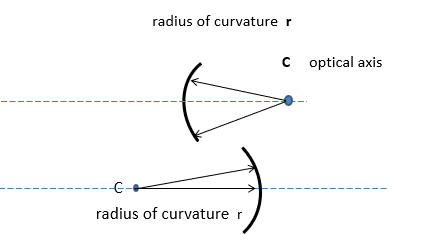
Single spherical surface: A surface generated by a single arc, with all points equidistant from the center of curvature.
Center of curvature (C): The reference point equidistant from any point on the surface.
Radius of curvature (r): The distance from the center of curvature to any point on the surface.
Curvature (R) or Vergence: Reciprocal of the radius of curvature, measured in diopters (D).
Convex and Concave Spherical Surfaces
Spherical surfaces can be classified as convex or concave, each affecting light differently:
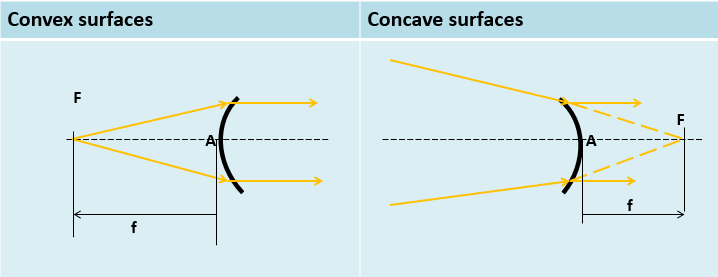
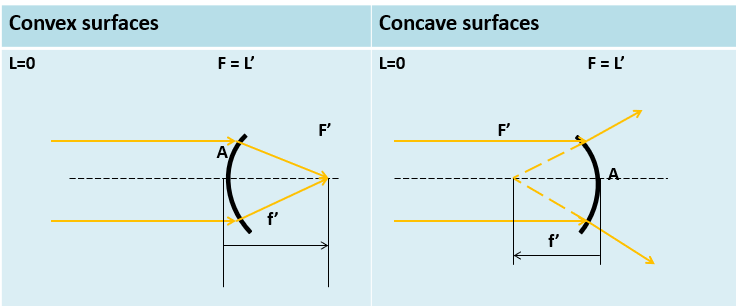
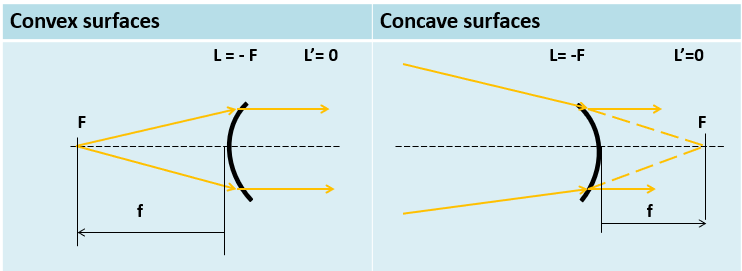
Convex surfaces: Center bulges out toward the medium (e.g., air). Plane waves incident on convex surfaces converge after refraction, forming a point image.
Concave surfaces: Center curves inward. Plane waves incident on concave surfaces diverge after refraction, forming a point image in object space.
Surface Dioptric Power Calculation
Surface Power Formula
The power of a curved surface (F) depends on the radius of curvature and the refractive indices of the media on either side of the surface. The formula is:
Surface Power Formula:
F = surface power (diopters, D)
n' = index of refraction after the surface
n = index of refraction before the surface
r = radius of curvature (meters)
Focal Points and Focal Lengths
Primary and Secondary Focal Points
Focal points are key reference positions in optical systems:
Primary Focal Point (F): Object position when the image is at infinity.
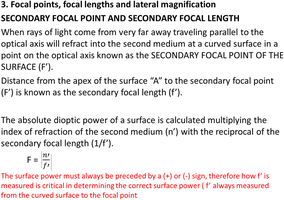
Secondary Focal Point (F’): Image position when the object is at infinity.
Primary Focal Length (f): Distance from the surface to the primary focal point.
Secondary Focal Length (f’): Distance from the surface to the secondary focal point.
Gaussian Imaging Equation
Vergence and Image Formation
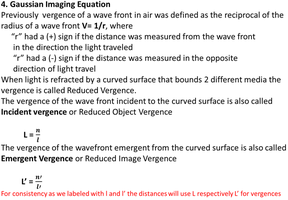
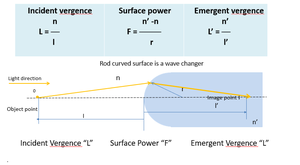
The Gaussian Imaging Equation relates the incident vergence, surface power, and emergent vergence:
Incident Vergence (L):
Emergent Vergence (L’):
Surface Power (F):
Gaussian Imaging Equation:
Lateral Magnification
Definition and Formula
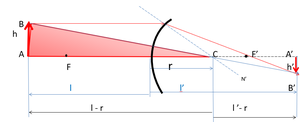
Lateral magnification describes the size of the image relative to the object:
Lateral Magnification (LM):
h = object size
h’ = image size
l = object distance
l’ = image distance
Worked Examples
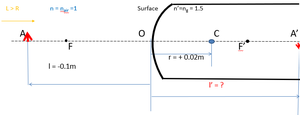
Example 1: Image Formation by a Convex Surface
An object is located 100mm in front of a convex spherical glass rod separating air from glass (n’=1.5, n=1). The radius of curvature is 20mm.
Given: l = 0.1m, r = 0.02m, n = 1, n’ = 1.5
Formula:
Solution: (image formed 100mm from rod apex)
Example 2: Image Formation by a Surface with Known Power
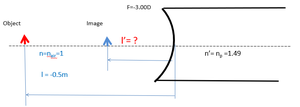
An object in air is placed 50cm in front of a rod made of plastic (n’=1.49) with a surface power of -3.00D.
Given: l = 0.5m, F = -3.00D, n’ = 1.49
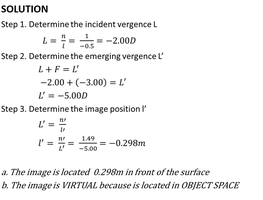
Steps:
Determine incident vergence:
Determine emergent vergence:
Determine image position:
The image is located 0.298m in front of the surface and is virtual.
Example 3: Image Formation by a Convex Surface (Polycarbonate)
An object is located 80mm in front of a convex single spherical surface separating air from polycarbonate (n’=1.586). Radius of surface is 40mm.
Given: l = 0.08m, r = 0.04m, n = 1, n’ = 1.586
Formula:
Solution: (image formed 0.738m from rod apex)
Summary Table: Key Formulas and Concepts
Concept | Formula | Units |
|---|---|---|
Surface Power | Diopters (D) | |
Incident Vergence | Diopters (D) | |
Emergent Vergence | Diopters (D) | |
Gaussian Imaging Equation | Diopters (D) | |
Lateral Magnification | None |
Additional info:
These notes cover the principles of geometric optics relevant to refraction at spherical surfaces, including sign conventions, surface power, focal points, Gaussian imaging, and magnification.
All equations are provided in LaTeX format for clarity and academic rigor.
Images included are directly relevant to the explanation of each topic, reinforcing key concepts and problem-solving steps.
