 Back
BackOptics - Refraction of Light: Lenses, Image Formation, and Magnification
Study Guide - Smart Notes
 Tailored notes based on your materials, expanded with key definitions, examples, and context.
Lenses and Refraction of Light
Introduction to Lenses
Lenses are optical devices that refract light to form images. The behavior of light as it passes through a lens depends on the lens's shape and material. There are two primary types of lenses: converging (convex) and diverging (concave). Each type has distinct properties and applications in optics.
Diverging Lenses (Concave)
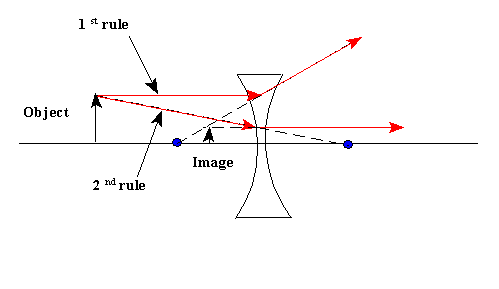
Diverging lenses are thinner at the center and thicker at the edges. They always produce a virtual image that is small and upright. The focal length for diverging lenses is negative, indicating that the refracted rays diverge and must be extended backward to locate the virtual focal point.
Key Properties:
Virtual image is always formed on the same side as the object.
Focal length () is negative.
Used for correcting nearsightedness (myopia).
Example: A diverging lens is used in eyeglasses for people whose images form in front of the retina.
Converging Lenses (Convex)
Converging lenses are thicker at the center and thinner at the edges. They have a positive focal length and can produce real or virtual images depending on the object's position relative to the lens.
Key Properties:
Focal length () is positive.
Can produce real, inverted images or virtual, upright images.
Used for correcting farsightedness (hyperopia).
Resemble the shape and function of the human eye.
Example: A converging lens is used in magnifying glasses and cameras.
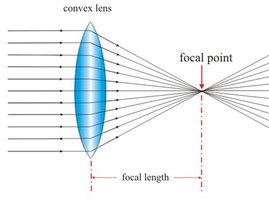
Image Formation by Lenses
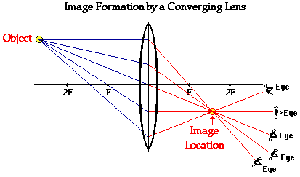
The location and nature of the image formed by a lens depend on the object distance ( or ) and the focal length ().
If the object is beyond twice the focal length (), the image is real, inverted, and smaller (camera setup).
If the object is between and , the image is real, inverted, and enlarged (projector setup).
If the object is between the focal point and the lens, the image is virtual, upright, and enlarged (magnifying glass).
Thin Lens Equation and Magnification
The thin lens equation relates the object distance (), image distance (), and focal length ():
Thin Lens Equation:
Magnification Equation:
Interpretation:
If is positive, the image is upright.
If is negative, the image is inverted.
If , the image is enlarged.
If , the image is reduced.
Rules for Lens Sign Conventions
If focal length () is positive: converging lens.
If focal length () is negative: diverging lens.
If object distance () is positive: object is on the left (real).
If object distance () is negative: object is on the right (virtual).
If image distance () is positive: image is real and on the right.
If image distance () is negative: image is virtual and on the left.
Applications and Examples
Camera: Object at produces a small, inverted real image.
Projector: Object between and produces a large, inverted real image.
Magnifying Glass: Object between and the lens produces a virtual, upright, enlarged image.
Eyeglasses: Diverging lenses correct myopia; converging lenses correct hyperopia.
Summary Table: Lens Properties and Image Formation
Lens Type | Focal Length | Image Type | Image Orientation | Application |
|---|---|---|---|---|
Converging (Convex) | Positive | Real or Virtual | Inverted or Upright | Camera, Magnifier, Eye |
Diverging (Concave) | Negative | Virtual | Upright | Eyeglasses for Myopia |
Additional info:
For both lens types, the focal length is the distance from the lens to the focal point.
Image formation rules are based on geometric optics and ray diagrams.
