 Back
BackRelativistic Velocity Addition: Spaceship and Missile Scenario
Study Guide - Smart Notes
 Tailored notes based on your materials, expanded with key definitions, examples, and context.
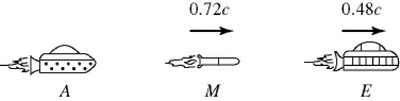
Q6. The captain of spaceship A observes enemy spaceship E escaping with a relative velocity of 0.48c. A missile M is fired from ship A, with a velocity of 0.72c relative to ship A. What is the relative velocity of approach of missile M, observed by the crew on ship E?
Background
Topic: Relativistic Velocity Addition
This question tests your understanding of how to combine velocities in special relativity, especially when objects are moving at speeds close to the speed of light (c). The classical formula for adding velocities does not apply at relativistic speeds; instead, you must use the relativistic velocity addition formula.
Key Terms and Formulas
Relativistic velocity addition formula:
= velocity of missile relative to spaceship A ()
= velocity of spaceship A relative to spaceship E (; negative because E is moving away from A)
= velocity of missile relative to spaceship E (what you are solving for)
= speed of light
Step-by-Step Guidance
Identify the velocities involved: Missile M moves at relative to spaceship A, and spaceship E moves at relative to A (in the same direction).
Determine the correct signs for the velocities: Since E is moving away from A, use when plugging into the formula.
Set up the relativistic velocity addition formula:
Plug in the values: , , is the speed of light.
Try solving on your own before revealing the answer!
Final Answer: 0.37c
The relativistic velocity addition formula ensures that the resulting velocity does not exceed the speed of light.
