 Back
Representing Motion: Foundations of Kinematics
Study Guide - Smart Notes
 Tailored notes based on your materials, expanded with key definitions, examples, and context.
Representing Motion
Introduction to Kinematics
Kinematics is the branch of physics that describes the motion of objects without considering the causes of motion. Understanding motion requires the use of a coordinate system, appropriate units, and mathematical tools such as vectors. This chapter introduces the fundamental concepts and methods used to represent and analyze motion in one and more dimensions.
Fundamental Units in Physics
Length: Measured in meters (m)
Mass: Measured in kilograms (kg)
Time: Measured in seconds (s)
All other physical quantities in mechanics are derived from these three fundamental units.
Dimensional Analysis
Dimensional analysis is a method to check the correctness of equations by comparing the dimensions on both sides. An equation is dimensionally correct if the fundamental units match on both sides.
Example: To check if is dimensionally correct, note that , , . Thus, , which matches .
Scientific Prefixes and Unit Conversions
Physics uses prefixes to represent powers of ten for units. Common prefixes include:
kilo- (k):
centi- (c):
milli- (m):
micro- (\mu):
nano- (n):
pico- (p):
Unit conversions are essential for solving physics problems. For example:
Convert 3.0 cm to pm:
Convert 10 m/s to mi/hr:
Coordinate Systems
A coordinate system is used to specify the position of an object in space. The choice of origin and axes is arbitrary but should be consistent throughout the analysis.
Motion Diagrams
Motion diagrams visually represent the position of an object at successive time intervals. They help in understanding how an object's position changes over time.
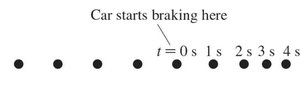
Key Point: The spacing between dots indicates speed; closer dots mean slower motion.
Example: A car starts braking at s. The decreasing distance between dots shows the car is slowing down.
Types of Motion
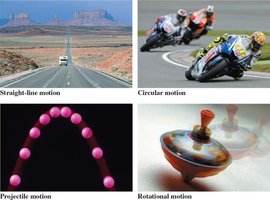
Motion can be classified into several types based on the path and nature of movement:
Straight-line motion: Movement along a straight path.
Circular motion: Movement along a circular path.
Projectile motion: Curved path under gravity.
Rotational motion: Spinning around an axis.
Plots in Kinematics
Plots such as position vs. time, velocity vs. time, and acceleration vs. time are used to analyze motion quantitatively. The slope of a position-time graph gives velocity, while the slope of a velocity-time graph gives acceleration.
Vectors in Motion
A vector is a quantity with both magnitude and direction. Vectors are essential for representing displacement, velocity, and acceleration in two or more dimensions.
Components: Any vector can be broken into perpendicular components, typically along the x and y axes.
Notation:
Displacement Vector
Displacement is a vector representing the change in position of an object. It is defined as:
Displacement depends only on the initial and final positions, not the path taken.

Distance vs. Displacement
Distance: Total length of the path traveled (scalar).
Displacement: Straight-line vector from start to end point.
Calculating Average Speed and Velocity
Average speed is the total distance traveled divided by the total time taken. Average velocity is the displacement divided by the total time.
Average speed:
Average velocity:

Example: If it takes 10 minutes to walk along a path of 140 meters, but the straight-line displacement is 80 meters, then:
Distance traveled: 140 m
Displacement: 80 m
Average speed:
Average velocity: (in the direction of displacement)
Summary Table: Distance vs. Displacement
Quantity | Type | Definition | SI Unit |
|---|---|---|---|
Distance | Scalar | Total path length | meter (m) |
Displacement | Vector | Straight-line from start to end | meter (m) |
