 Back
BackWeek 4 Lec. 2
Study Guide - Smart Notes
 Tailored notes based on your materials, expanded with key definitions, examples, and context.
Resistivity and Resistance
Definition and Formula
Resistivity (ρ) is a fundamental property of materials that quantifies how strongly a material opposes the flow of electric current. Resistance (R) of a wire depends on its length (l), cross-sectional area (A), and the material's resistivity.
Formula:
Resistivity Units: Ohm-meters ()
Conductivity: The reciprocal of resistivity, , with units (
Comparing Resistance of Cylindrical Resistors
When comparing two cylindrical resistors made from the same material and of equal length, but with different diameters, the resistance is inversely proportional to the cross-sectional area.
If one resistor has diameter d and the other 2d, the second resistor's area is four times larger, so its resistance is one-fourth that of the first.
Example:
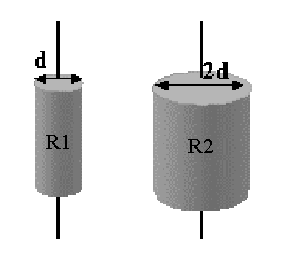
Effect of Length and Area
Increasing length increases resistance.
Increasing cross-sectional area decreases resistance.
Material composition affects resistivity and thus resistance.
Current and Electron Velocity Comparison
For identical materials and equal current, the average drift velocity of electrons is higher in the resistor with smaller cross-sectional area.
Electric Circuits and Bulb Brightness
Series and Parallel Effects
In a circuit with two identical bulbs, removing one bulb and completing the circuit changes the brightness of the remaining bulb.
With both bulbs, the total resistance is higher, so the current is lower and each bulb is dimmer.
With one bulb, resistance is lower, so current increases and the bulb is brighter.
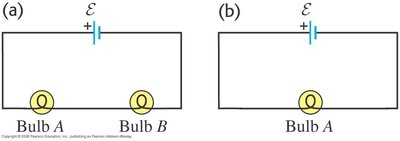
Internal Resistance of Power Sources
Definition and Effects
All real power sources (batteries, generators) have internal resistance (r), which reduces the terminal voltage and limits the current delivered to a load.
Terminal Voltage:
Current through Load:
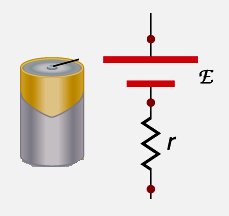
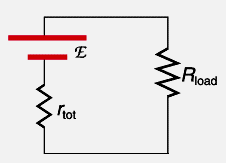
Electric Potential and Potential Energy
Point Charges
The electric potential (V) at a distance r from a point charge q is given by:
Potential energy of a two-charge system:
For multiple charges, use superposition:
Worked Example
Calculate the potential at a point due to two charges using the above formulas.
Ohm's Law and Non-Ohmic Devices
Current–Voltage Relationships
Ohm's Law states that the current through a conductor between two points is directly proportional to the voltage across the two points.
Ohm's Law:
Some devices (non-ohmic) do not follow this linear relationship.
Resistance and Temperature
Temperature Dependence
Resistance and resistivity of materials change with temperature due to changes in the number of free charges and collision rates.
For metals, resistivity increases linearly with temperature:
is resistivity at reference temperature
is the temperature coefficient of resistivity
Worked Example: Platinum Wire
Calculate resistance at different temperatures using the formula above.
For a platinum wire of length 20 m and diameter 0.5 mm at 20°C:
At 1000°C, use
Behavior of Different Materials
Most metals: resistivity increases with temperature.
Some materials (e.g., semiconductors): resistivity may decrease with temperature due to increased free charge carriers.
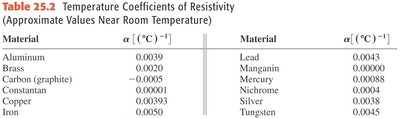
Summary Table: Temperature Coefficients of Resistivity
The table below summarizes the temperature coefficients of resistivity for common materials:
Material | α (°C-1) |
|---|---|
Aluminum | 0.0039 |
Brass | 0.0020 |
Carbon (graphite) | -0.0005 |
Constantan | 0.0001 |
Copper | 0.00393 |
Iron | 0.0050 |
Lead | 0.0043 |
Manganin | 0.00000 |
Mercury | 0.00088 |
Nichrome | 0.0004 |
Silver | 0.0038 |
Tungsten | 0.0045 |
Additional info: The notes above expand on the original content by providing full academic explanations, formulas, and context for each topic, ensuring completeness and clarity for exam preparation.
