 Back
BackResistors in Series and Parallel, and Battery Internal Resistance
Study Guide - Smart Notes
 Tailored notes based on your materials, expanded with key definitions, examples, and context.
Resistors in Series
Series Connection of Resistors
When resistors are connected end-to-end so that the same current flows through each, they are said to be in series. This configuration is fundamental in circuit analysis and affects the total resistance and current distribution.
Negligible Wire Resistance: The resistance of connecting wires is assumed negligible compared to the resistors themselves.
Current Flow: The same current flows sequentially through each resistor in the series.
Series Definition: A series connection means all resistors are arranged in a single path for current.
Total Resistance: The total resistance in a series circuit is the sum of individual resistances:
Example: If three resistors of 120 Ω, 240 Ω, and 360 Ω are connected in series, the total resistance is:

Resistors in Parallel
Parallel Connection of Resistors
Resistors are in parallel when their ends are connected to the same two points, so each resistor has the same potential difference across it. This configuration is common in electrical circuits to reduce overall resistance and distribute current.
Negligible Wire Resistance: The resistance of connecting wires is negligible.
Potential Difference: The potential difference across each resistor is the same.
Current Distribution: Each resistor carries a different current, inversely proportional to its resistance: , ,
Total Current: The total current is the sum of the individual currents:
Total Resistance: The reciprocal of the total resistance is the sum of reciprocals of individual resistances:
Example: If three resistors of 120 Ω, 240 Ω, and 360 Ω are connected in parallel, the total resistance is:

Combination of Resistors
Equivalent Resistance Calculation
Complex circuits often combine series and parallel arrangements. The equivalent resistance simplifies analysis by reducing the circuit to a single resistor.
Series Combination: Add resistances directly.
Parallel Combination: Use reciprocal formula.
Stepwise Reduction: Reduce complex circuits step by step, combining series and parallel groups.
Example: A circuit with 240 Ω, 90 Ω, and 240 Ω in series gives:





Resistivity in Coaxial Conductors
Core and Cladding Resistivity
Coaxial conductors consist of a core and a cladding, each with different resistivities. The total resistance depends on the geometry and material properties.
Core vs. Cladding: The resistivity of the core is not equal to the resistivity of the cladding.
Application: Used in cables and transmission lines to control resistance and signal loss.
Battery Internal Resistance
Real Battery Model
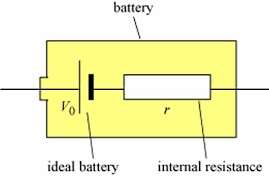
A real battery is modeled as an ideal voltage source in series with a small internal resistance. This internal resistance causes a voltage drop when current flows.
Series Model: The battery's internal resistance is in series with the ideal voltage source.
Voltage Drop: The voltage across the battery terminals is reduced by the internal resistance:
Open Circuit: When no current flows (open circuit), the terminal voltage equals the ideal voltage .
Example: If a battery has an ideal voltage and internal resistance , and current flows, the terminal voltage is:
Summary Table: Series vs. Parallel Resistors
Property | Series | Parallel |
|---|---|---|
Current | Same through all | Divided among branches |
Voltage | Divided across resistors | Same across all |
Total Resistance | ||
Example Use | Current limiting | Voltage distribution |
Additional info: Academic context and stepwise examples were added to clarify calculation methods and circuit analysis.
