 Back
BackResonance, Interference, and Beats in Sound Waves
Study Guide - Smart Notes
 Tailored notes based on your materials, expanded with key definitions, examples, and context.
Resonance in Harmonic Oscillators
Forced Oscillations and Resonance
Resonance occurs when a harmonic oscillator is driven by a periodic force whose frequency matches the natural frequency of the oscillator. This results in the maximum amplitude of oscillation. - Harmonic Oscillator: A system (such as a mass on a spring) that oscillates with a natural frequency . - Driving Force: The external force applied, , where is the driving frequency. - Resonance Condition: Maximum amplitude occurs when . - Energy Transfer: At resonance, the driving force is always in phase with the oscillator, efficiently transferring energy. 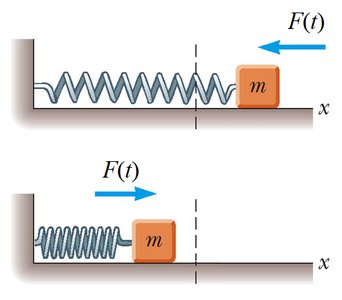
Mathematical Description
The equation of motion for a forced oscillator is: where is mass, is damping coefficient, is spring constant. At resonance: The amplitude is maximized and energy is continuously supplied to the system.
Resonant Frequencies in Pipes
Frequency Spectrum of Sound in Pipes
Sound waves in pipes exhibit resonance at specific frequencies, determined by the pipe's geometry and boundary conditions. - Open Pipe: Both ends open. Resonant frequencies: with and - Closed Pipe: One end closed. Resonant frequencies: with and - Normal Modes: Outside noise can excite these modes at their resonance frequencies. - Resonant Peaks: Peaks have finite width and height due to energy dissipation, imperfections, and turbulence. 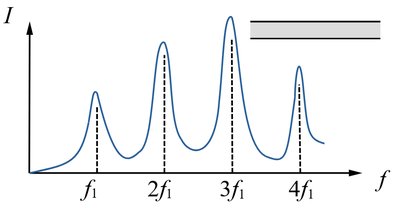
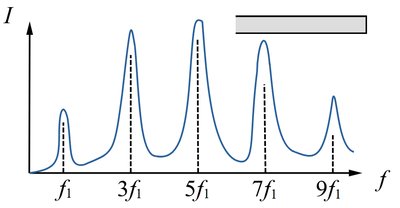
Interference of Sound Waves
Interference from Two Sources
When two sound waves of the same frequency overlap, their superposition can result in constructive or destructive interference, depending on their phase difference. - Wave Equations: - Phase Difference: - Constructive Interference: , - Destructive Interference: , - Special Case: If , then , where and . Constructive: Destructive:
Interference in Two and Three Dimensions
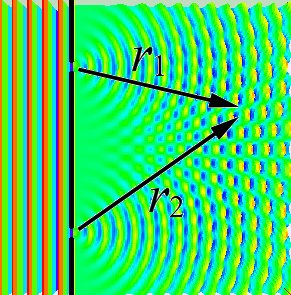
In two and three dimensions, waves from point sources are circular or spherical, and their interference patterns depend on the path difference between sources. - Excess Pressure: - Two Sources: - Path Difference: - Phase Difference: - Interference Conditions: Same as above. 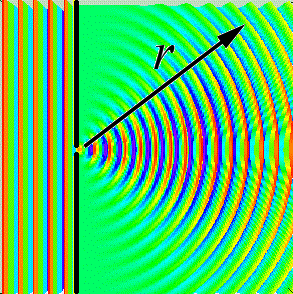
Beats
Formation of Beats
Beats occur when two waves of slightly different frequencies interfere, resulting in a periodic variation in amplitude. - Wave Equations: , - Superposition: - Beat Frequency: - Beat Period: - Amplitude Maxima: Occur when 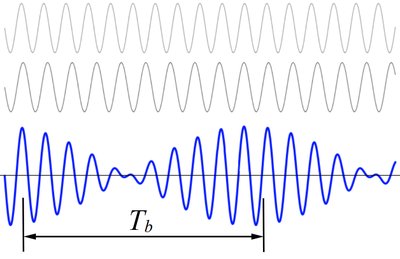
Exercises and Applications
Exercise 1: Human Ear and Speech Frequencies
- Natural Frequencies of Human Ear: Determined by the length of the auditory canal (~25 mm). - Loudest Sounds: 3-4 kHz frequencies are perceived as loudest due to resonance in the ear canal. - Typical Speech Frequencies: Human speech typically ranges from 85 Hz to 255 Hz (male and female voices), with the vocal tube length (~17 cm) influencing the fundamental frequency.
Exercise 2: Interference from Two Speakers
- Setup: Two speakers 3.0 m apart, listener moves perpendicular to the line connecting them. - First Cancellation: Occurs at a point where the path difference equals half a wavelength (), resulting in destructive interference. - Frequency Calculation: Use geometry and interference conditions to solve for the oscillator frequency. 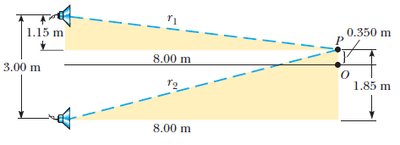
Exercise 3: Piano Tuning and Beats
- Beats Heard: 2.00 beats/s between reference oscillator (523 Hz) and string. - Possible String Frequencies: Hz (521 Hz or 525 Hz). - After Tightening: 3.00 beats/s heard, so Hz (520 Hz or 526 Hz). - Percentage Change in Tension: To bring the string into tune, calculate the required change in tension using the relationship , where is tension.
Step | Calculation |
|---|---|
Initial Beat Frequency | |
After Tightening | |
Required Frequency | Hz |
Percentage Change |
Example: If the string is at 526 Hz, to decrease to 523 Hz: so or 1.14%. Additional info: The exercises reinforce the concepts of resonance, interference, and beats in practical contexts such as hearing and musical tuning.
