 Back
BackRolling Motion, Angular Momentum, and Equilibrium – Study Notes
Study Guide - Smart Notes
 Tailored notes based on your materials, expanded with key definitions, examples, and context.
Rolling Motion, Angular Momentum, and Equilibrium
Combining Translation and Rotation
Many physical systems involve both translational and rotational motion. Understanding how these motions combine is essential for analyzing rolling objects, such as wheels and cylinders.
Translational Motion: The movement of the center of mass of an object in a straight line.
Rotational Motion: The spinning of an object around an axis, often through its center of mass.
Rolling Without Slipping: Occurs when the point of contact between a rolling object and the surface is momentarily at rest relative to the surface.
Rolling With Slipping: Happens when the object slides as it rolls, so the velocity at the contact point is not zero.
Combined Motion: The velocity of any point on a rolling object is the vector sum of the translational velocity of the center of mass and the rotational velocity about the center of mass.
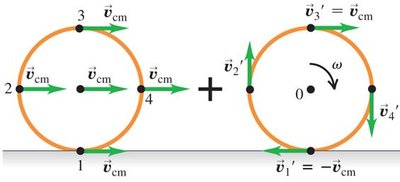
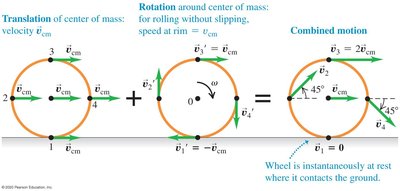
Example: A wheel rolling without slipping has its lowest point instantaneously at rest relative to the ground.
Center of Mass
The center of mass is the point at which the mass of a system or body can be considered to be concentrated for the purposes of analyzing translational motion.
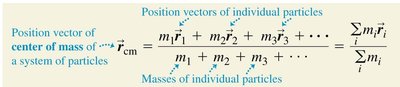
Definition: For a system of particles, the position vector of the center of mass is given by:
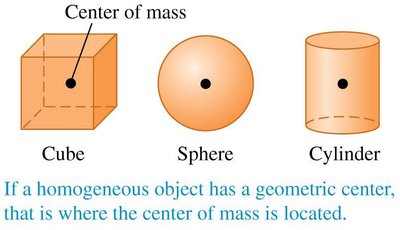
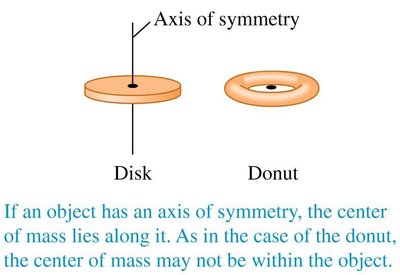
Symmetrical Objects: For homogeneous objects with geometric centers, the center of mass is at the geometric center.
Axis of Symmetry: For objects with an axis of symmetry, the center of mass lies along that axis. For example, a donut's center of mass is at the center of the hole, which is not within the material of the object.
Kinetic Energy in Rolling Motion
When a rigid body rolls, its total kinetic energy is the sum of the translational kinetic energy of its center of mass and the rotational kinetic energy about its center of mass.
Translational Kinetic Energy:
Rotational Kinetic Energy:
Total Kinetic Energy:
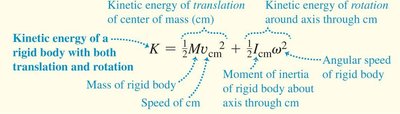
Example: For a solid sphere rolling without slipping, and .
Angular Momentum
Linear and Angular Momentum
Momentum is a fundamental concept in physics, with both linear and angular forms. Each has its own conservation law and is associated with different types of motion.
Linear Momentum:

Angular Momentum (for a particle):

Conservation of Angular Momentum: If the net external torque on a system is zero, the total angular momentum remains constant.
Example: A spinning figure skater pulls in their arms to spin faster, conserving angular momentum.
Equilibrium
Conditions for Equilibrium
An object is in equilibrium when it is at rest or moving with constant velocity, and there is no net force or net torque acting on it. There are two main conditions for equilibrium:
First Condition (Translational Equilibrium): The vector sum of all external forces must be zero.

Second Condition (Rotational Equilibrium): The vector sum of all external torques about any axis must be zero.

Example: A bridge supported at both ends with equal weights distributed symmetrically is in equilibrium.
Weight and Center of Gravity
The weight of an object is the force of gravity acting on it. For extended bodies, the weight can be considered to act at a single point called the center of gravity, which coincides with the center of mass if gravity is uniform.
Definition: The center of gravity is the point where the total gravitational torque on the body is zero.
Application: In equilibrium problems, treat the entire weight as acting at the center of gravity.
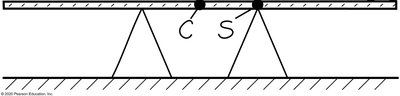
Equilibrium Example Problems
Solving equilibrium problems involves drawing free-body diagrams, applying the conditions for equilibrium, and solving for unknown forces or torques.
Step 1: Draw a diagram showing all forces acting on the object.
Step 2: Write equations for the sum of forces in each direction (usually x and y).
Step 3: Write equations for the sum of torques about a convenient axis.
Step 4: Solve the equations for the unknowns (e.g., tension, normal force).
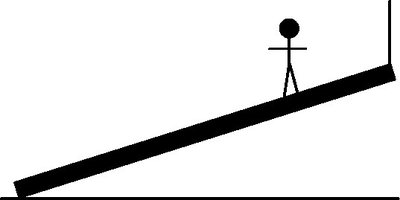
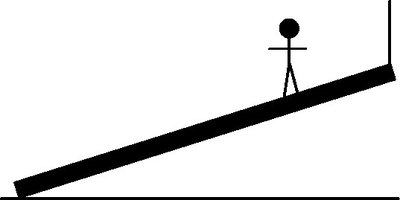
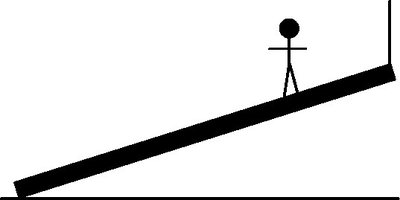
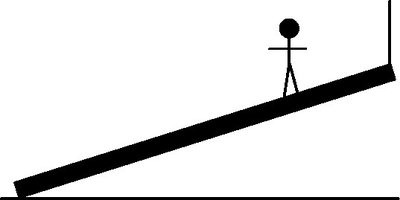
Example: A uniform plank supported at one end by the floor and at the other by a rope, with a person standing on it. Find the tension in the rope and the force exerted by the floor.
Summary Table: Conditions for Equilibrium
Condition | Mathematical Expression | Physical Meaning |
|---|---|---|
Translational Equilibrium | No net force; object does not accelerate linearly | |
Rotational Equilibrium | No net torque; object does not accelerate rotationally |
Additional info: These principles are foundational for analyzing static and dynamic systems in physics, including engineering structures, vehicles, and biological systems.
