 Back
BackRolling, Torque, and Angular Momentum: Study Notes
Study Guide - Smart Notes
 Tailored notes based on your materials, expanded with key definitions, examples, and context.
Rolling, Torque, and Angular Momentum
Rolling as Translation and Rotation Combined
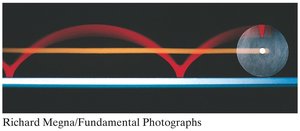
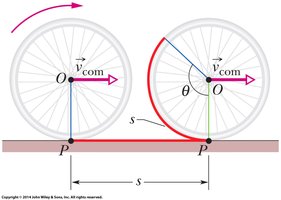
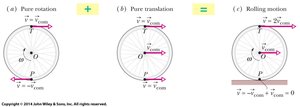
When an object rolls smoothly (without slipping), its motion can be described as a combination of pure translation of its center of mass and pure rotation about its center of mass. The center of mass moves in a straight line parallel to the surface, while the object rotates around this point.
Smooth rolling means the point of contact with the surface is instantaneously at rest relative to the surface.
The velocity of the center of mass (vcom) and the angular velocity (\omega) are related by vcom = R\omega, where R is the radius of the rolling object.
At the top of the wheel, the linear speed is 2vcom; at the bottom, it is zero relative to the surface.
Forces and Kinetic Energy of Rolling
The kinetic energy of a rolling object is the sum of its translational kinetic energy (due to the motion of the center of mass) and its rotational kinetic energy (due to rotation about the center of mass).
Translational kinetic energy:
Rotational kinetic energy:
Total kinetic energy:
For smooth rolling,

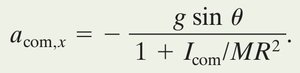
When a rolling object moves up or down a ramp, the forces acting on it include gravity, the normal force, and static friction. The frictional force is necessary for rolling without slipping and provides the torque that causes rotation.
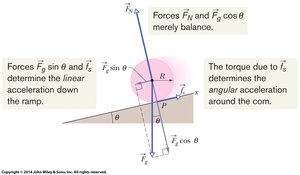
The acceleration of the center of mass for a rolling object on an incline is:
Friction is essential for rolling; without it, the object would slide instead of roll.
The Yo-Yo as a Rolling Object
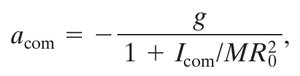
A yo-yo moving up or down its string is analogous to an object rolling up or down a ramp with a 90° incline. The tension in the string provides the torque necessary for rotation.
The acceleration of the yo-yo is given by:
Torque as a Vector Quantity
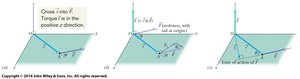
Torque is a vector quantity that measures the tendency of a force to rotate an object about a point or axis. The point about which torque is calculated must always be specified. The direction of torque is determined by the right-hand rule.
General equation for torque:
Magnitude:
Torque can also be expressed using the moment arm or the perpendicular component of force.
Angular Momentum
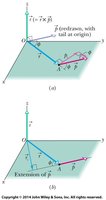
Angular momentum is a vector quantity that describes the rotational analog of linear momentum. It is defined for a particle as the cross product of its position vector and its linear momentum vector.
Angular momentum of a particle:
Magnitude:
The direction is perpendicular to the plane formed by r and p, determined by the right-hand rule.
Units: kg·m2/s (or J·s)
Newton's Second Law in Angular Form
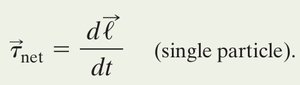
Newton's second law can be expressed in angular form, relating the net torque acting on a particle to the rate of change of its angular momentum.
Angular form:
This is analogous to the linear form:
Both torque and angular momentum must be defined with respect to the same point.

Angular Momentum of a Rigid Body
The angular momentum of a rigid body rotating about a fixed axis is the sum of the angular momenta of its constituent particles. For rotation about a fixed axis, the angular momentum is proportional to the rotational inertia and the angular velocity.
Angular momentum of a rigid body:
For a system of particles:
The net external torque on a system is equal to the time rate of change of the system's total angular momentum:
Conservation of Angular Momentum
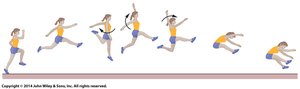
If the net external torque acting on a system is zero, the total angular momentum of the system remains constant, regardless of internal changes. This is the law of conservation of angular momentum.
Conservation law: (if )
Applies to isolated systems or when external torques are negligible.
Examples include a spinning figure skater pulling in arms to spin faster, or a diver tucking to increase rotation rate.
Precession of a Gyroscope
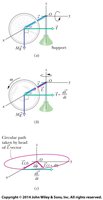
When a spinning gyroscope is subjected to an external torque (such as gravity), the direction of its angular momentum vector changes, causing the gyroscope to precess (rotate about a vertical axis). The precession rate is independent of the gyroscope's mass but depends on its geometry and spin rate.
Precession rate:
Precession occurs because the torque changes the direction, not the magnitude, of the angular momentum.
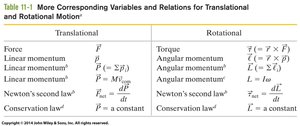
Summary Table: Translational vs. Rotational Motion
The following table summarizes the correspondence between translational and rotational variables and laws:
Translational | Rotational |
|---|---|
Force, | Torque, |
Linear momentum, | Angular momentum, |
Newton's second law, | Newton's second law, |
Conservation law, constant | Conservation law, constant |
Key Equations
Additional info: These notes expand on the provided slides and textbook images by including definitions, equations, and academic context for each topic. Examples and applications are included where relevant to reinforce understanding.
