 Back
BackRolling, Torque, and Angular Momentum: Study Notes
Study Guide - Smart Notes
 Tailored notes based on your materials, expanded with key definitions, examples, and context.
Rolling, Torque, and Angular Momentum
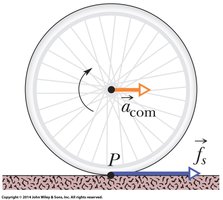
Rolling as Translation and Rotation Combined
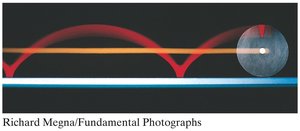
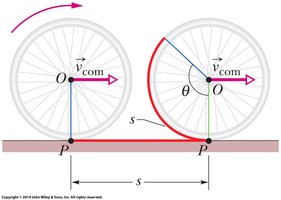
When an object rolls smoothly (without slipping), its motion can be described as a combination of pure translation of its center of mass and pure rotation about its center of mass. The center of mass moves in a straight line parallel to the surface, while the object rotates around this point.
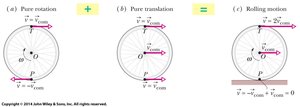
Pure Translation: Every point on the object moves with the same velocity as the center of mass.
Pure Rotation: Every point on the object moves in a circle around the center of mass.
Rolling Motion: The velocity at any point is the vector sum of the translational and rotational velocities.
Condition for Smooth Rolling: The point of contact with the surface is instantaneously at rest relative to the surface.
Relationship: where is the center-of-mass speed, is the radius, and is the angular speed.
Velocity at Top and Bottom: The top of a rolling wheel moves at , the bottom at $0$ (relative to the ground).
Checkpoint Example
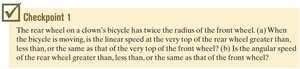
Question: If the rear wheel of a bicycle has twice the radius of the front wheel, is the linear speed at the top of the rear wheel greater than, less than, or the same as that of the front wheel? Is the angular speed greater than, less than, or the same?
Answer: (a) The same; (b) Less than.
Forces and Kinetic Energy of Rolling
The kinetic energy of a rolling object is the sum of its translational kinetic energy (due to the motion of the center of mass) and its rotational kinetic energy (due to rotation about the center of mass).
Total Kinetic Energy:
Work-Energy Principle: The work done on a rolling object changes its total kinetic energy.
Mechanical Energy Conservation: For smooth rolling (no slipping), mechanical energy is conserved.
Friction: Static friction is necessary for rolling without slipping; it does no work if there is no slipping.

Rolling Down a Ramp
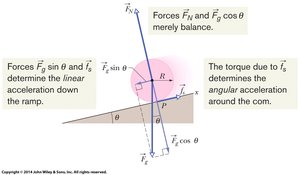
Forces: Gravity acts downward, the normal force is perpendicular to the ramp, and friction acts up the ramp.
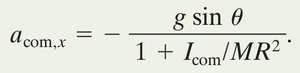
Acceleration: The acceleration of the center of mass is given by:
Role of Friction: Friction provides the torque necessary for rotation; without it, the object would slide instead of roll.

Checkpoint Example
Question: Two identical disks roll with equal speeds. Disk A rolls up a rough incline, disk B up a frictionless incline. Which reaches a greater height?
Answer: Disk A reaches a greater height because all kinetic energy (translational and rotational) is converted to potential energy. For disk B, only translational kinetic energy is converted.
The Yo-Yo as a Rolling Object
A yo-yo moving up or down its string is analogous to an object rolling up or down a ramp with a 90° incline. The tension in the string provides the torque necessary for rotation.
Energy Transformation: As the yo-yo descends, it loses potential energy and gains both translational and rotational kinetic energy.
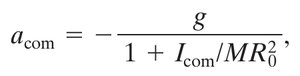
Acceleration:
Tension: The tension in the string slows the descent compared to free fall.
Torque Revisited
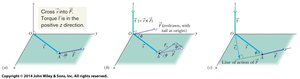
Torque is a vector quantity that measures the tendency of a force to rotate an object about a specified point. The direction of torque is determined by the right-hand rule.
Definition:
Magnitude: where is the angle between and .
Moment Arm:
Point of Calculation: Always specify the point about which torque is calculated.

Angular Momentum
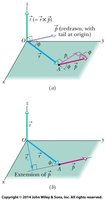
Angular momentum is a vector quantity that describes the rotational analog of linear momentum. It is defined with respect to a specific origin.
Definition for a Particle:
Magnitude:
Direction: Perpendicular to the plane formed by and (right-hand rule).
Units: kg·m2/s or J·s
Newton's Second Law in Angular Form
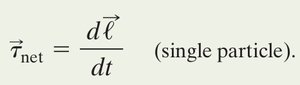
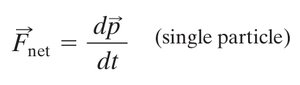
Newton's second law for rotation relates the net torque acting on a particle to the rate of change of its angular momentum, both defined with respect to the same point.
Angular Form: (single particle)
Comparison: Analogous to for linear motion.

Angular Momentum of a Rigid Body
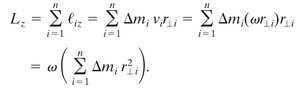
The angular momentum of a rigid body rotating about a fixed axis is the sum of the angular momenta of its constituent particles. For rotation about a fixed axis, it simplifies to .
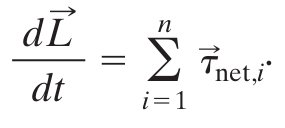
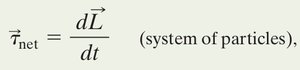
System of Particles:
Rate of Change:
Rigid Body: where is the rotational inertia about the axis.
Multiple Bodies: Total angular momentum is the sum for each body about the same axis.


Conservation of Angular Momentum
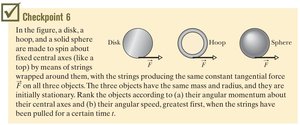
If no external net torque acts on a system along a specified axis, the angular momentum of the system about that axis remains constant. This is a fundamental conservation law in rotational dynamics.
Conservation Law:
Component Form: Each component (x, y, z) is conserved separately if no external torque acts along that axis.
Changing Mass Distribution: If the distribution of mass changes but no external torque acts, .
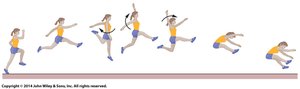
Applications: Figure skaters, divers, and long jumpers change their rotational inertia to control their spin rate.



Precession of a Gyroscope
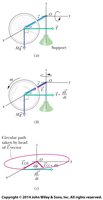
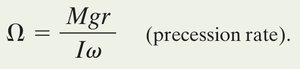
A spinning gyroscope subjected to gravity experiences a torque that causes its angular momentum vector to rotate about the vertical axis, a motion known as precession. The precession rate is independent of the gyroscope's mass but depends on its geometry and spin rate.
Precession: The axis of a spinning gyroscope rotates around the vertical due to torque from gravity.
Angular Momentum: The torque changes only the direction, not the magnitude, of the angular momentum vector.
Precession Rate:
Independence from Mass: The precession rate does not depend on the mass of the gyroscope.
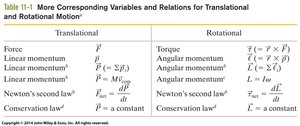
Summary Table: Translational vs. Rotational Motion
Translational | Rotational |
|---|---|
Force | Torque |
Linear momentum | Angular momentum |
Newton's second law | Newton's second law |
Conservation law constant | Conservation law constant |
