 Back
BackRotation of a Rigid Body and Rotational Dynamics
Study Guide - Smart Notes
 Tailored notes based on your materials, expanded with key definitions, examples, and context.
Rotation of a Rigid Body
Rotational Kinetic Energy
When a rigid body rotates about a fixed axis, each particle in the body has kinetic energy due to its motion. The total rotational kinetic energy is the sum of the kinetic energies of all the particles:
Rotational Kinetic Energy:
Moment of Inertia (I): (sum over all particles, where is the mass and is the distance from the axis)
Angular Velocity (\omega): The rate at which the body rotates about the axis.
Example: A rotating disk, where mass is distributed farther from the axis, has a larger moment of inertia and thus more rotational kinetic energy for the same angular velocity.
Rotational Dynamics and Newton's Laws
Rotational motion has direct analogies to linear motion. The key quantities and their rotational counterparts are summarized below:
Linear Quantity | Rotational Quantity |
|---|---|
Force () | Torque () |
Mass () | Moment of Inertia () |
Acceleration () | Angular Acceleration () |
Newton's 2nd Law: | |
Kinetic Energy: |
Conservation of Energy in Rotational Motion
In the absence of non-conservative forces (like friction), the total mechanical energy is conserved. For a rotating body, this includes both rotational kinetic energy and gravitational potential energy:
If the axis of rotation does not pass through the center of mass, the potential energy changes as the object rotates.
Example Problem: Rotating Meter Stick
A 70 g meter stick pivoted at one end is released from the horizontal. To find the speed of the far end at the lowest position, use conservation of energy:
Initial potential energy is converted to rotational kinetic energy at the bottom.
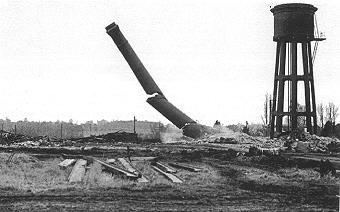
Toppling Chimneys
When tall structures like chimneys fall, the upper sections can experience large tangential accelerations, causing them to break before hitting the ground. This is due to shear forces exerted by the lower sections.
Rolling Motion
Rolling Without Slipping
Rolling motion combines rotation and translation. For an object rolling without slipping:
Each point on the rim traces a cycloid path.
The center of mass moves in a straight line, covering per revolution.
The velocity of the center of mass:
Velocity of Points on a Rolling Wheel
The velocity of a point on a rolling wheel is the vector sum of the translational velocity of the center of mass and the rotational velocity about the center:
At the bottom point (P), the velocities cancel, so (instantaneously at rest).
At the top, .

Kinetic Energy of a Rolling Object
The total kinetic energy of a rolling object is the sum of its rotational kinetic energy about the center of mass and the translational kinetic energy of the center of mass:
This can be derived using the parallel axis theorem:

The Great Downhill Race
When different objects roll down an incline, their acceleration depends on their moment of inertia. The final speed at the bottom is given by:
For ,
Objects with more mass concentrated farther from the axis (larger ) accelerate more slowly.



Rolling Friction
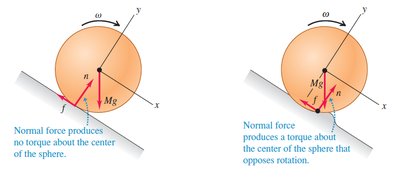
Rolling friction arises due to deformations at the contact point between the rolling object and the surface. The normal force may exert a torque that opposes rotation, and some sliding can occur, leading to energy loss.
Vector Description of Rotational Motion
Angular Velocity as a Vector
Rotational quantities such as angular velocity are vectors. Their direction is given by the right-hand rule: curl the fingers in the direction of rotation, and the thumb points in the direction of the vector.
The Cross Product and Torque
The torque produced by a force applied at a distance from a pivot is given by the cross product:
Magnitude:
The cross product is maximal when vectors are perpendicular and zero when parallel.
Angular Momentum
Definition and Conservation
Angular momentum () is the rotational analog of linear momentum. For a particle:
For a rigid body:
Units: kg·m2/s
Conservation Law: If the net external torque is zero, angular momentum is conserved:
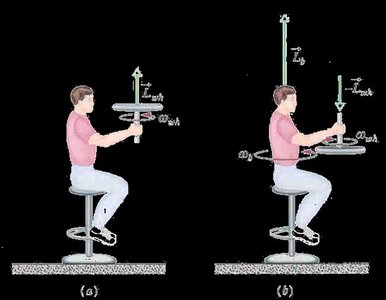
Example: Rotating Student and Bicycle Wheel
A student on a rotating stool holding a spinning wheel demonstrates conservation of angular momentum. When the wheel is inverted, the student and stool rotate to conserve total angular momentum.
General Case: Non-Circular Motion
For non-circular motion, angular momentum is still defined as , where and may not be perpendicular. The time derivative of angular momentum gives the net torque:
This is analogous to in linear motion.
Summary Table: Linear vs. Rotational Quantities
Linear | Rotational |
|---|---|
Momentum: | Angular Momentum: |
Kinetic Energy: | Rotational Kinetic Energy: |
Conservation: conserved if | conserved if |
