 Back
BackRotation of a Rigid Body: Kinematics, Dynamics, and Energy
Study Guide - Smart Notes
 Tailored notes based on your materials, expanded with key definitions, examples, and context.
Rigid Body Motion
Introduction to Rigid Body Motion
Rigid body motion is a fundamental concept in physics, describing the movement of objects whose size and shape remain constant during motion. Unlike the particle model, which treats objects as point masses, the rigid body model considers the internal structure and distribution of mass.
Rigid Body: An object that does not deform, compress, or stretch during motion.
Types of Motion: Translational, rotational, and combinations of both.
All points on a rigid body share the same angular velocity and angular acceleration.

Rotational Kinematics
Angular Displacement, Velocity, and Acceleration
Rotational kinematics describes the motion of objects as they rotate about an axis. The key variables are angular displacement (θ), angular velocity (ω), and angular acceleration (α).
Angular Displacement (θ): The angle through which a point or line has been rotated in a specified sense about a specified axis.
Angular Velocity (ω): The rate of change of angular displacement: (unit: rad/s).
Angular Acceleration (α): The rate of change of angular velocity: (unit: rad/s2).
Sign Conventions: Counterclockwise (CCW) is positive, clockwise (CW) is negative.
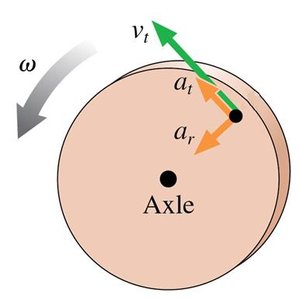
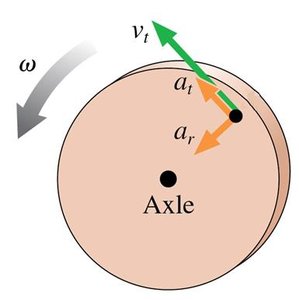
Tangential and Radial Quantities
Each point on a rotating rigid body has both tangential and radial components of velocity and acceleration.
Tangential Velocity:
Radial (Centripetal) Acceleration:
Tangential Acceleration:
Total Velocity and Acceleration: ,
Kinematic Equations for Rotational Motion
For constant angular acceleration, the following equations apply (analogous to linear kinematics):
Center of Mass
Definition and Calculation
The center of mass (CM) is the mass-weighted average position of all the particles in an object. For a system of particles:
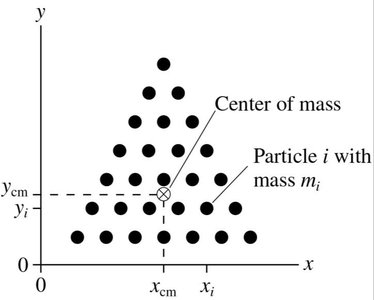
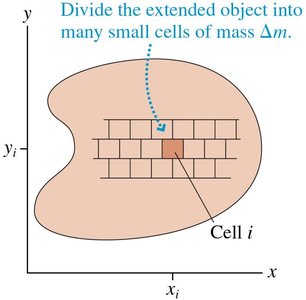
For continuous objects, the sums become integrals:
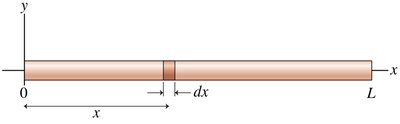
Example: Uniform Rod
For a uniform rod of length L and mass M, the center of mass is at its midpoint:
Rotational Kinetic Energy and Moment of Inertia
Rotational Kinetic Energy
Each particle in a rotating object has kinetic energy due to its motion. The total rotational kinetic energy is:
where I is the moment of inertia, the rotational analog of mass.
Moment of Inertia
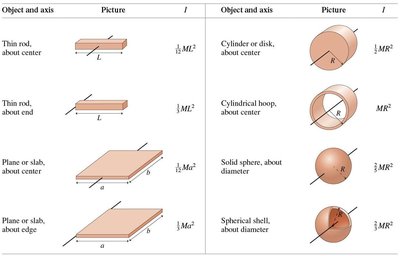
The moment of inertia depends on the mass distribution and the axis of rotation:
(discrete particles)
(continuous mass distribution)
Common moments of inertia for standard shapes are tabulated for reference.
Parallel-Axis Theorem
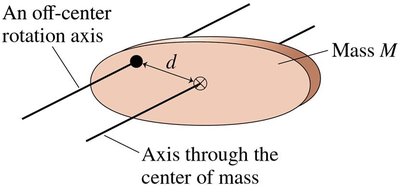
If the axis of rotation is a distance d from the center of mass, the moment of inertia is:
Torque and Rotational Dynamics
Definition of Torque
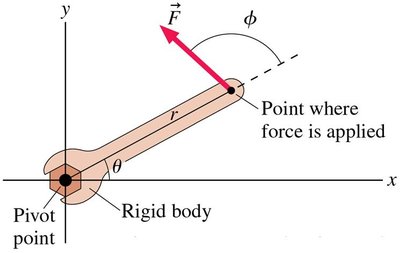
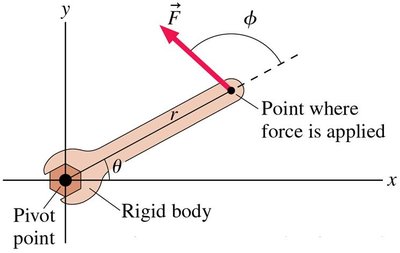
Torque is the rotational equivalent of force, quantifying the ability of a force to cause rotation:
Magnitude:
Unit: Newton-meter (N·m)
Lever Arm and Line of Action
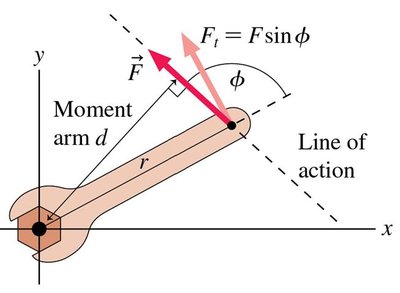
The lever arm (d) is the perpendicular distance from the axis of rotation to the line of action of the force:
Newton's Second Law for Rotation
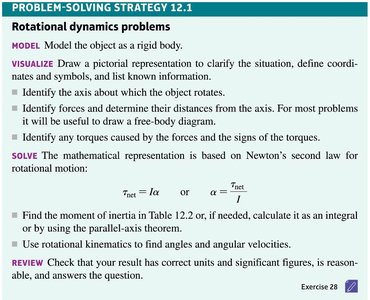
The rotational analog of Newton's second law relates net torque to angular acceleration:
Constraints Due to Ropes and Pulleys
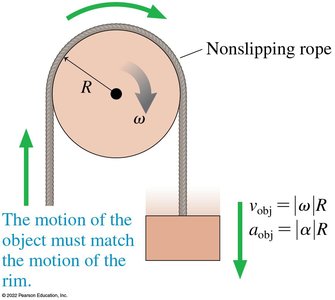
When a rope passes over a pulley without slipping, the velocity and acceleration of the rope match those at the rim of the pulley:
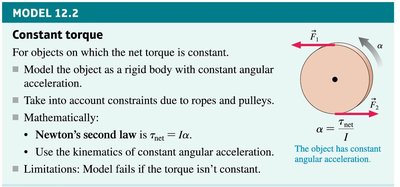
Constant Torque Model
For objects with constant net torque, angular acceleration is also constant:
Use and rotational kinematics for constant acceleration.
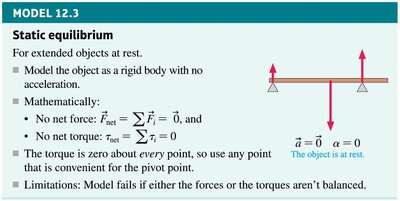
Static Equilibrium
An object is in static equilibrium if both the net force and net torque are zero:
Rolling Motion
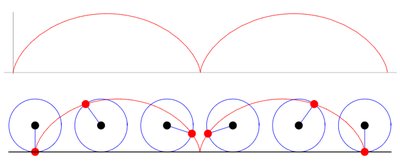
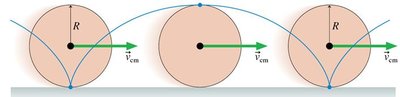
Rolling Without Slipping
When an object rolls without slipping, its center of mass moves a distance equal to the circumference in one revolution:
(rolling constraint)
Kinetic Energy of Rolling Objects
The total kinetic energy of a rolling object is the sum of translational and rotational energies:
Rotational Motion and Vectors
Angular Velocity and the Right-Hand Rule
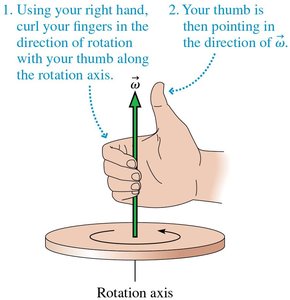
The direction of angular velocity and angular acceleration vectors is determined by the right-hand rule: curl the fingers in the direction of rotation, and the thumb points along the axis.
Vector Cross Product
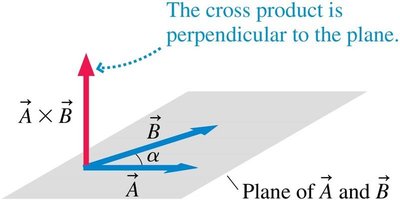
The cross product of two vectors yields a vector perpendicular to the plane of the original vectors, with magnitude .
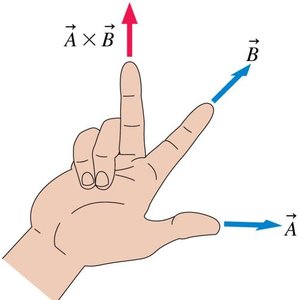
Right-Hand Rule for Cross Product
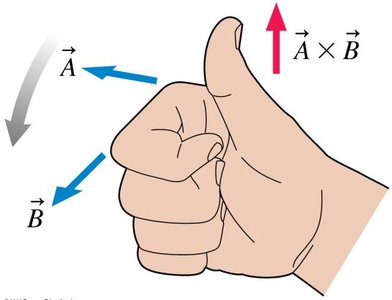
To find the direction of the cross product , use the right-hand rule: point your fingers in the direction of , curl toward , and your thumb points in the direction of the result.
Angular Momentum
Definition and Conservation
Angular momentum is the rotational analog of linear momentum:
For a particle in circular motion:
For a rigid body about a fixed axis:
Conservation: If , then
Newton's Second Law for Rotation (Angular Momentum Form)
Comparison of Linear and Rotational Motion
Rotational Motion | Linear Motion |
|---|---|
Angular momentum conserved if | Momentum conserved if |
Additional info: This guide includes expanded explanations, examples, and formulas to ensure a comprehensive understanding of rotational dynamics, suitable for college-level physics students.
