 Back
BackRotation of Rigid Bodies and Torque – Study Notes
Study Guide - Smart Notes
 Tailored notes based on your materials, expanded with key definitions, examples, and context.
Rotation of Rigid Bodies and Torque
Introduction to Rotational Motion
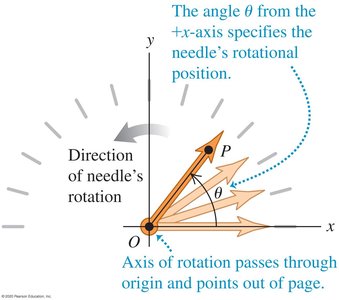
Rotational motion describes the movement of objects around a fixed axis. Unlike linear motion, where all points move in the same direction, in rotational motion, all points rotate through the same angle in a given time interval. The position of a rotating object can be specified by the angle θ it makes with a reference axis.
Angular Velocity and Angular Acceleration
Just as velocity and acceleration describe linear motion, angular velocity (ω) and angular acceleration (α) describe rotational motion. These quantities are defined as follows:
Instantaneous angular velocity:
Instantaneous angular acceleration:
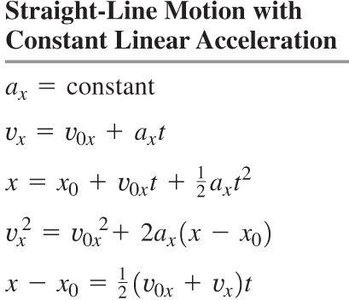
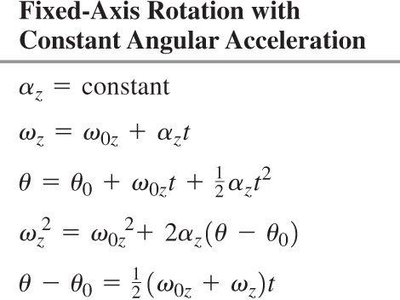
For constant angular acceleration, the equations of motion are analogous to those for linear acceleration:
Angular Displacement and Radians
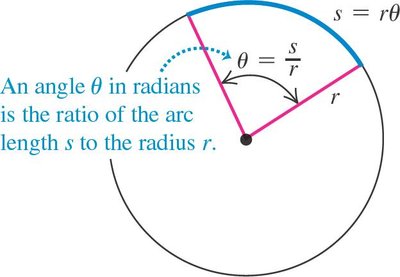
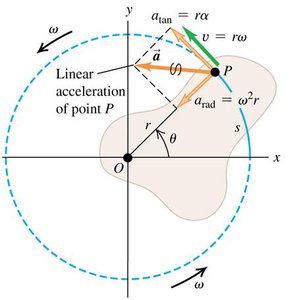
The angle θ is measured in radians, where one radian is the angle subtended by an arc length equal to the radius of the circle. The relationship between arc length s, radius r, and angle θ is:
Linking Linear and Angular Kinematics
For a point at a distance r from the axis of rotation, the linear (tangential) speed v is related to the angular speed ω by:

The tangential and radial (centripetal) accelerations are given by:
Tangential acceleration:
Radial (centripetal) acceleration:
Moment of Inertia
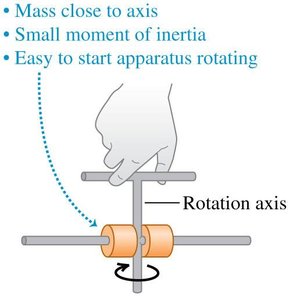
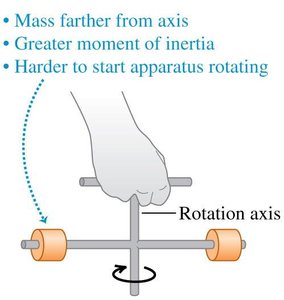
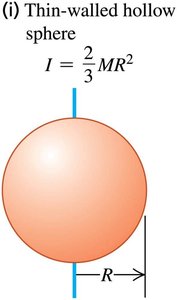
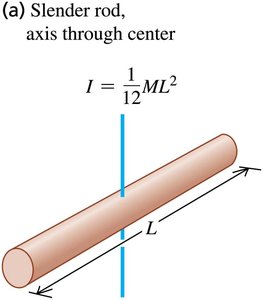
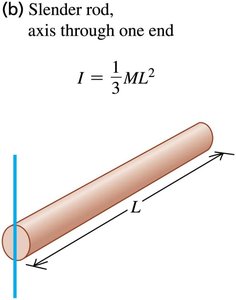
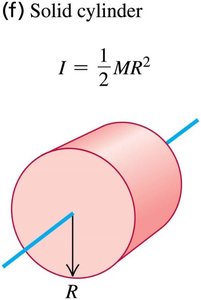
The moment of inertia (I) quantifies how mass is distributed relative to the axis of rotation and determines how difficult it is to change an object's rotational motion. It is defined as:

Objects with mass farther from the axis have a larger moment of inertia and are harder to rotate.
Common Moments of Inertia
Object | Moment of Inertia (I) |
|---|---|
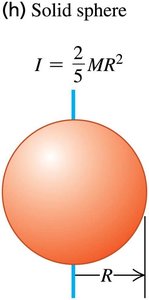
Solid sphere | |
Thin-walled hollow sphere | |
Slender rod (center) | |
Slender rod (end) | |
Solid cylinder | |
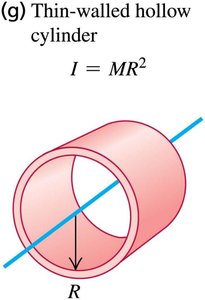
Thin-walled hollow cylinder |
Rotational Kinetic Energy
The kinetic energy of a rotating rigid body is given by:

Torque
Torque (τ) is the rotational equivalent of force. It measures the tendency of a force to rotate an object about an axis. The magnitude of torque is given by:
Where r is the distance from the axis of rotation to the point of application of the force, F is the magnitude of the force, and θ is the angle between the force and the lever arm.
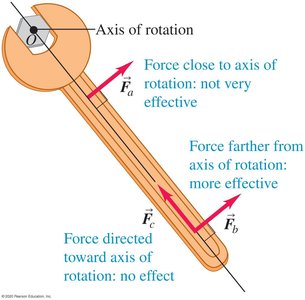
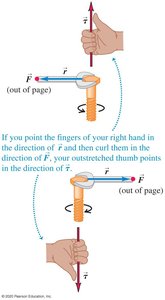
Forces applied farther from the axis or at a greater angle produce more torque. The direction of torque is determined by the right-hand rule.
Torque and Angular Acceleration (Newton's Second Law for Rotation)
Newton's second law for rotation relates net torque to angular acceleration:
This equation is the rotational analogue of for linear motion.
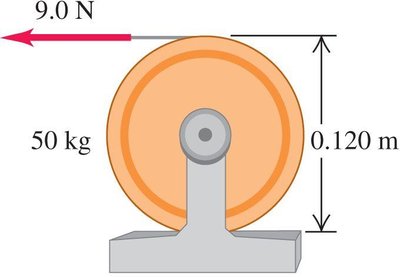
Worked Example: Calculating Torque
Consider a force of 9.0 N applied tangentially to a wheel of radius 0.120 m. The torque produced is:
Summary Table: Linear vs. Rotational Quantities
Linear Motion | Rotational Motion |
|---|---|
Displacement: | Angular displacement: |
Velocity: | Angular velocity: |
Acceleration: | Angular acceleration: |
Mass: | Moment of inertia: |
Force: | Torque: |
Newton's 2nd Law: | Rotational analogue: |
Additional info: The above notes synthesize and expand upon the provided lecture slides, integrating standard textbook context for clarity and completeness.
