 Back
BackRotation of Rigid Bodies: Angular Kinematics and Dynamics
Study Guide - Smart Notes
 Tailored notes based on your materials, expanded with key definitions, examples, and context.
Rotation of Rigid Bodies
Introduction to Rotational Motion
Rotational motion is a fundamental aspect of physics, describing the movement of objects around a fixed axis. Examples include airplane propellers, ceiling fans, and Ferris wheels. In this chapter, we focus on the ideal case of perfectly rigid bodies, where the shape and size of the object do not change during rotation.

Angular Coordinate
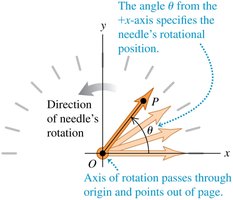
The angular coordinate, denoted as θ, specifies the rotational position of a point or object about a fixed axis. For example, the position of a car’s speedometer needle can be described by the angle it makes with a reference direction.
Reference Axis: The axis about which rotation occurs is typically labeled as the z-axis.
Measurement: The angle θ is measured from a fixed reference line (often the positive x-axis) to the position vector of the point.
Units of Angles
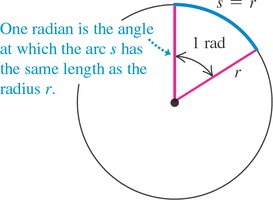
Angles can be measured in degrees, revolutions, or radians. The radian is the SI unit and is most useful in physics because it directly relates arc length to radius.
Definition of a Radian: One radian is the angle at which the arc length s equals the radius r of the circle.
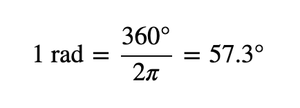
Conversion:
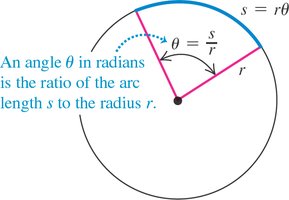
An angle θ in radians is given by the ratio of the arc length s to the radius r:
Angular Velocity and Acceleration
Average Angular Velocity
The average angular velocity describes how quickly an object rotates through an angle over a time interval. It is defined as:
The subscript z indicates rotation about the z-axis.
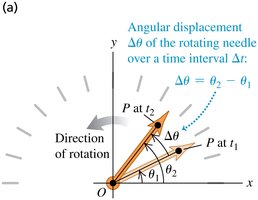
Sign Convention for Angular Velocity
By convention, angles increasing in the counterclockwise direction are positive, while those increasing clockwise are negative. This affects the sign of angular velocity:
Counterclockwise:
Clockwise:
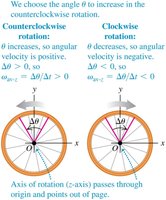
Instantaneous Angular Velocity
The instantaneous angular velocity is the rate of change of angular position at a specific instant:
It can be positive or negative, depending on the direction of rotation.

Angular Velocity as a Vector
Angular velocity is a vector quantity. Its direction is determined by the right-hand rule: curl the fingers of your right hand in the direction of rotation, and your thumb points in the direction of the angular velocity vector.
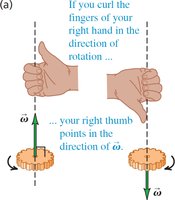
The sign of indicates whether the vector points in the positive or negative z-direction.
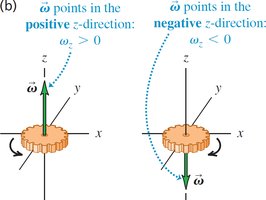
Angular Acceleration
Angular acceleration measures how quickly the angular velocity changes with time. The average angular acceleration is:
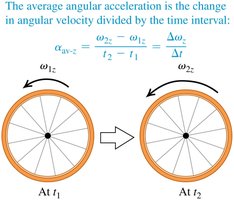
The instantaneous angular acceleration is:
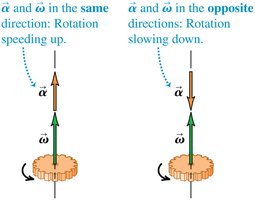
Angular acceleration is also a vector, and its direction is determined by whether the rotation is speeding up or slowing down.
Rotation with Constant Angular Acceleration
Kinematic Equations for Rotational Motion
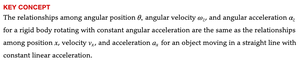
When angular acceleration is constant, the equations for rotational motion mirror those for linear motion:
These equations allow us to solve for angular displacement, velocity, and acceleration in rotational systems.
Relating Linear and Angular Kinematics
Linear Speed and Acceleration in Rotating Bodies
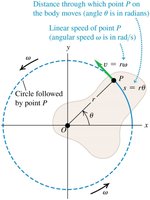
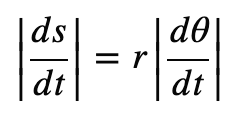
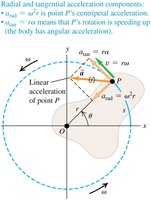
For a point at a distance r from the axis of rotation:
Linear speed:
Tangential acceleration:
Centripetal (radial) acceleration:
The Importance of Using Radians
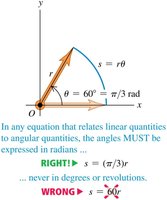
When relating linear and angular quantities, angles must always be expressed in radians. Using degrees or revolutions will yield incorrect results.
Examples and Applications
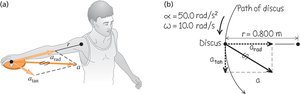
Example: Throwing a Discus
When an athlete throws a discus, the arm and discus rotate about the shoulder. The tangential and radial accelerations can be calculated using the above relationships.
Additional info: The notes above cover the foundational aspects of rotational kinematics, including angular displacement, velocity, acceleration, and their relationships to linear motion. The moment of inertia and rotational kinetic energy, as well as more advanced applications, would be covered in subsequent sections of the chapter.
