 Back
BackRotation of Rigid Bodies: Angular Kinematics and Dynamics
Study Guide - Smart Notes
 Tailored notes based on your materials, expanded with key definitions, examples, and context.
Rotation of Rigid Bodies
Introduction to Rotational Motion
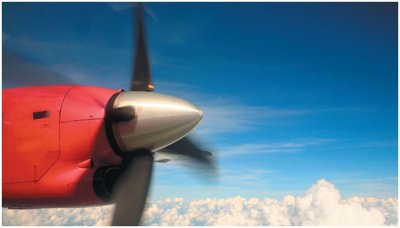
Rotational motion is a fundamental aspect of physics, describing the movement of objects around a fixed axis. Examples include airplane propellers, revolving doors, ceiling fans, and Ferris wheels. In this chapter, we focus on the rotation of perfectly rigid bodies, where the distances between all particles remain constant during motion.
Angular Coordinate
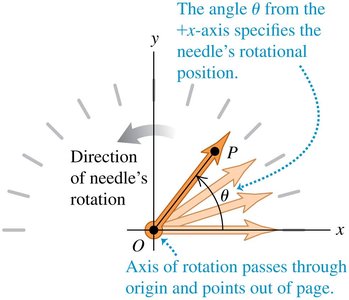
The angular coordinate, θ, specifies the rotational position of a point or object relative to a reference axis. It is measured from the positive x-axis in the plane of rotation, typically in radians.
Axis of Rotation: The fixed line about which the object rotates.
Reference Point: The origin or center of rotation.
Units of Angles
Angles can be measured in degrees or radians, but radians are the standard unit in physics for rotational motion.
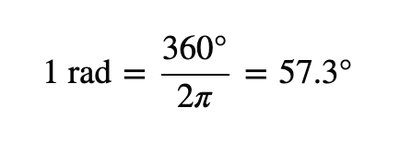
1 revolution = 360° = 2π radians
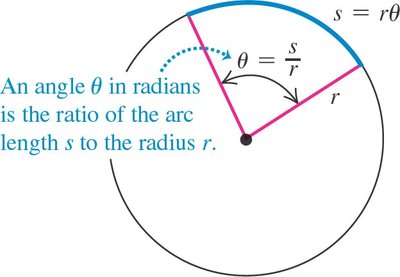
1 radian is the angle at which the arc length equals the radius of the circle.
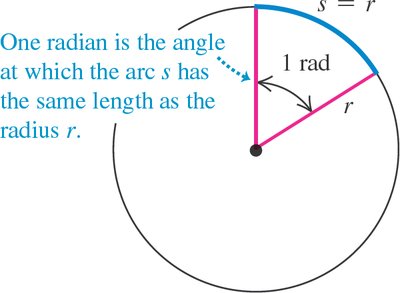
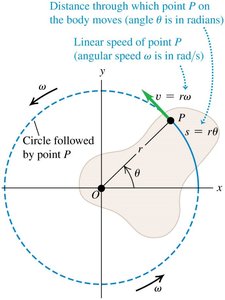
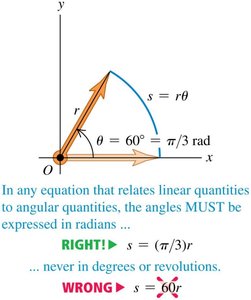
The relationship between arc length s, radius r, and angle θ (in radians) is:
Angular Displacement, Velocity, and Acceleration
Angular Displacement
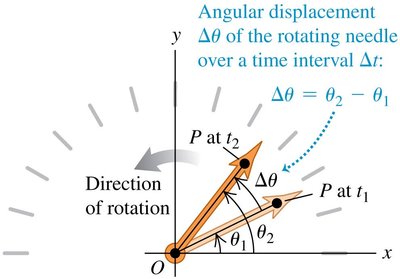
Angular displacement, Δθ, is the change in angular position over a time interval. It is analogous to linear displacement in straight-line motion.
Angular Velocity
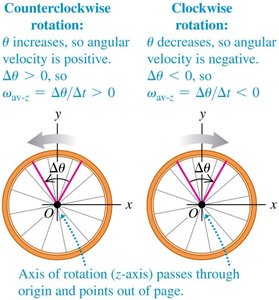
The average angular velocity is the rate of change of angular displacement with respect to time:
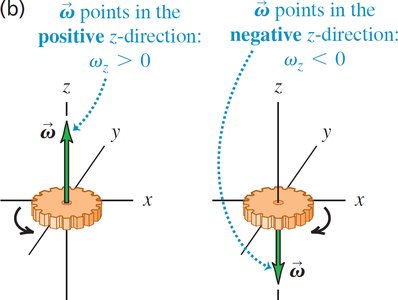
Counterclockwise rotation: θ increases, ω is positive.
Clockwise rotation: θ decreases, ω is negative.
Instantaneous Angular Velocity
The instantaneous angular velocity is the limit of the average angular velocity as the time interval approaches zero:

Angular Velocity as a Vector
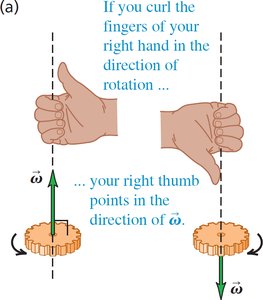
Angular velocity is a vector quantity. Its direction is determined by the right-hand rule: curl the fingers of your right hand in the direction of rotation, and your thumb points in the direction of the angular velocity vector.
Angular Acceleration
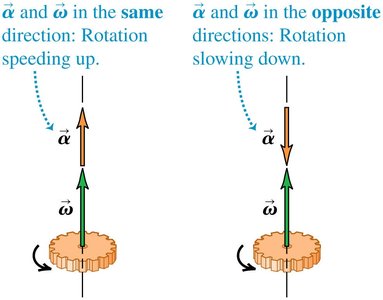
Angular acceleration, α, is the rate of change of angular velocity with respect to time:
Positive α: Angular velocity increases (speeds up).
Negative α: Angular velocity decreases (slows down).
Rotation with Constant Angular Acceleration
Kinematic Equations for Rotation
For constant angular acceleration, the equations of rotational motion mirror those of linear motion:
Linear Motion | Rotational Motion |
|---|---|
Key Concept: The mathematical structure of rotational kinematics is analogous to linear kinematics.
Relating Linear and Angular Kinematics
Linear Speed and Acceleration in Rotational Motion
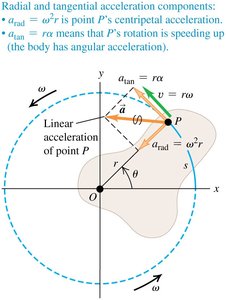
For a point at a distance r from the axis of rotation:
Linear speed:
Tangential acceleration:
Centripetal (radial) acceleration:
The Importance of Using Radians
When relating linear and angular quantities, angles must always be expressed in radians. Using degrees or revolutions will yield incorrect results.
Worked Examples
Example: Calculating Angular Position and Velocity
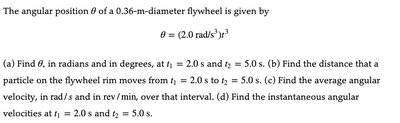
The angular position θ of a 0.36-m-diameter flywheel is given by .
(a) Find θ, in radians and degrees, at t₁ = 2.0 s and t₂ = 5.0 s.
(b) Find the distance that a particle on the flywheel rim moves from t₁ to t₂.
(c) Find the average angular velocity, in rad/s and rev/min, over that interval.
(d) Find the instantaneous angular velocities at t₁ and t₂.
Example: Calculating Angular Acceleration
For the flywheel above, find the average angular acceleration between t₁ = 2.0 s and t₂ = 5.0 s. Also, find the instantaneous angular accelerations at t₁ and t₂.

Example: Throwing a Discus
An athlete whirls a discus in a circle of radius 0.80 m. At a certain instant, the athlete is rotating at 10.0 rad/s and the angular speed is increasing at 50.0 rad/s². Find the tangential and centripetal components of the acceleration of the discus and the magnitude of the acceleration.

Example: Designing a Propeller
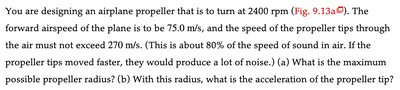
You are designing an airplane propeller to turn at 2400 rpm. The forward airspeed is 75.0 m/s, and the speed of the propeller tips must not exceed 270 m/s. (a) What is the maximum possible propeller radius? (b) With this radius, what is the acceleration of the propeller tip?
Summary Table: Linear vs. Rotational Kinematics
Linear Quantity | Rotational Quantity | Relationship |
|---|---|---|
Displacement (x) | Angular displacement (θ) | |
Velocity (v) | Angular velocity (ω) | |
Acceleration (a) | Angular acceleration (α) | |
Centripetal acceleration | — |
Additional info: The above notes include expanded academic context and explanations to ensure completeness and clarity for college-level physics students.
