 Back
BackRotation of Rigid Bodies: Angular Kinematics and Dynamics
Study Guide - Smart Notes
 Tailored notes based on your materials, expanded with key definitions, examples, and context.
Rotation of Rigid Bodies
Introduction to Rotational Motion
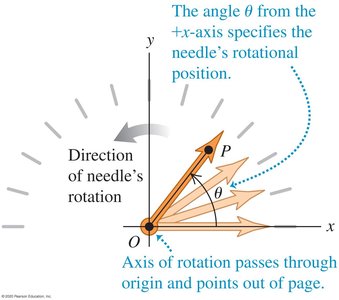
Rotational motion describes the movement of rigid bodies around a fixed axis. Unlike point particles, extended bodies require a more comprehensive approach to analyze their motion. In this section, we focus on the kinematics and dynamics of rigid bodies rotating about a fixed axis.
Rigid Body: An object with a definite shape that does not deform during motion.
Axis of Rotation: The straight line about which all points in the body move in circles.
All points on a rigid body rotate through the same angle in the same time interval.
Units of Angles
Degrees and Radians
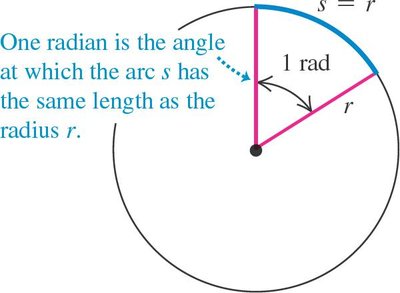
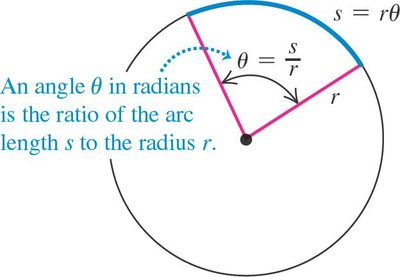
Angles in rotational motion are measured in degrees or radians. The radian is the SI unit for measuring angles and is defined based on the arc length and radius of a circle.
Degree (°): One complete revolution is 360°.
Radian (rad): One radian is the angle at which the arc length equals the radius of the circle.
Conversion: radians, so .
Angular Position, Velocity, and Acceleration
Definitions and Formulas
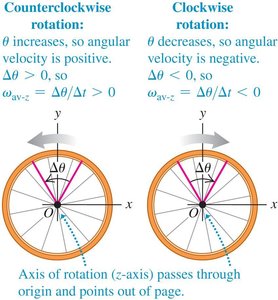
Angular kinematics describes how the rotational position, velocity, and acceleration of a body change with time.
Angular Position (θ): The angle a reference line makes with a fixed axis, measured in radians.
Angular Velocity (ω): The rate of change of angular position with respect to time.
Angular Acceleration (α): The rate of change of angular velocity with respect to time.
Mathematical definitions:
Instantaneous angular velocity:
Instantaneous angular acceleration:
Rotation with Constant Angular Acceleration
Kinematic Equations for Rotational Motion
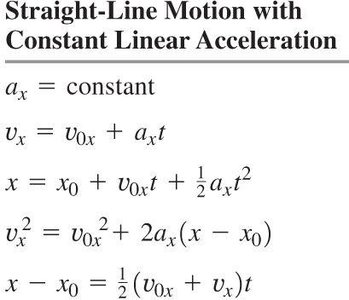
When angular acceleration is constant, the equations for rotational motion closely resemble those for linear motion with constant acceleration.
Angular acceleration:
Angular velocity:
Angular position:
Angular velocity squared:
Displacement:
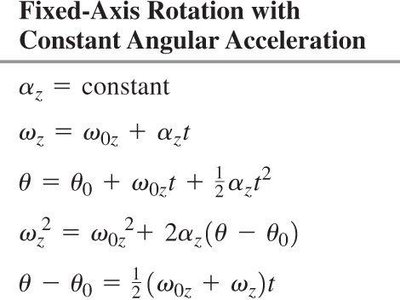
Comparison Table:
Linear Motion | Rotational Motion |
|---|---|
Relation Between Linear and Angular Kinematics
Connecting Rotational and Translational Quantities
For a point at a distance r from the axis of rotation, its linear (tangential) speed and acceleration are related to the angular quantities as follows:
Linear speed:
Tangential acceleration:
Centripetal (radial) acceleration:

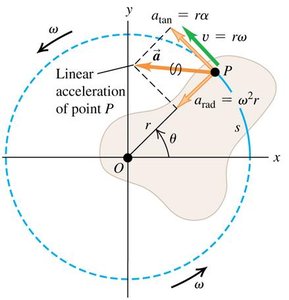
Example: If a point is 0.10 m from the axis and moves at 150 m/s, then rad/s. If the speed is constant, and m/s2.
Comparing Points on a Rotating Disk
Angular and Linear Speeds at Different Radii
All points on a rigid body share the same angular speed, but their linear speeds depend on their distance from the axis of rotation.
Angular speed (ω): Same for all points on the disk.
Linear speed (v): Increases with distance from the axis ().
Example: Point A on the edge of a disk and point B closer to the center have the same angular speed, but A has a greater linear speed because its radius is larger.
Summary Table: Key Rotational Kinematic Quantities
Quantity | Symbol | SI Unit | Formula |
|---|---|---|---|
Angular Position | radian (rad) | — | |
Angular Velocity | rad/s | ||
Angular Acceleration | rad/s2 | ||
Linear Speed | m/s | ||
Tangential Acceleration | m/s2 | ||
Centripetal Acceleration | m/s2 |
Additional info: These notes cover the foundational aspects of rotational kinematics, including the definitions, equations, and relationships necessary for analyzing rigid body rotation. For further study, see textbook sections on torque, moment of inertia, and rotational dynamics.
