 Back
BackRotation of Rigid Bodies – Comprehensive Study Notes
Study Guide - Smart Notes
 Tailored notes based on your materials, expanded with key definitions, examples, and context.
Rotation of Rigid Bodies
Rotational Position & Displacement
Rotational motion refers to the movement of an object around a fixed point, following a circular path. The rotational equivalent of linear position (x) is angular position (θ), and the equivalent of linear displacement (Δx) is angular displacement (Δθ).
Linear Position (x): Distance from the origin, measured in meters. The origin is arbitrary, and direction can be positive or negative.
Rotational Position (θ): Angle from a reference direction, measured in radians. The origin is typically at the center of rotation. Direction is positive for counterclockwise (CCW) and negative for clockwise (CW) rotation.
Relationship: (where r is the radius of the circle, and Δθ must be in radians).
Radians and Degrees: . To convert:
Example: An object moves along a circle of radius 10 m from 30° to 120°. Find (a) angular displacement and (b) linear displacement.
Displacement in Multiple Revolutions
When an object completes full revolutions around a circle:
One revolution: radians,
N revolutions: ,
Number of revolutions:
Example: If you make 2.2 revolutions around a circle of radius 20 m, calculate (a) rotational displacement in degrees, (b) degrees away from 0°, and (c) linear displacement.
Rotational Velocity & Acceleration
The rotational equivalents of linear velocity and acceleration are angular velocity (ω) and angular acceleration (α):
Average angular velocity: [rad/s]
Instantaneous angular velocity: [rad/s]
Average angular acceleration: [rad/s²]
Instantaneous angular acceleration: [rad/s²]
1 RPM = rad/s; 1 Hz = rad/s
Example: A 30-kg disc of radius 2 m rotates at 120 RPM. Calculate its (a) period and (b) angular speed.
Motion Equations for Rotation
Rotational motion equations are analogous to linear kinematics:
Linear | Rotational |
|---|---|
Example: A wheel accelerates from rest at 4 rad/s² to 80 rad/s. Find (a) the angle rotated (in degrees) and (b) the time taken.
Converting Between Linear and Rotational Quantities
Linear (tangential) and rotational (angular) variables are linked:
(tangential acceleration)
All points on a rigid body have the same angular quantities, but their linear speeds depend on their distance from the axis.
Example: A wheel of radius 8 m spins at 10 rad/s. Find angular and linear speeds at the center, halfway, and at the edge.
Types of Acceleration in Rotation
There are four types of acceleration in rotational motion:
Tangential acceleration (aT):
Radial (centripetal) acceleration (aC):
Total linear acceleration:
Angular acceleration (α):
Example: A carousel of radius 10 m completes one cycle every 45 s. Find the tangential velocity, angular acceleration, radial acceleration, tangential acceleration, and total linear acceleration for a point at the edge.
Rolling Motion (Free Wheels)
When a rigid body both rotates and translates (e.g., a rolling wheel), the center of mass moves with velocity , and the body rotates with angular velocity .
For rolling without slipping:
At the top of the wheel:
At the bottom:
Example: A wheel of radius 0.30 m rolls at 10 m/s. Find (a) angular speed and (b) speed at the bottom of the wheel relative to the floor.
Connected Wheels and Gears
When two wheels or gears are connected by a chain or belt, their angular velocities are related by their radii:
For gears: If one rotates clockwise, the other rotates counterclockwise.
Example: Two gears with radii 2 m and 3 m are connected. If the smaller spins at 40 rad/s, the larger spins at .
Moment of Inertia
The moment of inertia (I) quantifies an object's resistance to angular acceleration, depending on both mass and its distribution relative to the axis of rotation.
For a point mass:
For a solid disk (about center):
For a solid sphere (about center):
For a thin rod (about center):
For a thin rod (about end):
The total moment of inertia for a system is the sum of the moments of inertia of its parts.
Example: Two masses at the ends of a rod:
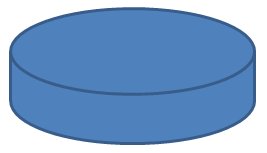
Parallel Axis Theorem
If the axis of rotation does not pass through the center of mass, the parallel axis theorem is used:
Where is the moment of inertia about the center of mass, is the total mass, and is the distance between axes.
Example: Find the moment of inertia of a disk about an axis at its rim:
Rotational Kinetic Energy
Objects with angular velocity possess rotational kinetic energy:
If an object both translates and rotates:
Example: A basketball of mass 0.62 kg, diameter 24 cm, spins at 15 rad/s. Calculate its linear, rotational, and total kinetic energy.
Conservation of Energy with Rotation
When both linear and rotational motion are present, the conservation of energy principle includes both kinetic energies:
Where
Example: A solid disc is pulled by a rope. Use conservation of energy to find the angular speed after the rope has unwound a certain distance.
Rotational Dynamics with Two Motions
When torque causes angular acceleration, and the system also has linear motion, use both Newton's second law for rotation and translation:
For rotation:
For translation:
Link:
Example: A block attached to a pulley: derive expressions for the acceleration of the block and the angular acceleration of the pulley.
Finding Moment of Inertia by Integration
For continuous mass distributions, the moment of inertia is found by integrating:
For a ring:
For a disk: (integration required for derivation)
Example: Find the moment of inertia for a non-uniform disk with mass distribution .
Summary Table: Common Moments of Inertia
Object | Axis | Moment of Inertia (I) |
|---|---|---|
Point mass | Distance r | |
Solid disk | Center | |
Solid sphere | Center | |
Thin rod | Center | |
Thin rod | End |
Practice and Applications
Calculate angular displacement, velocity, and acceleration for various rotating objects.
Apply conservation of energy to systems with both linear and rotational motion.
Use the parallel axis theorem for non-standard axes of rotation.
Integrate to find moments of inertia for complex mass distributions.
Additional info: These notes cover the core concepts, equations, and applications for the topic of rotation of rigid bodies, as found in a typical university physics course. All equations are provided in LaTeX format for clarity and academic rigor.
