 Back
BackRotation of Rigid Bodies II: Torque, Work, and Rolling Motion
Study Guide - Smart Notes
 Tailored notes based on your materials, expanded with key definitions, examples, and context.
Rotation of Rigid Bodies II
Torque
Torque is a measure of the tendency of a force to rotate an object about an axis. It is a fundamental concept in rotational dynamics, analogous to force in linear motion.
Definition: Torque (\( \tau \)) is defined as the cross product of the position vector (\( \vec{r} \)) and the force vector (\( \vec{F} \)):
Unit: The SI unit of torque is the newton-meter (N·m).
Direction: The direction of torque is given by the right-hand rule.
Sign Convention: Clockwise torques are considered negative, and counterclockwise torques are positive.
Effectiveness: The effectiveness of a force in producing rotation depends on its distance from the axis and its direction relative to the lever arm.
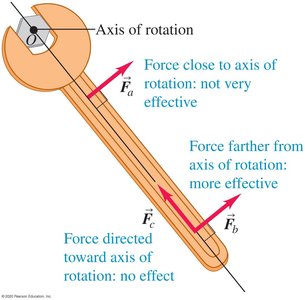
Methods of Calculating Torque
Tangential Force Method: Only the component of force perpendicular to the lever arm contributes to torque.
Lever Arm Method: Torque can also be calculated as the product of the force and the perpendicular distance from the axis of rotation to the line of action of the force:
Where \( r \) is the distance from the axis, \( F \) is the magnitude of the force, and \( \theta \) is the angle between \( \vec{r} \) and \( \vec{F} \).
Comparing Torques from Multiple Forces
When multiple forces act at different points and angles, the torque produced by each force depends on both the magnitude and the lever arm.
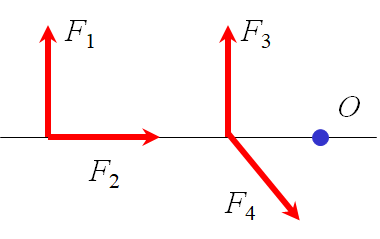
Example: The force that is farthest from the axis and perpendicular to the lever arm produces the greatest torque.
Example Problem: Torque on a Wrench
Given: A force of 150.0 N acts at 15.0 cm from the center of a nut at 60° above the horizontal. Find the magnitude of the torque about the center of the nut.
Use the formula:
Substitute: m, N,
Calculation: N·m
Torque and Angular Acceleration
Torque is related to angular acceleration in the same way that force is related to linear acceleration. This relationship is the rotational analogue of Newton's second law.
Newton's Second Law (Linear):
Rotational Analogue:
Where is the moment of inertia and is the angular acceleration.
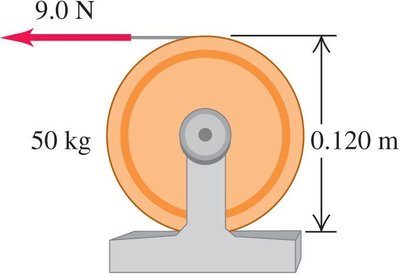
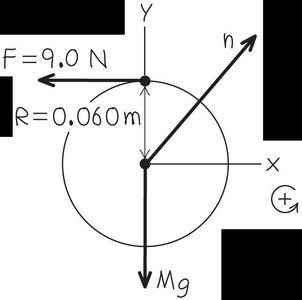
Example Problem: Net Torque and Angular Acceleration
Given: Net torque on a cable drum is 0.54 N·m, moment of inertia .
Find angular acceleration:
Angular Velocity from Angular Acceleration
If the disc starts from rest, angular velocity after time is:
Linear acceleration of a point on the rim:
Work in Rotational Motion
Work can be done by a torque acting through an angular displacement, analogous to work done by a force through a linear displacement.
Work by Constant Torque:
Work by Varying Torque:
Work-Energy Theorem (Rotational): The net work done by torques equals the change in rotational kinetic energy.
Combining Translation and Rotation
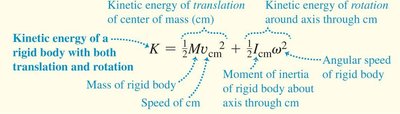
Rigid bodies can undergo both translational and rotational motion. The total kinetic energy is the sum of translational and rotational kinetic energies.
Kinetic Energy:
Where is the mass, is the velocity of the center of mass, is the moment of inertia about the center of mass, and is the angular speed.
Center of Mass
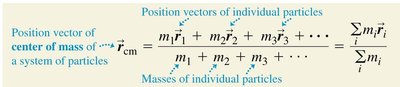
The center of mass is the point at which the mass of a system or body can be considered to be concentrated for translational motion analysis.
Position Vector of Center of Mass:
Where and are the mass and position vector of the th particle.
Center of Mass of Symmetrical Objects
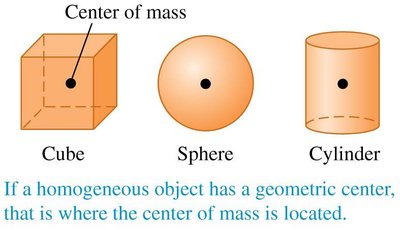
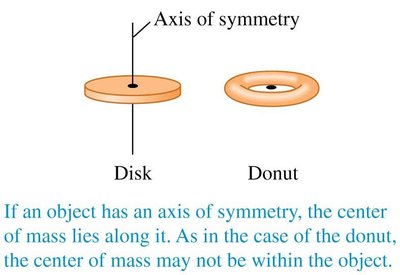
For homogeneous objects with geometric symmetry, the center of mass coincides with the geometric center.
Rolling Motion: With and Without Slipping
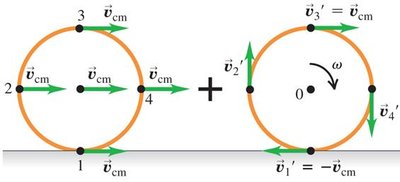
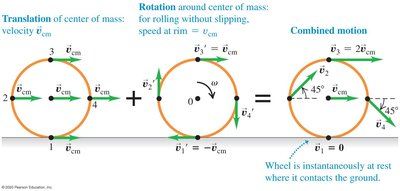
Rolling motion involves both rotation and translation. If a wheel rolls without slipping, the velocity at the point of contact with the ground is zero relative to the ground.
Rolling Without Slipping:
Rolling With Slipping:
Static Friction: Static friction is necessary for rolling without slipping and adjusts up to a maximum value.
Combined Translation and Rotation in Rolling
The motion of a rolling object can be analyzed as a combination of translation of the center of mass and rotation about the center of mass.

Example: For a tire rolling without slipping, a point at the top of the tire moves at relative to the ground, while the point at the bottom is instantaneously at rest.
Additional info: These notes cover key aspects of rotational dynamics, including torque, work in rotational motion, center of mass, and rolling motion, as outlined in typical college physics curricula (Chapters 9 and 10).
