 Back
BackRotation of Rigid Bodies: Structured Study Notes
Study Guide - Smart Notes
 Tailored notes based on your materials, expanded with key definitions, examples, and context.
Rotation of Rigid Bodies
Introduction to Rotational Motion
Rotational motion is a fundamental aspect of physics, describing how objects spin about a fixed axis. Examples include airplane propellers, revolving doors, ceiling fans, and Ferris wheels. In this chapter, we focus on rigid bodies, which are idealized objects that do not deform during rotation.

Angular Coordinate
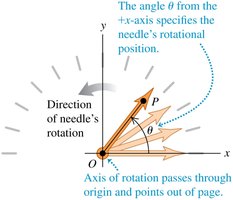
The angular coordinate (θ) specifies the rotational position of a point or object relative to a reference axis. It is measured from the positive x-axis and increases in the direction of rotation.
Axis of rotation: The fixed line about which the object rotates.
Reference angle: The angle θ is measured from the reference axis to the position vector of the point.
Units of Angles
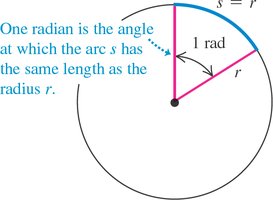
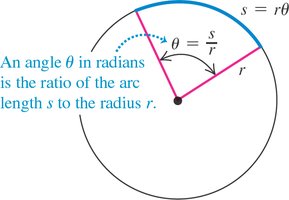
Angles are measured in radians, which are defined by the ratio of the arc length to the radius of the circle. One complete revolution corresponds to radians.
Definition: One radian is the angle at which the arc length equals the radius.
Formula: , where s is the arc length and r is the radius.
Angular Velocity
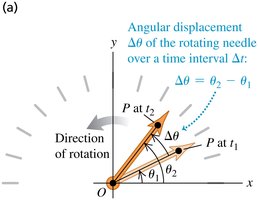
Angular velocity describes how quickly an object rotates about an axis. It is defined as the rate of change of angular coordinate with respect to time.
Average angular velocity:
Instantaneous angular velocity:
The sign of angular velocity depends on the direction of rotation (counterclockwise is positive, clockwise is negative).
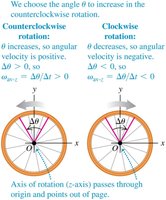

Angular Velocity as a Vector
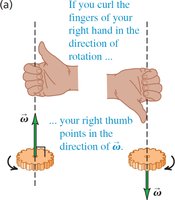
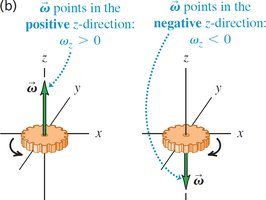
Angular velocity is a vector quantity, pointing along the axis of rotation. The direction is determined by the right-hand rule: curl your fingers in the direction of rotation, and your thumb points in the direction of the angular velocity vector.
Right-hand rule: Used to determine the direction of the angular velocity vector.
Sign convention: Positive if pointing in the positive z-direction, negative if in the negative z-direction.
Angular Acceleration
Angular acceleration measures how quickly the angular velocity changes with time. It is defined as the rate of change of angular velocity.
Average angular acceleration:
Instantaneous angular acceleration:
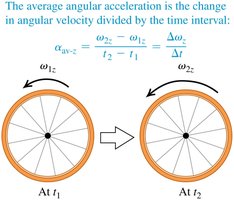
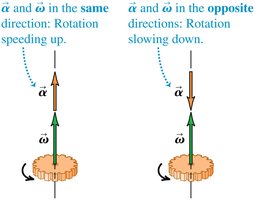
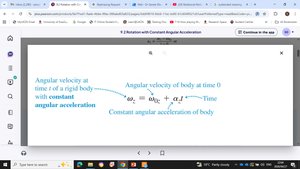
Rotation with Constant Angular Acceleration
When angular acceleration is constant, rotational kinematics equations mirror those for linear motion. These equations allow calculation of angular position, velocity, and acceleration over time.
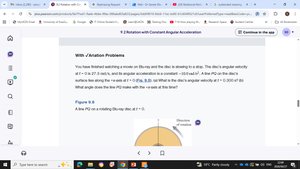
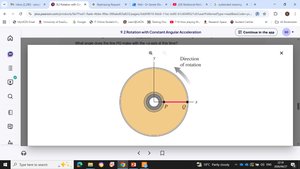

Relating Linear and Angular Kinematics
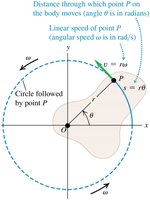
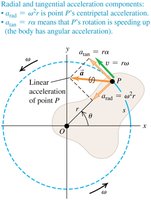
For a point at a distance r from the axis of rotation, its linear speed and acceleration are related to the angular quantities.
Linear speed:
Tangential acceleration:
Centripetal (radial) acceleration:
The Importance of Using Radians
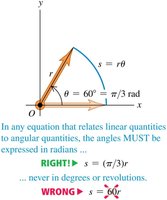
When relating linear and angular quantities, angles must be expressed in radians. Using degrees or revolutions leads to incorrect results.
Correct: (θ in radians)
Incorrect: (θ in degrees)
Rotational Kinetic Energy
The kinetic energy associated with the rotation of a rigid body is called rotational kinetic energy. It depends on the moment of inertia and the angular speed.
Formula:
Moment of inertia (I): A measure of how mass is distributed relative to the axis of rotation.

Moment of Inertia
The moment of inertia quantifies the resistance of an object to changes in its rotational motion. It is calculated by summing the products of each particle's mass and the square of its distance from the axis.
Formula:
The SI unit is kg·m².

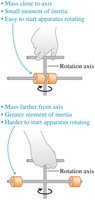
Moment of Inertia: Physical Interpretation
Moving mass closer to the axis reduces the moment of inertia, making it easier to rotate the object. Moving mass farther increases the moment of inertia, making rotation harder.
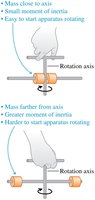
Moment of Inertia in Nature
Birds with smaller wings (lower moment of inertia) can flap rapidly, while birds with larger wings (higher moment of inertia) flap more slowly. This demonstrates the effect of moment of inertia in biological systems.

Moments of Inertia of Common Objects
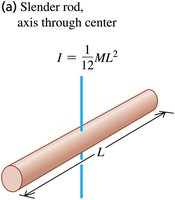
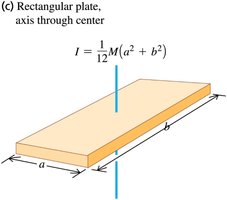
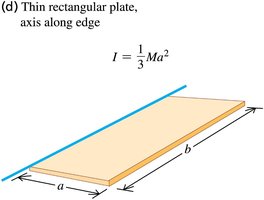
Different shapes have characteristic moments of inertia, depending on mass distribution and axis of rotation. Below are some common examples:
Object | Axis | Moment of Inertia (I) |
|---|---|---|
Slender rod | Through center | |
Slender rod | Through one end | |
Rectangular plate | Through center | |
Thin rectangular plate | Along edge |
The Parallel-Axis Theorem
The parallel-axis theorem relates the moment of inertia about an axis through the center of mass to the moment of inertia about any parallel axis. This is useful for calculating moments of inertia for axes not passing through the center of mass.
Formula:
Where is the moment of inertia about the center of mass, M is the total mass, and d is the distance between axes.
Moment of Inertia Calculations
For continuous mass distributions, the moment of inertia is calculated by integrating over the object's volume:
Formula:
Applications include measuring Earth's moment of inertia to understand its internal mass distribution.
Additional info: The moment of inertia is a central concept in rotational dynamics, affecting how objects respond to applied torques and how energy is distributed in rotational systems.
