 Back
BackRotational Dynamics: Torque, Rotational Inertia, and Angular Momentum
Study Guide - Smart Notes
 Tailored notes based on your materials, expanded with key definitions, examples, and context.
Rotational Dynamics
Introduction to Rotational Dynamics
Rotational dynamics extends the principles of Newtonian mechanics to systems that rotate about an axis. Key concepts include torque, rotational inertia (moment of inertia), angular acceleration, and angular momentum. These concepts allow us to analyze and predict the motion of rotating bodies, analogous to how force, mass, and acceleration are used in linear motion.
Torque (\(\tau\)): The rotational equivalent of force, responsible for causing angular acceleration.
Rotational Inertia (Moment of Inertia, \(I\)): The rotational equivalent of mass, quantifying an object's resistance to changes in its rotational motion.
Angular Acceleration (\(\alpha\)): The rate of change of angular velocity.
Angular Momentum (\(l\)): The rotational equivalent of linear momentum, conserved in isolated systems.
Torque
Definition and Calculation of Torque
Torque is the measure of the effectiveness of a force to rotate an object about an axis. It depends on the magnitude of the force, the distance from the axis of rotation, and the angle between the force and the lever arm.
Formula: where:
\(r\): Distance from the axis to the point of force application
\(F\): Magnitude of the force
\(\phi\): Angle between the force and the position vector
Maximum torque occurs when the force is perpendicular to the lever arm (\(\phi = 90^\circ\)).
Units: Newton-meter (N·m)
Example: Opening a door is easier when you push at the edge farthest from the hinge and perpendicular to the door.
Rotational Inertia (Moment of Inertia)
Definition and Dependence on Mass Distribution
Rotational inertia quantifies how difficult it is to change the rotational motion of an object. It depends not only on the total mass but also on how that mass is distributed relative to the axis of rotation.
Formula for a system of point masses: where:
\(m_i\): Mass of the i-th particle
\(r_i\): Distance from the axis of rotation to the i-th particle
Objects with more mass farther from the axis have greater rotational inertia.
Example: A broom is easier to spin when held near the heavy end, as more mass is closer to the axis.
Common Moments of Inertia
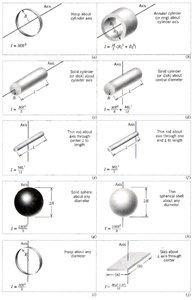
The moment of inertia varies with the shape and axis of rotation. The following table summarizes common moments of inertia for standard objects:
Object | Axis | Moment of Inertia (I) |
|---|---|---|
Thin hoop | About center | |
Solid cylinder or disk | About center | |
Solid cylinder | About central diameter | |
Thin rod | About center perpendicular to length | |
Thin rod | About end perpendicular to length | |
Solid sphere | About diameter | |
Thin spherical shell | About diameter | |
Thin ring | About any diameter | |
Slab about center | Perpendicular to length |
Newton's Second Law for Rotational Motion
Rotational Formulation
Newton's second law for rotation relates the net torque acting on a body to its angular acceleration and moment of inertia:
Formula: where:
\(\tau\): Net torque
\(I\): Moment of inertia
\(\alpha\): Angular acceleration
This is analogous to \(F = ma\) in linear motion.
Example: If a torque of 12 N·m is applied to a disk with kg·m², the angular acceleration is rad/s².
Static Equilibrium
Conditions for Static Equilibrium
A rigid body is in static equilibrium if both the net force and the net torque acting on it are zero:
This ensures the object does not accelerate linearly or rotationally.
Sign convention: Counterclockwise torques are positive; clockwise torques are negative.
Choice of axis: The axis for calculating torque can be chosen for convenience, often where unknown forces act.
Example: Calculating the forces on a ladder leaning against a wall involves setting the sum of forces and torques to zero.
Angular Momentum
Definition and Conservation
Angular momentum is the rotational analog of linear momentum and is defined as:
Formula for a rigid body: where:
\(l\): Angular momentum
\(I\): Moment of inertia
\(\omega\): Angular velocity
Formula for a point mass: where \(\theta\) is the angle between the position and velocity vectors.
Conservation: In the absence of external torques, the total angular momentum of a system remains constant.
Example: If two beads slide outward on a rotating wire, their angular speed decreases to conserve angular momentum.
Summary Table: Key Rotational Quantities
Linear Motion | Rotational Motion |
|---|---|
Force (F) | Torque (\(\tau\)) |
Mass (m) | Moment of Inertia (I) |
Acceleration (a) | Angular Acceleration (\(\alpha\)) |
Momentum (p = mv) | Angular Momentum (l = I\(\omega\)) |
Learning Goals
Define and use torque, rotational inertia, and angular acceleration.
Apply Newton’s second law to rotational systems.
Understand and use the concepts of center of gravity and static equilibrium.
Apply the principle of conservation of angular momentum.
