 Back
BackRotational Kinematics and Dynamics: Study Notes
Study Guide - Smart Notes
 Tailored notes based on your materials, expanded with key definitions, examples, and context.
Rotational Kinematics
Introduction to Rotational Motion
Rotational motion describes the movement of objects around a fixed axis, distinct from translational motion where the center of mass moves through space. In rotational motion, the center of mass remains stationary while the object rotates about it. This chapter introduces the fundamental concepts and equations governing rotational motion, drawing analogies to linear motion.
Rigid Body: An object with mass distributed throughout its volume, not just at a single point.
Path of Rotation: Any point on a rotating object traces a circular path around the axis of rotation.

Angular Quantities
Angular quantities are used to describe rotational motion, analogous to linear quantities in translational motion.
Angular Displacement (\(\Delta \theta\)): The angle through which an object rotates, measured in radians. One full rotation equals \(2\pi\) radians.
Angular Velocity (\(\omega\)): The rate of change of angular displacement, measured in radians per second (rad/s).
Angular Acceleration (\(\alpha\)): The rate of change of angular velocity, measured in radians per second squared (rad/s2).
Relation Between Linear and Angular Quantities
Linear and angular quantities are related through the radius (\(r\)) of the circular path:
Points farther from the axis travel greater distances in the same time interval, but all points share the same angular displacement and velocity.

Units and Conversions
1 revolution = 360° = \(2\pi\) radians
Radians are dimensionless and are the standard unit for angular measurements in physics.
Sign Convention
In rotational motion, directions are described as clockwise (negative) and counter-clockwise (positive) by convention. The choice of sign convention is arbitrary but must be consistent throughout a problem.
Period and Frequency
Period (\(T\)): The time for one complete revolution (in seconds).
Frequency (\(f\)): The number of revolutions per second (in Hz).
Rotational Kinematic Equations
For constant angular acceleration, the kinematic equations for rotation mirror those for linear motion:
Example: Bicycle Wheel
Given: A bicycle slows from \(v_0 = 8.40\) m/s to rest over 115 m. Wheel diameter = 68.0 cm.
Find: Angular velocity at \(t = 0\): rad/s
Total revolutions before stopping: rad rev
Angular acceleration: rad/s2
Time to stop: s








Rotational Energy and Moment of Inertia
Work and Power in Rotation
Work done by a torque:
Power in rotation:
Rotational Kinetic Energy
The kinetic energy of a rotating object is given by:
Moment of Inertia (\(I\)): The rotational equivalent of mass, depends on mass distribution and axis of rotation.
Moment of Inertia: Common Objects
Object | Axis | Moment of Inertia (I) |
|---|---|---|
Point Particle | Through Center | |
Uniform Rod | Through End | |
Solid Sphere | Through Center | |
Solid Disk/Cylinder | Through Center | |
Hoop | Through Center | |
Hollow Sphere | Through Center |





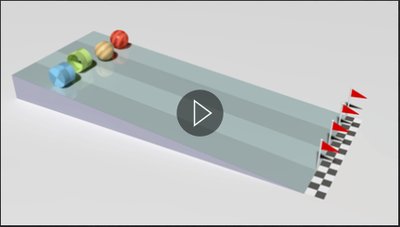
Example: Dumbbell System
Given: Two masses (5.0 kg and 7.0 kg) on a 4.0 m rod.
Moment of inertia about midpoint:
Moment of inertia about axis 0.5 m from 7.0 kg mass:


Total Kinetic Energy
For objects undergoing both translational and rotational motion:
Example: Sphere Rolling Down an Incline
Conservation of Energy:
For a solid sphere, and
Solve for :




Angular Momentum and Conservation
Angular Momentum
Definition:
Conservation Law: If net external torque is zero, total angular momentum is conserved.
Example: Rotating Plates (Clutch)
Given: Two plates (6.0 kg and 9.0 kg, R = 0.60 m). Plate A accelerated to 7.2 rad/s in 2.0 s.
Angular momentum of A: kg·m2/s
Torque required: N·m
Final angular velocity after clutch engages: rad/s






Direction of Angular Quantities
Angular velocity and acceleration are vectors, with direction given by the right-hand rule: curl fingers in direction of rotation, thumb points along the axis (direction of vector).
Rotational Dynamics
Torque and Lever Arm
Torque (\(\tau\)): The rotational equivalent of force, defined as , where is the lever arm and is the angle between force and lever arm.
Only the perpendicular component of force produces torque.
Newton's Second Law for Rotation
Rotational analog:
Moment of inertia (\(I\)) is the rotational equivalent of mass.
Example: Pulley with Friction
Given: Force of 15.0 N applied to a pulley (m = 4.00 kg, r = 0.33 m), frictional torque 1.10 N·m, angular speed 30.0 rad/s in 3.00 s.
Net torque:
Angular acceleration: rad/s2
Moment of inertia: kg·m2


Example: Bucket on a Pulley
Given: Bucket mass 1.53 kg, pulley I = 0.385 kg·m2, r = 0.33 m, frictional torque 1.10 N·m.
Equations: rad/s2, m/s2




Example: Atwood Machine with Rotating Pulley
Given: Masses 65 kg and 75 kg, pulley mass 6.0 kg, R = 0.45 m.
Equations: , m/s2




Additional info: These notes provide a comprehensive overview of rotational kinematics and dynamics, including key equations, examples, and the physical meaning of each concept. The included images directly support the explanations and calculations presented.
