 Back
BackRotational Kinematics and Energy: Mini-Textbook Study Notes
Study Guide - Smart Notes
 Tailored notes based on your materials, expanded with key definitions, examples, and context.
Rotational Kinematics
Introduction to Rotational Motion
Rotational motion is a fundamental aspect of physics, describing how objects spin about an axis. Understanding rotational kinematics is essential for analyzing the motion of rigid bodies, from spinning disks to planetary orbits. - Rotational motion involves objects rotating about a fixed axis. - Angular displacement is measured in radians and describes the change in angle as an object rotates. - Positive direction is defined as counterclockwise; clockwise rotation is negative.
Polar Coordinates and Angular Quantities
To describe rotational motion, we use a polar coordinate system: radius (r) from the axis and angle (θ) from a reference line. - Arc length (s) relates to angle: (θ in radians only). - Angular displacement: - Linear displacement:
Angular Speed and Acceleration
Angular speed and acceleration mirror their linear counterparts. - Average angular speed: - Average linear speed: - Angular acceleration:
Angular Kinematics Equations
The kinematic equations for angular motion are analogous to linear motion, especially under constant acceleration.
Comparison Table:
Linear | Angular |
|---|---|
x | θ |
v | ω |
a | α |
Tangential and Centripetal Acceleration
Points on a rotating object experience two types of acceleration: tangential (due to changing speed) and centripetal (due to changing direction). - Tangential speed: - Tangential acceleration: - Centripetal acceleration:
Period and Angular Velocity
The period (T) is the time for one complete rotation. - -
Example: Ninja on a Rotating Platform
Two objects (Ninja A and Ninja B) on a rotating platform illustrate angular speed and tangential velocity. - Both have the same angular speed (), but their tangential speeds differ: , 

Centripetal Acceleration Example
For Ninja B at m and rad/s: m/s2 

Rolling Motion
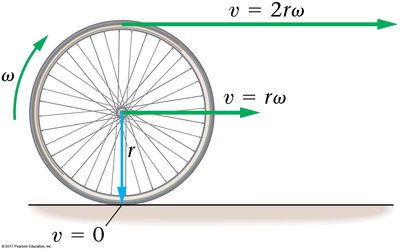
Rolling motion combines rotational and translational motion. For pure rolling (no slipping), the point of contact is instantaneously at rest relative to the surface. - Translation speed of axle: - Velocity at different points: Bottom: , Center: , Top: 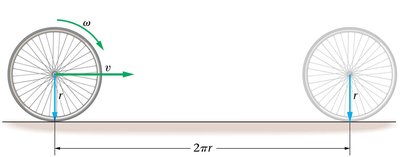
Rotational Kinetic Energy and Moment of Inertia
Kinetic Energy of Rotating Objects
Rotational kinetic energy is analogous to linear kinetic energy, but depends on the moment of inertia (I) and angular velocity (). - Rotational kinetic energy: - Moment of inertia: (for discrete masses) 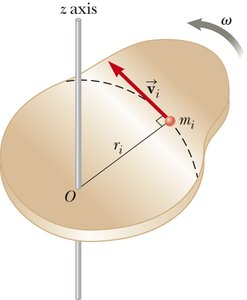
Moment of Inertia: Definition and Examples
The moment of inertia quantifies how mass is distributed relative to the axis of rotation. It determines how difficult it is to rotate an object. - Depends on axis location - For solid objects: Common Moments of Inertia:
Object | Moment of Inertia |
|---|---|
Hoop | |
Disk | |
Solid Sphere | |
Hollow Sphere |


Parallel Axis Theorem
If the axis of rotation is not through the center of mass, the parallel axis theorem is used: - : moment of inertia about center of mass - : distance between axes
Compound Objects
For compound objects, sum the moments of inertia of each part.
Rotational vs. Translational Kinetic Energy
For rolling objects, total kinetic energy is the sum of translational and rotational components: For rolling with : , where
Comparing Kinetic Energy of Different Shapes
For objects with the same mass and radius rolling at the same speed: - Sphere: - Disk: - Hoop: The rotational component is largest for the hoop. 

Energy Distribution in Rolling Objects
The fraction of energy converted to rotational energy depends on the shape:
Object | Fraction Rotational |
|---|---|
Solid sphere | 2/7 |
Solid disk | 1/3 |
Hoop | 1/2 |
Applications of Rotational Motion
Centrifugation
Centrifuges use rotational motion to separate components of mixtures, such as blood. The effective gravity (relative centrifugal force) is given by: 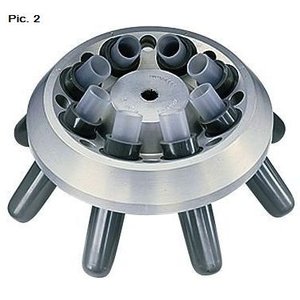


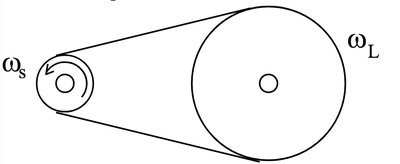
Belt-Driven Wheels
When two wheels are connected by a belt, the angular velocity of each wheel depends on their radii: 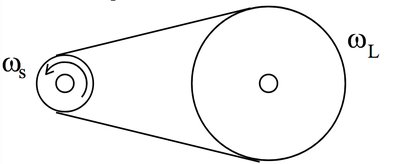
Summary Table: Rotational Kinematics and Energy
Quantity | Linear | Rotational |
|---|---|---|
Displacement | x | θ |
Velocity | v | ω |
Acceleration | a | α |
Kinetic Energy | ||
Mass/Moment of Inertia | m | I |
Key Formulas
Additional info: Academic context was added to clarify the relationships between linear and rotational motion, and to provide self-contained explanations for exam preparation.
