 Back
Rotational Motion and Dynamics: Physics with Calculus Study Notes
Study Guide - Smart Notes
 Tailored notes based on your materials, expanded with key definitions, examples, and context.
Rotational Motion
Describing Circular and Rotational Motion
Rotational motion refers to the movement of objects that spin about an axis. This type of motion is fundamental in understanding the behavior of many physical systems, from wheels to planetary orbits.
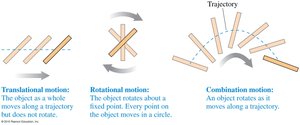
Rotational motion: The object spins about a fixed axis.
Circular motion: A point or particle moves along a circular path.
Combination motion: An object rotates as it moves along a trajectory.
Translational motion: The object moves along a trajectory but does not rotate.
Angular Position
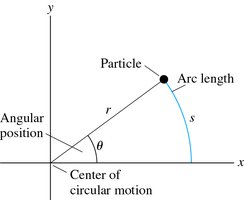
The angular position, denoted by θ, describes the location of a particle in circular motion relative to the positive x-axis. It is measured in radians, which is the standard unit for angular measurements in physics.
θ is positive when measured counterclockwise from the positive x-axis.
θ is negative when measured clockwise from the positive x-axis.
Arc length (s) is the distance traveled along the circular path.
Relationship: , where r is the radius.
One radian is the angle subtended by an arc length equal to the radius.
Angular Displacement and Angular Velocity
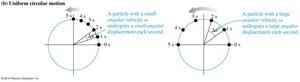
Angular displacement is the change in angular position over time. Angular velocity (ω) is the rate at which angular displacement occurs, and is constant for uniform circular motion.
Angular velocity: (rad/s)
Angular speed: The absolute value of angular velocity.
For uniform circular motion, angular velocity is constant.
Relationship to period (T):
Frequency (f): (rev/s)
Relating Linear Speed and Angular Speed
Points farther from the axis of rotation move at higher linear speeds. The linear speed (v) at any point is related to the angular speed (ω) by:
Angular speed must be in units of rad/s.
Application: Wind turbine blades, where tips move faster than points near the hub.

The Rotation of a Rigid Body
Rotational Motion of a Rigid Body
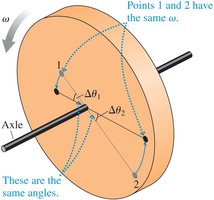
In a rigid body, every point rotates with the same angular velocity, but points at different distances from the axis have different linear speeds.
All points share the same angular velocity (ω).
Linear speed increases with distance from the axis.
Angular Acceleration
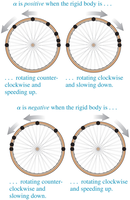
Angular acceleration (α) is the rate of change of angular velocity. It is measured in rad/s² and indicates how quickly an object speeds up or slows down its rotation.
Positive α: speeding up counterclockwise or slowing down clockwise.
Negative α: speeding up clockwise or slowing down counterclockwise.
Synthesis: Linear and Circular Motion
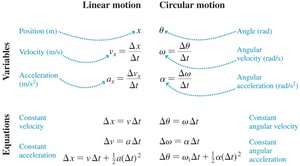
Variables and equations for linear motion have direct analogs in circular motion. This synthesis helps in understanding rotational dynamics using familiar concepts from linear kinematics.
Position: x (linear), θ (angular)
Velocity: (linear), ω (angular)
Acceleration: (linear), α (angular)
Equations for constant acceleration:
Tangential Acceleration
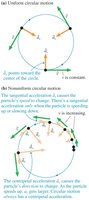
Tangential acceleration is the component of acceleration directed along the tangent to the circle. It measures the rate at which the speed of a particle moving in a circle increases.
It is related to angular acceleration.
Example: A particle speeding up as it moves around a circle.
Torque
Definition and Calculation of Torque
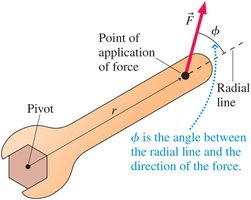
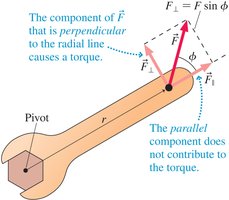
Torque is the rotational equivalent of force. It measures the ability of a force to cause an object to rotate about an axis.
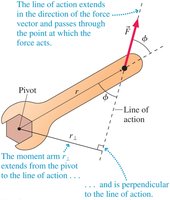
Depends on force magnitude (F), distance from pivot (r), and angle of application (φ).
Torque formula:
Units: newton-meters (N·m)
Moment arm: perpendicular distance from pivot to line of action of force.
Net Torque
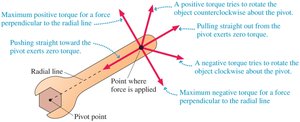
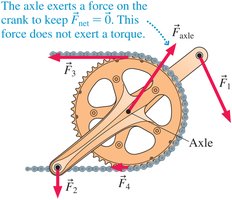
The net torque is the sum of all torques acting on an object. It determines the angular acceleration according to Newton's second law for rotation.
Positive torque: counterclockwise rotation
Negative torque: clockwise rotation
Example: Force in Turning a Capstan
A capstan is turned by applying forces at different distances from the axis. The net torque must be zero for constant speed.
Rope tension exerts torque at radius R.
Sailor's force exerts torque at radius 7R.
Balance condition:

Gravitational Torque and Center of Gravity
Gravitational Torque
Gravity exerts a torque on every particle of an object. The net gravitational torque can be calculated by assuming the weight acts at the center of gravity.
Center of gravity: point where the net force of gravity acts.
Torque due to gravity:
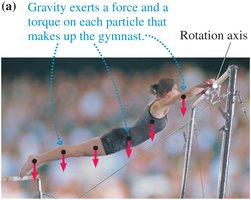
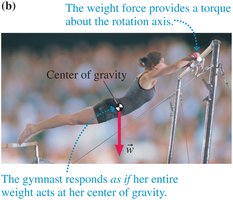
Example: Gravitational Torque on a Flagpole
The gravitational torque on a flagpole is calculated using the moment arm and the weight acting at the center of gravity.
Moment arm:
Torque:
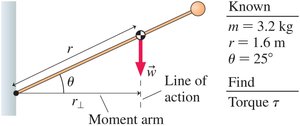
Calculating the Center of Gravity
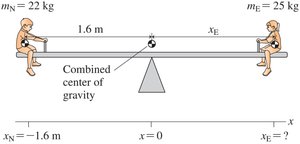
The center of gravity is found by balancing torques on either side of a pivot. For point masses in a 2D plane:
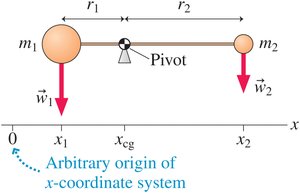
Example: Balancing a Seesaw
To balance a seesaw, the combined center of gravity of the children must be at the pivot. The heavier child sits closer to the pivot.
Balance condition:
Heavier person sits closer to the pivot.
Rotational Dynamics and Moment of Inertia
Moment of Inertia
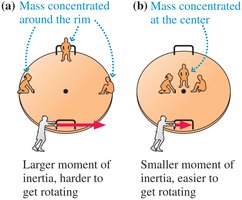
The moment of inertia (I) is the rotational equivalent of mass. It depends on both the mass and its distribution relative to the axis of rotation.
for point masses
For extended objects, I depends on shape and axis location.
Higher moment of inertia: harder to rotate.
Newton’s Second Law for Rotational Motion
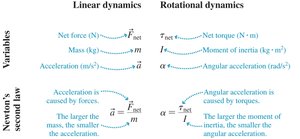
Newton's second law for rotation states that a net torque causes angular acceleration proportional to the moment of inertia.
Analogous to in linear motion.
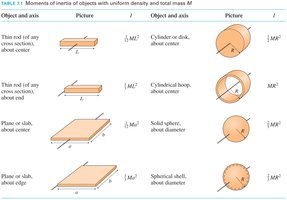
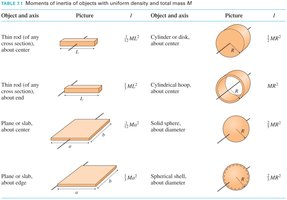
Moments of Inertia of Common Shapes
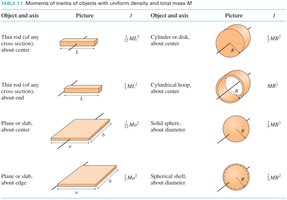
Different shapes have characteristic moments of inertia, depending on mass and geometry.
Object and Axis | Picture | Moment of Inertia (I) |
|---|---|---|
Thin rod, center |
| |
Cylinder or disk, center |
| |
Solid sphere, diameter |
|
Rolling Motion
Rolling Motion and Constraints
Rolling motion is a combination of rotation and translation. For rolling without slipping, the velocity of the object's center is linked to its angular velocity.
Constraint:
Point at bottom of wheel is instantaneously at rest.
Application: Car tires, rolling spheres.
Example: Rotating Your Tires
When driving, the tires rotate many times per second. The speed at the top of the tire is twice the speed of the car.
Angular speed:
Frequency:
Speed at top of tire:
