 Back
BackRotational Motion and Dynamics: Study Notes
Study Guide - Smart Notes
 Tailored notes based on your materials, expanded with key definitions, examples, and context.
Rotational Motion
Rotational Kinetic Energy
When a rigid body rotates about an axis, each particle in the body has kinetic energy due to its motion. The total kinetic energy of the rotating body is called rotational kinetic energy and is given by:
Formula:
Moment of inertia (I): Measures how mass is distributed relative to the axis of rotation (SI unit: kg·m2).
Angular speed (\omega): The rate at which the body rotates (in radians per second).

Example: A spinning disk, a rotating wheel, or a planet orbiting a star all possess rotational kinetic energy.
Moment of Inertia
The moment of inertia quantifies how difficult it is to change the rotational motion of an object. It depends on both the mass of the object and how that mass is distributed with respect to the axis of rotation.
Mass closer to the axis results in a smaller moment of inertia, making it easier to rotate the object.
Mass farther from the axis increases the moment of inertia, making it harder to rotate the object.
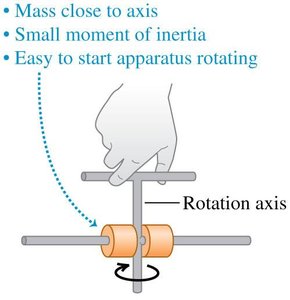
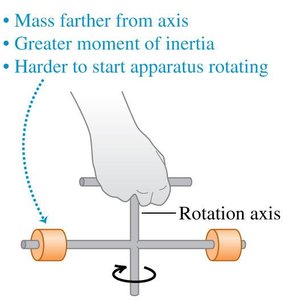
Example: A figure skater spinning with arms extended has a larger moment of inertia and spins slower; pulling arms in reduces the moment of inertia and increases spin rate.
Moment of Inertia in Nature
Animals with different wing sizes demonstrate the effect of moment of inertia in nature. Smaller wings (lower moment of inertia) can be flapped rapidly, while larger wings (higher moment of inertia) move more slowly.

Example: Hummingbirds can beat their wings up to 70 times per second, while large birds like condors flap much more slowly.
Moments of Inertia of Various Bodies
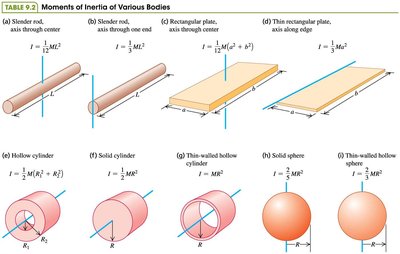
The moment of inertia depends on the shape of the object and the axis about which it rotates. Common formulas include:
Body | Axis | Moment of Inertia (I) |
|---|---|---|
Slender rod | Center | |
Slender rod | End | |
Rectangular plate | Center | |
Thin rectangular plate | Edge | |
Hollow cylinder | Center | |
Solid cylinder | Center | |
Thin-walled hollow cylinder | Center | |
Solid sphere | Center | |
Thin-walled hollow sphere | Center |
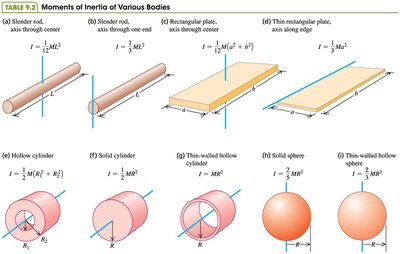
Application: These formulas are essential for solving problems involving rotational dynamics.
Sample Problem: Composite Rotating System
Consider a machine part consisting of three disks linked by lightweight struts. To find the moment of inertia about different axes and the kinetic energy when rotating, use the parallel axis theorem and the definition of rotational kinetic energy.
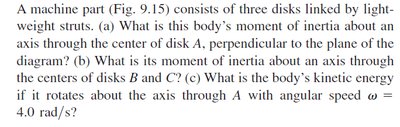
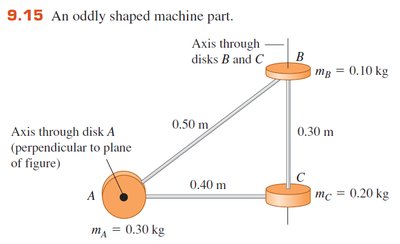
Step 1: Identify the axis of rotation and distances from the axis to each mass.
Step 2: Use for point masses or the appropriate formula for extended bodies.
Step 3: Calculate kinetic energy using .
Rotational Dynamics: Unwinding Cable Example
When a force unwinds a cable from a rotating cylinder, energy methods can be used to find the final angular speed and speed of the cable.
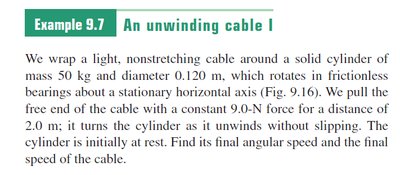
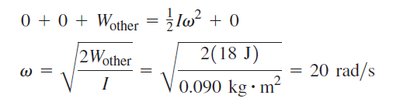
Work-Energy Principle: The work done by the force is converted into rotational kinetic energy.
Formula:
Application: This approach is useful for analyzing winches, pulleys, and similar systems.
Rotational Dynamics: Block and Cylinder System
When a block falls while attached to a cable wound around a cylinder, both the block and the cylinder gain kinetic energy. Conservation of energy allows us to find the speed of the block and the angular speed of the cylinder as the block strikes the floor.
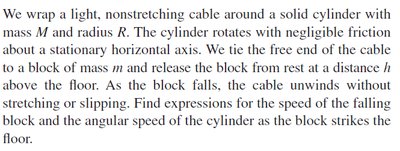
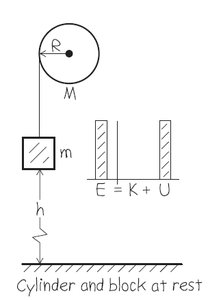
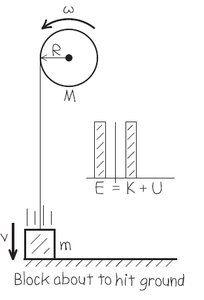
Energy Conservation:
Relationship: (no slipping)
Application: This principle is widely used in analyzing Atwood machines and rotational pulleys.
Gravitational Potential Energy of Extended Bodies
The gravitational potential energy of an extended body can be treated as if all its mass were concentrated at its center of mass:
Formula:
This simplification is useful for analyzing the motion of athletes, projectiles, and other extended objects.
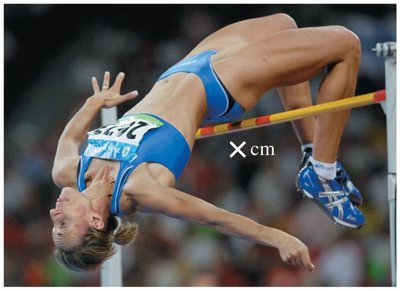
Example: In high jump, athletes arch their bodies so their center of mass passes under the bar, minimizing the energy required to clear it.
Dynamics of Rotational Motion
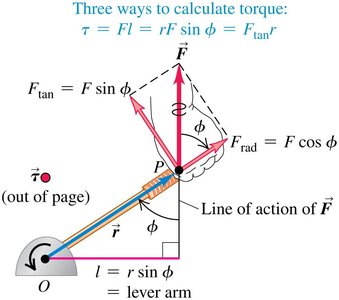
Torque
Torque is the rotational analog of force. It measures the tendency of a force to rotate an object about an axis.
Definition:
Lever arm: The perpendicular distance from the axis of rotation to the line of action of the force.
Only the component of force perpendicular to the lever arm produces torque.

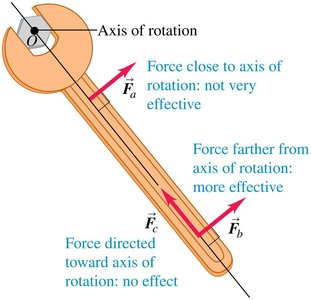
Example: Using a wrench, applying force farther from the axis increases torque.
Torque as a Vector
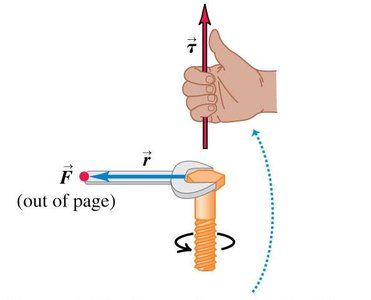
Torque is a vector quantity, and its direction is determined by the right-hand rule.
Vector Product:
Direction: Curl the fingers of your right hand in the direction of rotation; your thumb points in the direction of the torque vector.
Torque and Angular Acceleration
The rotational analog of Newton's second law relates torque to angular acceleration:
Formula:
Where is the angular acceleration.
Example: Loosening or tightening a screw requires applying a torque to produce angular acceleration.
Work and Power in Rotational Motion
Work done by a torque changes the rotational kinetic energy of a body. Power is the rate at which work is done by the torque.
Work:
Power:
Example: The engine of a helicopter does positive work to keep the rotor spinning at a constant rate, while air resistance does negative work.
Angular Momentum
Angular Momentum of a Rigid Body
The angular momentum of a rigid body rotating about a symmetry axis is given by:
Formula:
Direction is parallel to the angular velocity vector.


Example: A spinning figure skater or a rotating planet possesses angular momentum.
Conservation of Angular Momentum
When the net external torque acting on a system is zero, the total angular momentum of the system remains constant:
Conservation Law:
This principle explains phenomena such as a spinning skater pulling in their arms to spin faster.
Application: Conservation of angular momentum is fundamental in analyzing collisions and rotational motion in isolated systems.
Summary Table: Moments of Inertia of Various Bodies
Body | Axis | Moment of Inertia (I) |
|---|---|---|
Slender rod | Center | |
Slender rod | End | |
Rectangular plate | Center | |
Thin rectangular plate | Edge | |
Hollow cylinder | Center | |
Solid cylinder | Center | |
Thin-walled hollow cylinder | Center | |
Solid sphere | Center | |
Thin-walled hollow sphere | Center |
Additional info: These notes cover the core concepts of rotational motion, moment of inertia, torque, work and power in rotational systems, angular momentum, and conservation laws, as outlined in Chapters 9 and 10 of a typical college physics curriculum.
